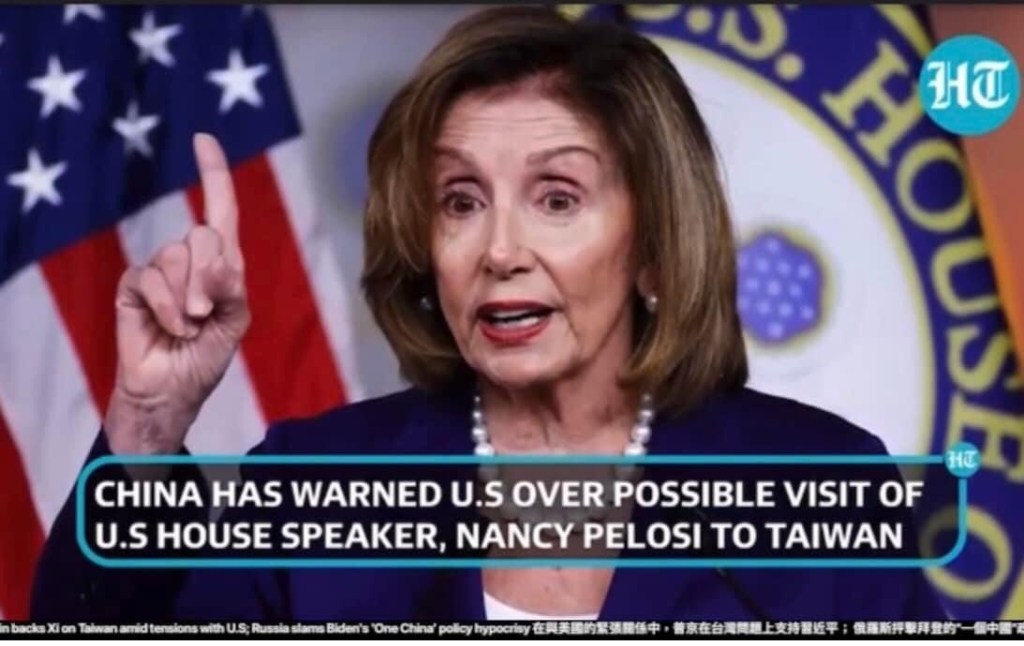
Will Nancy Pelosi’s Visit to Taiwan Trigger A Crisis? – Political Violence at a Glance 南希佩洛西訪台會引發危機嗎? – 政治暴力一覽
Below is the text of the RAND study from which the authors drew their conclusions that:
“despite their potency, these warnings look far less aggressive when compared to statements China has used in the past prior to full-blown escalations…So far, China’s official rhetoric has been far below the threshold of China’s previous verbal signals that imply escalation or outright war”
Of course this is wrong. The RAND study referred to actually says:
This is implemented ‘by a carefully calibrated hierarchy of official protests, authoritative press comment, and leadership statements’. Moreover, they highlight the ‘systematic integration of political and diplomatic action with military preparations as the signalling escalates through higher levels of authority’.
Providing more detail, they outline a ‘lexicon of threat and retaliation warnings . . . with increasing explicitness that conveys Beijing’s readiness to use force’.In order of increasing seriousness (with 1 being least serious and 9 most serious in terms of signalling willingness to consider the use of force), these include
1.X is ‘playing with fire’ and may ‘get burned’. (This phrase is the only referred to in the article, but there are others)
2.Beijing so far has ‘exercised the greatest restraint and forbearance’ but this ‘should not be taken as weakness and submissiveness’.
3.Do ‘not turn a deaf ear to China’s warnings’; China ‘cannot stand idly by’.
(This phrase has been used many times already, and was the warning used just before the Korean war). 4.‘How far will you go? We shall wait and see’. 5.‘China’s forbearance has limits’; X is ‘deluding itself in thinking we are weak and can be bullied’. (This is very similar to the message, “But this doesn’t mean that we will trade our core interests for peace and tolerate bullying”)
6.If X does not cease its behaviour, it ‘will meet the punishment it deserves’.
7.‘Do not complain later that we did not give you a clear warning in advance’.
8.We have been ‘driven beyond forbearance’ and are ‘forced to counterattack’; our ‘restraint was regarded as an invitation to bullying’; our ‘warning fell on deaf ears’.
9.‘We will not attack if we are not attacked; if we are attacked, we will certainly counterattack
(*This was stated this morning)
Although much has changed in recent years in terms of China’s strategic goals, military capabilities, and available communication channels, the available indications suggest that this hierarchy of warnings remains highly relevant today.
 Business Blog