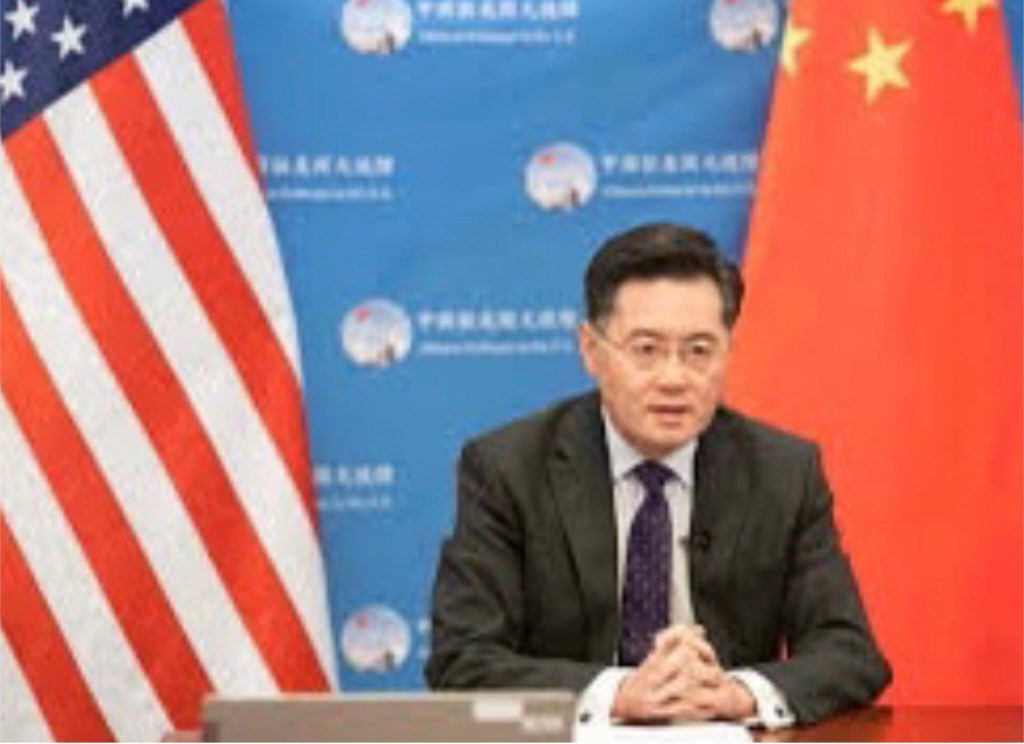
Video: China’s Practical Democracy verses US’s Phantom Democracy. China’s Ambassador to US delivers keynote speech on two democracies 中國的實踐實質民主與美國的幻影虛擬民主相對. 中國駐美國大使就兩個民主國家發表主旨演講Qin Gang was welcomed as China’s Ambassador to the US by the George H. W. Bush Foundation for US-China Relations and the US Carter Center on Wed Sept 22, 2021. http://johnsonwkchoi.business.blog/2021/09/23/video-chinas-practical-democracy-verses-uss-phantom-democracy-chinas-ambassador-to-us-delivers-keynote-speech-on-two-democracies/
https://rumble.com/v1hm14p-chinas-practical-democracy-verses-uss-phantom-democracy.html
https://www.facebook.com/100036400039778/posts/571734717383191/?d=n
Speech by Ambassador Qin Gang At the Conversation Jointly Held by The Carter Center and The George H.W. Bush Foundation for US-China Relations
2021/09/22
Dear Mr. Neil Bush,
Ms. Barbara Smith,
Mr. David J. Firestein,
Ladies and Gentlemen,
My Friends,
I want to thank The Carter Center and The George H.W. Bush Foundation for US-China Relations for hosting this event. It’s my great pleasure to meet with you online.
I wish to thank President Carter for his warm letter and thank Mr. Neil Bush for his kind remarks. We will never forget that 42 years ago, President Carter and Mr. Deng Xiaoping made the historic decision of establishing diplomatic relations between China and the United States. Facing the difficulties in China-US relations after the Cold War, President George H.W. Bush stayed committed to engagement and dialogue with China to increase mutual understanding and trust. Thanks to generations of Chinese and American leaders and people, China-US relations have made remarkable progress.
However, today, some Americans’ misunderstanding and misjudgment about China is building up. A fundamental one is to define America’s relations with China as democracy versus authoritarianism, and to stoke up ideological confrontation, which has led to serious difficulties in China-US relations. Let me share with you my view here.
What is democracy?
As a political system, the word “democracy” originated in ancient Greece. It means “rule by the people”, or “sovereignty of the people”. So a basic criterion of democracy should be whether the people have the right to govern their country, whether their needs are met, and whether they have a sense of fulfillment and happiness. At the center of democracy is people. President Lincoln defines democracy as “of the people, by the people, for the people”. Whatever political system a country chooses, its purpose is to select appropriate persons to govern the country and create a better life for the people.
In ancient Greece, Plato believed that citizens need to receive various kinds of education at early ages. When they grow up, they would be evaluated to see if they are qualified to be politicians in the future, and those selected would be put to the bottom of society to get prepared for ruling the state. After a long time, the middle-aged candidates, who have survived all the trials and tribulations, no longer engage in empty talk, and they become determined and experienced. When they are ready, they would undertake governing positions, but they can only lead simple lives to prevent corruption.
Is China a democracy?
- The idea of people first has been deep in the genes of the Chinese since ancient times. Dr. Henry Kissinger said to me, China is a communist and Confucian country. Confucius, an ancient Chinese thinker who lived in the same time as ancient Greece, raised the idea that people are the foundation of a country. Mencius, Confucius’ follower, said, “To a state, the people are the most important thing. The state comes second. The ruler is the least important.” An ancient Chinese ruler believed that the people are to the monarch what water is to boat, and he cautioned that the water can carry the boat; it can also overturn the boat. 100 years ago, the Communist Party of China (CPC) was established as a political party for the poor, and its founding mission is to pursue happiness for the people. With the slogans of anti-dictatorship, anti-autocracy and anti-oppression, it enabled the people to become master of their own country and won the people’s hearts. As the governing party, it has remained faithful to its founding mission: people-centered, and serving the people whole-heartedly.
- What China has today is whole-process democracy. China’s Constitution prescribes that all power belongs to the people. The people have the right to election, and they can be broadly involved in national governance according to law. They exercise state power through the National People’s Congress and local people’s congresses at different levels, equivalent to America’s Congress and state legislatures. Deputies to the people’s congresses at the county and township levels are directly elected. Those above the county level are indirectly elected. People elect deputies, who will politically represent them and elect leaders. Deputies maintain close contact with the people, and all major legislations and decisions are made through scientific and democratic processes and extensive consultations. China also has a unique political consultation system and corresponding institutions, which are important ways for the people to exercise democracy. Any matters that concern people’s keen interests are broadly discussed by people’s congress, the government, political consultative conference, social organizations and industry associations, before major decisions are made, to make sure what the people want are reflected in the final decisions. In China, government officials have many meetings to attend, and they do many field visits. Meetings are for discussing problems and exploring solutions, and field visits are for getting firsthand knowledge of things on the ground. Decisions are made through discussions and debates, which are extensive and intense, just like those on the Capitol Hill. Let me give you an example. The Civil Code is the first law of China with “code” in its name, and is regarded as “an encyclopedia of social life”. When drafting it, there had been ten rounds of collection of public opinions, and over one million opinions were gathered from more than 420,000 people. Another example is the five-year plans on economic and social development. When formulating the current 14th Five-Year Plan, there were also full public consultations. Over 1,000 suggestions were summarized from more than one million online posts, and 366 edits were made to the draft on the basis of them. After the deliberations by the national-level people’s congress and political consultation conference, another 55 adjustments were made before the adoption of the Plan. There are seldom fierce arguments or long-pending bills in people’s congresses in China, because most of the problems and conflicts of interests have been resolved and suggestions accepted in consultations, which also make implementation of the policies easier.
- In China, talents were chosen based on their abilities and merit since ancient times. Another Chinese philosopher, who was a contemporary of Plato, once said, “Prime ministers must have served as local officials; great generals must have risen from the ranks.” China had an imperial examination system over 1,400 years ago. Whoever passed the exams, regardless of their age and wealth, could be appointed as officials. They usually started from positions at the lowest level of government, and then got promoted or deposed based on their performance. This is the original form of the civil service system in the West today. Nowadays, a Chinese has to pass all kinds of exams in his or her lifetime. At work, there are additional trainings, assessments and selections, as well as oversight from superiors, colleagues, the public and the media. CPC members are also subject to Party disciplines, which are stricter than the law. Any violation will result in serious punishment. Take the Chinese Embassy in the US for example. There is a quarterly assessment of each diplomat from his or her supervisor. Lower-level diplomats can exercise their right of oversight of their supervisors at any time, and once a year, they can grade their supervisors’ performances. In such a system, officials who are incompetent, or not clean, or disapproved by the people have no chance to be promoted. The incumbent members of the Standing Committee of the Political Bureau of the CPC Central Committee, the top leadership of China, have all had long years of work experience from grassroots up to higher levels in different localities. President Xi Jinping became a farmer in a poor village in Northwestern China at the age of 16. He was appointed Party Secretary of Shanghai, the biggest city in China, at 54. The decades in between saw him work on various posts and in different places, and the populations he served varied from several hundred to several hundred thousand, millions and to tens of millions. As he rose through the ranks, he has got to know the people’s kitchen table concerns. He deeply loves the people, cares about the people, and has become capable of managing complexities and getting things done for the people. At the same time, he is loved, trusted and supported by the people. This is why you often find China’s senior officials elected with an overwhelming majority of votes or even unanimously.
How to evaluate if a system is democratic?
There are many political systems in the world. Whether a system is democratic depends on whether it can represent the overall interests of the people and whether the people are satisfied. Democracy is not for embellishment; it should deliver. Samuel Huntington writes, “The most important political distinction among countries concerns not their form of government, but their degree of government.” According to a survey done by Harvard Kennedy School for 10 years in a row, the Chinese people’s satisfaction of the CPC has been over 90% for each of the 10 years. Some people wonder why. The answer can be long, but I try to provide a brief explanation. Changchun, a provincial city in Northeastern China, has had a Mayor’s Hotline for 22 years, which citizens can use to report problems that need the government’s attention, and that Hotline works 24/7. Over the years, more than nine million problems have been reported and then resolved through the Hotline, and people’s satisfaction rating has remained above 90%. There are many similar hotlines and high satisfaction ratings across China. If you know about them, is it still hard to understand the results of Harvard surveys?
My Friends,
When some people are busy fanning up the battle between democracy and authoritarianism, and putting together an alliance of democracies, what is happening on the land of China? Well, absolute poverty has become a thing of the past, and 1.4 billion people are striving towards common prosperity. China has become the world’s second largest economy and biggest trading nation, and contributes over 30% to global economic growth annually. Every day, 16,000 companies are created in China. Every day, over 120 foreign enterprises are rushing to China, one of the biggest consumer markets and the top investment destination in the world. Almost every Chinese has basic medical insurance and old-age pension insurance. Products from remote areas are sold across the country through live streaming. Farmers in deep mountains and young people in cities take high-speed trains to look for jobs elsewhere and pursue their dreams. Green and low-carbon living has become a new fashion. The Chinese are driving 50% of the world’s new-energy vehicles, on the biggest network of expressways in the world. 10% of the Chinese population have visited other countries to open up their eyes. Chinese astronauts have safely returned to Earth after several months’ stay in our space station. The rights and freedoms of the Chinese are fully protected by the Constitution, and they are on their way to ballot stations. Muslims in Xinjiang and other places go to mosques nearby. One billion Chinese netizens get connected with the world for information and engagement at the click of a mouse. China has signed 26 international instruments on human rights. COVID-19 has been basically put under control in China, with 1.1 billion people fully vaccinated. China has provided vaccines to over 100 countries and international organizations, and will supply altogether two billion doses by the end of this year. The Belt and Road Initiative, guided by the principle of extensive consultation, joint contribution and shared benefits, will take tens of millions of people of other countries out of poverty. Over 2,400 Chinese peacekeepers are on duty worldwide. President Xi Jinping yesterday proposed a Global Development Initiative. China is working with other countries to build a community with a shared future for mankind.
I’m not saying China is perfect. There are many difficulties and challenges on our way ahead, such as how to make our development more balanced and adequate, and ensure fairness and justice in a market economy. We are deepening reform, improving socialist democracy, and modernizing national governance. These efforts are to meet the people’s aspiration for a better life and make greater contribution to mankind.
My friends, isn’t it obvious that China is just pursuing peace, development, fairness, justice, democracy and freedom, which are common values of mankind? Isn’t it obvious that both China’s people-center philosophy and President Lincoln’s “of the people, by the people, for the people” are for the sake of the people? Shall we understand China’s socialist whole-process democracy as this: from the people, to the people, with the people, for the people?
My friends,
China and the US are different in history, culture and political system. But just as President Carter said, both the American and Chinese people desire peace and prosperity, and leaders in Washington and Beijing share one common goal: to create peaceful and stable conditions for their people to pursue happiness. This is the biggest commonality between China and the US. We never say that our system is the best, because we know only the suited is the best. Whether it is good or not should not be judged by what we say, but what we do. Our two countries should not and cannot change each other. Instead, we should break ideological barriers, discard zero-sum mentality, respect other countries, and accommodate each other without losing our own distinctions, so as to get along with each other in peace.
President Xi stressed, “China and the United States need to show broad vision and shoulder great responsibilities. The two countries should look ahead and press forward, and bring China-US relations back to the right track of stable development as soon as possible, for the good of the people in both countries and around the world”. Let’s demonstrate strategic courage and political resolve to chart a new course in China-US relations.
Thank you.
China’s Whole-Process Democracy: From the people, To the people,With the people, For the people
-Amb. Qin Gang Attends the Conversation Held by The Carter Center and The Bush China Foundation
2021/09/22
On September 22, 2021, Ambassador Qin Gang attended the online conversation jointly held by The Carter Center and The George H.W. Bush Foundation for US-China Relations and delivered a speech. Former US President Jimmy Carter and CEO of The Carter Center Paige Alexander sent a joint letter of congratulations to the event. Mr. Neil Bush, Chairman of The George H.W. Bush Foundation for US-China Relations, delivered remarks. Around 400 participants from various sectors of the US attended the conversation online. The event was broadcast live by CGTN.
Ambassador Qin spoke highly of the historic contributions made by Presidents Carter and George H. W. Bush to the development of China-US relations. He commended the efforts of The Carter Center and the Bush China Foundation to promote exchanges and cooperation between China and the US. He pointed out that thanks to generations of Chinese and American leaders and people, China-US relations have made remarkable progress. However, today, some Americans define America’s relations with China as democracy versus authoritarianism, and try to stoke up ideological confrontation, which has led to serious difficulties in China-US relations.
Ambassador Qin pointed out that a basic criterion of democracy should be whether the people have the right to govern their country, whether their needs are met, and whether they have a sense of fulfillment and happiness. The idea of people first has been deep in the genes of the Chinese since ancient times. The Communist Party of China (CPC) was established with the mission to pursue happiness for the people. With the slogans of anti-dictatorship, anti-autocracy and anti-oppression, it enabled the people to become master of their own country and won the people’s hearts. As the governing party, it has remained faithful to its founding mission: people-centered, and serving the people whole-heartedly. What China has today is whole-process democracy. The people have the right to election, and they can be broadly involved in national governance according to law. They exercise state power through the National People’s Congress and local people’s congresses at different levels. China also has a unique political consultation system and corresponding institutions, which are important ways for the people to exercise democracy. Any matters that concern people’s keen interests are broadly discussed before major decisions are made to make sure what the people want are reflected in the final decisions. Most of the problems and conflicts of interests have been resolved and suggestions accepted in consultations, which also make implementation of the policies easier.
Ambassador Qin pointed out that in China, talents were chosen based on their abilities and merit since ancient times. A Chinese has to pass all kinds of exams in his or her lifetime. At work, there are additional trainings, assessments and selections, as well as oversight from superiors, colleagues, the public and the media. CPC members are also subject to Party disciplines, which are stricter than the law. The top leadership of China have all had long years of work experience from grassroots up to higher levels in different localities. As they rose through the ranks, they have got to know the people’s kitchen table concerns. They deeply love the people, care about the people, and have become capable of managing complexities and getting things done for the people. At the same time, they are loved, trusted and supported by the people.
Ambassador Qin said, whether a system is democratic depends on whether it can represent the overall interests of the people and whether the people are satisfied. Whether it is good or not should not be judged by what we say, but what we do. When some people are busy fanning up the battle between democracy and authoritarianism, and putting together an alliance of democracies, absolute poverty has become a thing of the past in China, and 1.4 billion people are striving towards common prosperity. China has become the world’s second largest economy and biggest trading nation, and contributes over 30% to global economic growth annually. Every day, 16,000 companies are created in China, and over 120 foreign enterprises are rushing to China, one of the biggest consumer markets and the top investment destination in the world. Almost every Chinese has basic medical insurance and old-age pension insurance. Products from remote areas are sold across the country through live streaming. Farmers in deep mountains and young people in cities take high-speed trains to look for jobs elsewhere and pursue their dreams. Green and low-carbon living has become a new fashion. The Chinese are driving 50% of the world’s new-energy vehicles, on the biggest network of expressways in the world. 10% of the Chinese population have visited other countries to open up their eyes. Chinese astronauts have safely returned to Earth after several months’ stay in our space station. The rights and freedoms of the Chinese are fully protected by the Constitution, and they are on their way to ballot stations. Muslims in Xinjiang and other places go to mosques nearby. One billion Chinese netizens get connected with the world for information and engagement at the click of a mouse. China has signed 26 international instruments on human rights. COVID-19 has been basically put under control in China, with 1.1 billion people fully vaccinated. China has provided vaccines to over 100 countries and international organizations, and will supply altogether two billion doses by the end of this year. The Belt and Road Initiative, guided by the principle of extensive consultation, joint contribution and shared benefits, will take tens of millions of people of other countries out of poverty. Over 2,400 Chinese peacekeepers are on duty worldwide. President Xi Jinping yesterday proposed a Global Development Initiative. China is working with other countries to build a community with a shared future for mankind.
Ambassador Qin pointed out that there are many difficulties and challenges on our way ahead. We are deepening reform, improving socialist democracy, and modernizing national governance. These efforts are to meet the people’s aspiration for a better life and make greater contribution to mankind. China is pursuing peace, development, fairness, justice, democracy and freedom, which are common values of mankind. China’s socialist whole-process democracy could be understood as this: from the people, to the people, with the people, for the people.
Ambassador Qin said, China and the US are different in history, culture and political system. But just as President Carter said, both the American and Chinese people desire peace and prosperity, and leaders in Washington and Beijing share one common goal: to create peaceful and stable conditions for their people to pursue happiness. This is the biggest commonality between China and the US. Our two countries should not and cannot change each other. Instead, we should break ideological barriers, discard zero-sum mentality, respect other countries, and accommodate each other without losing our own distinctions, so as to get along with each other in peace. President Xi stressed, “China and the United States need to show broad vision and shoulder great responsibilities. The two countries should look ahead and press forward, and bring China-US relations back to the right track of stable development as soon as possible, for the good of the people in both countries and around the world”. Let’s demonstrate strategic courage and political resolve to chart a new course in China-US relations.
Ambassador Qin also exchanged views with the audience on how China and the US can strengthen communication and dialogue, enhance mutual trust and cooperation, promote people-to-people exchanges, and respond to global challenges together, and what role China will play in economic integration of the Asia-Pacific.
President Carter and Mr. Bush said, the US-China relationship is the most important bilateral relationship in the world. Facing the new situation, the US and China should take a long-term vision, increase mutual understanding and trust through regular dialogue and communication, expand cooperation in various fields, and overcome the difficulties and challenges in bilateral relations so as to deliver more benefits to the two peoples and promote world peace and prosperity. The Carter Center and the Bush China Foundation will be committed to friendly exchanges between the US and China and play a positive role for the healthy and stable development of US-China relations.
When Political Relationship Between Two Countries Turns Confrontational It Is Impossible To Keep Other Spheres Intact
–Q&A by Amb. Qin Gang with Carter Center and George H.W. Bush Foundation for US-China Relations
2021/09/22
On September 22, 2021, Ambassador Qin Gang was invited to attend an online conversation jointly held by The Carter Center and The George H.W. Bush Foundation for US-China Relations and delivered a speech. The Ambassador also answered questions from the participants. The Q&A is as follows:
Q1: How to interpret and handle public mutual criticisms and blaming from China and the US?
A: A very important thing between China and the US is mutual respect. China is open and inclusive. We welcome and readily accept various suggestions or criticisms, as long as they are objective, truthful, well-intentioned and constructive, and we will make improvements according to them. As Chinese Ambassador to the US, a very important job of mine is to communicate and listen. However, we do not accept baseless slander and disinformation. We do not accept condescending lecturing. And we do not accept words or deeds that undermine China’s sovereignty, unity and territorial integrity. Citizens must abide by the law. Likewise, countries must abide by the basic norms governing international relations. US law prohibits secession and racial hatred, but why do some Americans want to treat China in this way?
Q2: What is China’s reaction to the cooperation between Australia, the UK and the US about nuclear submarines?
A: China has expressed concerns to the US side. Foreign Ministry spokesperson has made it clear. In fact, not only China, but also many other regional countries have stated their concerns and even opposition. The nuclear submarine cooperation between the US, the UK and Australia will intensify arms race, undermine regional peace and stability, and sabotage international nuclear non-proliferation efforts. It is extremely irresponsible. We urge these countries to discard Cold-War zero-sum mentality and narrow-minded geopolitical perception, and not to gang up. Security affairs of the Asia-Pacific should be jointly decided by people in the region, and not be dominated by the Anglo-Saxons. China will closely monitor the developments of the situation.
Q3: What is the role China will play in Asia-Pacific regional economic integration?
A: First, as the world’s second biggest economy and the number one trading partner of over 120 countries, especially Asian countries, China has maintained stable economic growth. This is in itself a powerhouse and a source of confidence for the growth of Asian and world economy and trade. China is a strong link in the global supply chain.
Second, China is striving towards common prosperity. It is committed to high-level opening-up. This means it will provide a broader market and greater development opportunities for Asian countries.
Third, China is committed to economic globalization and regional economic integration. We have joined the RCEP (Regional Comprehensive Economic Partnership), and are applying to join the CPTPP (Comprehensive and Progressive Agreement for Trans-Pacific Partnership). We will also upgrade FTA arrangements with the Republic of Korea and Singapore, and speed up negotiations of a China-Japan-ROK FTA. These initiatives will inject strong impetus into regional economic integration of the Asia-Pacific, advance integrated development of regional industrial chain, supply chain and value chain, boost trade and investment, and promote development and prosperity of the Asia-Pacific.
Q4: What are the concrete measures that can be taken by the US and China to promote mutual confidence, especially on the resumption of effective cooperation in educational, scientific and technological fields?
A: China-US relations were seriously damaged during the previous US administration. Our educational, technological and people-to-people exchanges also suffered. Some Americans say Chinese students are spies, and Confucius Institutes are engaging in cultural infiltration. Many Chinese students and scholars have been repatriated, denied visas, interrogated, and harassed for no reason. Scientific and technological exchanges between the two sides have almost been cut off. Educational, technological and cultural exchanges serve the interests of both countries. They are critical for our mutual understanding and trust. Since I assumed office, over 10 American universities and educational institutions have written to me, expressing their hope for continued US-China educational exchanges and cooperation. We hope that the Biden administration will turn this around as soon as possible. I noticed that the US side has recently issued visas to 85,000 Chinese students, but still some Chinese students’ applications got rejected. We hope that the US side will do more things to lift the iron curtain between our people, and allow our students, scholars, scientists and artists to talk and work together without fear and obstacles. For example, our scientists could cooperate on major infectious diseases and on climate change. China also welcomes American students to study in China.
Not long ago, President Xi Jinping spoke with President Joe Biden on the phone. They had candid, in-depth and strategic communication and exchanges, sending out positive signals. They have agreed to maintain frequent contact by multiple means and instructed officials at the working level to conduct extensive dialogue, tap the potential of cooperation, effectively manage differences so as to avoid conflict and create conditions for the further development of China-US relations. President Xi stressed that the two sides should advance coordination and cooperation on the basis of respecting each other’s core concerns and properly managing differences. To be frank, what I worry about is that the US uses competition to define China-US relations, while competition on the US side often takes the form of confrontation, especially on major issues concerning China’s core interests. If this does not change, it will undermine China’s efforts to promote our mutual trust and cooperation. There isn’t any example in the history of international relations where the political relationship between two countries is in competition or even confrontation but other spheres remain safe and sound.
Q5: At present, non-Chinese citizens need to wait several weeks or even months to get their visas to travel to China for emergent humanitarian reasons. Will the embassy re-consider expediting the processing of such visa at the shortest timeline possible in days? Have the US and China begun discussion on reopening the Consulates in Chengdu and Houston?
A: Due to the pandemic, in-person visa application has been replaced by a mail-in process. This has caused inconveniences to the applicants and affected the processing speed. In July last year, the US suddenly and unilaterally demanded China shut down the Consulate General in Houston. This is against the China-US Consular Convention, international law and basic norms governing international relations. It has seriously damaged China-US relations. Visa applications which used to be processed by Chinese Consulate General in Houston have been transferred to the Embassy, so there has been a sharp increase of workload for us, which makes the processing time somehow longer. Our staff at the Embassy will do their best to speed up. We also hope that visa applicants will provide complete and accurate information as required to avoid hiccups and delays.
Facing the abrupt closure of the Consulate General in Houston, the Chinese side had no choice but to reciprocate and close the US Consulate General in Chengdu. Let the person who tied the bell on the tiger take it off. This is something unilaterally started by the US side, and the US side must act first to resolve it.
Q6: Over the next decades, global issues where the United States and China must work together (global warming, nuclear proliferation, limits on cyber-warfare, and new technologies) will likely become more salient and their solutions more complex. What should be done to ensure that the next generation of US and Chinese diplomats are well equipped to handle these issues?
A: During the telephone conversation between President Xi Jinping and President Biden, President Xi emphasized that with the international community facing many common challenges, China and the US need to show broad vision and shoulder great responsibilities. On the basis of respecting each other’s core concerns and properly managing differences, the two countries need to continue their engagement and dialogue to advance coordination and cooperation on major international and regional issues.
On climate change, China and the US must first do their own things well. Both sides have announced their NDC goals, so we must honor our words with real actions. The international community has misgivings about whether the US can fulfill its promises and whether it will flip again.
Both China and the US should practice multilateralism, and safeguard the international system with the UN as the core and the international order based on international law. For example, on nuclear non-proliferation, the US cooperation with Australia on nuclear submarines give people reasons to question their sincerity and ability to honor international responsibilities and obligations, including non-proliferation commitments. If a country likes to talk about safeguarding a rules-based international order, but does not follow the rules set by itself, or only follows them selectively, or keeps flip-flopping, how can you expect other countries to trust this country?
The Internet and other new technologies have enabled progress, but also brought about risks and challenges. The international community must have new norms and standards to regulate them, so as to maximize their pros and minimize their cons. China and the US can negotiate and coordinate in this field. For example, China has put forward a Global Digital Security Initiative. We welcome the response from the US side, so that we can jointly maintain global digital and cyber security.
Q7: The US-China relationship is inching toward the danger of a conflict. What can China unilaterally do to deescalate the tensions in this relationship, so as to avoid conflict and confrontation between the two countries?
A: China has great sincerity in starting up a dialogue with the United States to deescalate the tensions in bilateral relationship. We will continue to work with the US side, as long as there are opportunities for cooperation. However, the cooperation between the two countries must be conducted in the principle of mutual respect. And the United States should not expect China’s cooperation in areas where only the US has demand and interests, while neglecting or even undermining China’s interests at the same time, in particular on these core issues concerning China’s sovereignty and territorial integrity.
 Business Blog