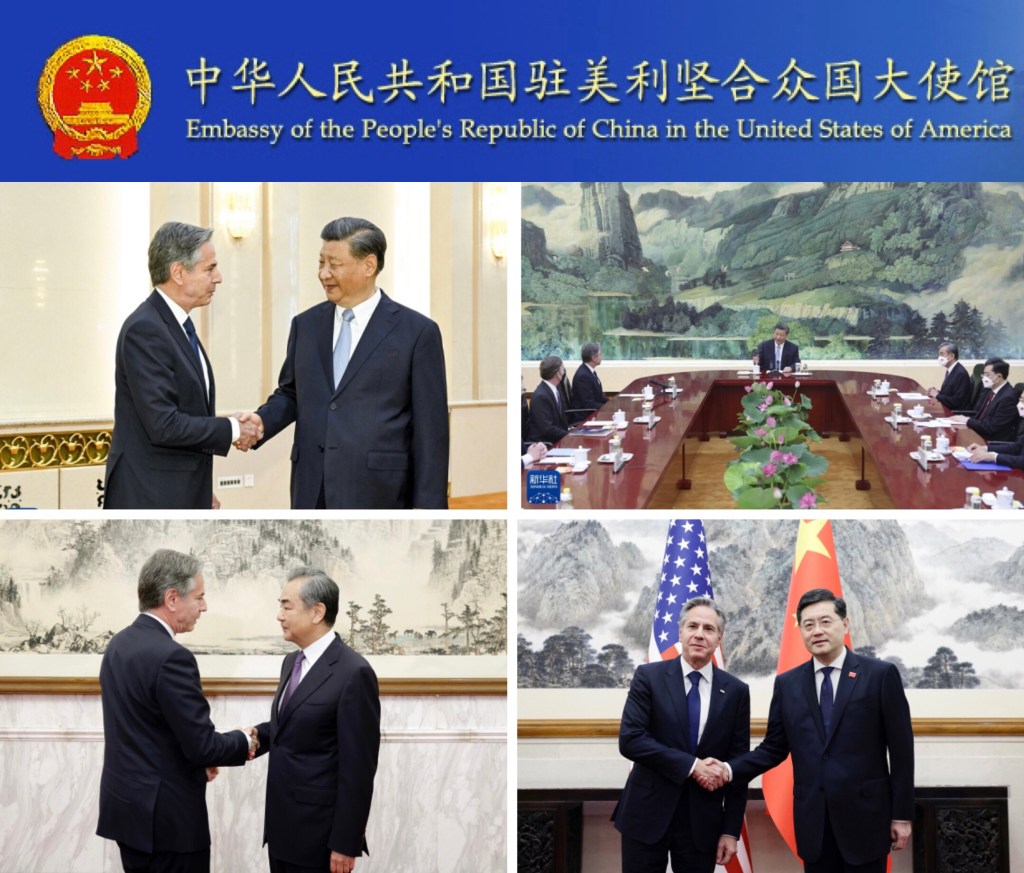
President Xi Jinping Meets with U.S. Secretary of State Antony Blinken
On the afternoon of June 19, President Xi Jinping met with U.S. Secretary of State Antony Blinken in Beijing.
President Xi pointed out that the world is developing and the times are changing. The world needs a generally stable China-U.S. relationship. Whether the two countries can find the right way to get along bears on the future and destiny of humanity. Planet Earth is big enough to accommodate the respective development and common prosperity of China and the United States. The Chinese, like the Americans, are dignified, confident and self-reliant people. They both have the right to pursue a better life. The common interests of the two countries should be valued, and their respective success is an opportunity instead of a threat to each other. The international community is generally concerned about the current state of China-U.S. relations. It does not want to see conflict or confrontation between China and the United States or choose sides between the two countries. It expects the two countries to coexist in peace and have friendly and cooperative relations. The two countries should act with a sense of responsibility for history, for the people and for the world, and handle China-U.S. relations properly. In this way, they may contribute to global peace and development, and help make the world, which is changing and turbulent, more stable, certain and constructive.
President Xi stressed that major-country competition does not represent the trend of the times, still less can it solve America’s own problems or the challenges facing the world. China respects U.S. interests and does not seek to challenge or displace the United States. In the same vein, the United States needs to respect China and must not hurt China’s legitimate rights and interests. Neither side should try to shape the other side by its own will, still less deprive the other side of its legitimate right to development. China always hopes to see a sound and steady China-U.S. relationship and believes that the two major countries can overcome various difficulties and find the right way to get along based on mutual respect, peaceful coexistence and win-win cooperation. He called on the U.S. side to adopt a rational and pragmatic attitude, and work with China in the same direction. President Xi pointed out that the two sides need to remain committed to the common understandings he and President Biden had reached in Bali, and translate the positive statements into actions so as to stabilize and improve China-U.S. relations.
Secretary Blinken conveyed President Biden’s greetings to President Xi. He said President Biden believes that the United States and China have an obligation to responsibly manage their relations. This is in the interest of the United States, China and the world. The United States is committed to returning to the agenda set by the two presidents in Bali. The United States stands by the commitments made by President Biden, namely the United States does not seek a new Cold War, it does not seek to change China’s system, its alliances are not directed at China, it does not support “Taiwan independence”, and it does not seek conflict with China. The U.S. side looks forward to having high-level engagement with the Chinese side, keeping open lines of communication, responsibly managing differences, and pursuing dialogue, exchanges and cooperation.
President Xi asked Secretary Blinken to convey his regards to President Biden.
Wang Yi and Qin Gang, among others, were present at the meeting.
Wang Yi Meets with U.S. Secretary of State Antony Blinken
On June 19, Member of the Political Bureau of the CPC Central Committee and Director of the Office of the Central Commission for Foreign Affairs Wang Yi met with U.S. Secretary of State Antony Blinken in Beijing.
Wang noted that the Secretary of State’s visit to Beijing comes at a critical juncture in China-U.S. relations, and a choice needs to be made between dialogue and confrontation, and cooperation and conflict. History always moves forward, and China-U.S. relations will also move on. Reversing the wheels of history will lead nowhere, and overturning what has been achieved is even less desirable. We need to shoulder our responsibilities to the people, history and the world, avert the downward spiral of the relationship, bring it back to the track of sound and steady development, and jointly explore the right way for China and the United States to get along with each other in the new era.
Noting that relations between China and the United States are at a low point, Wang underscored that the root cause is U.S. misperceptions toward China, which has led to misguided China policies. China-U.S. relations have gone through ups and downs, and it is necessary for the United States to reflect upon itself, and work with China to jointly manage differences and avoid strategic surprises. In order to stabilize China-U.S. relations, the most urgent task is to act on the common understandings reached between the two presidents with real actions. In order to ensure the steady and long-term growth of China-U.S. relations, the most critical task is to follow the principles of mutual respect, peaceful coexistence and win-win cooperation put forward by President Xi Jinping as the fundamental guidance.
Wang gave a comprehensive explanation of the historical logic and inevitable trend of China’s development and rejuvenation, and elaborated on the distinctive features of Chinese modernization and the rich substance of China’s whole-process people’s democracy. He urged the U.S. side not to project onto China the assumption that a strong country is bound to seek hegemony and not to misjudge China with the beaten path of traditional Western powers. This is key to whether the United States can truly return to an objective and rational policy toward China.
Wang demanded that the United States stop playing up the so-called “China threat”, lift illegal unilateral sanctions against China, stop suppressing China’s scientific and technological advances, and not wantonly interfere in China’s internal affairs. Wang specially analyzed the nature of the Taiwan question. He stressed that safeguarding national unity has always been the core of China’s core interests. It is where the future of the Chinese nation lies and the abiding historical mission of the CPC. On the Taiwan question,China has no room for compromise or concession. The United States must earnestly abide by the one-China principle set out in the three China-U.S. joint communiqués, respect China’s sovereignty and territorial integrity, and unequivocally oppose “Taiwan independence”.
Blinken laid out the U.S. views. He noted that the U.S. side is committed to going back to the agenda set by the two presidents during their summit in Bali and looks forward to enhancing communication with China, managing differences responsibly and cooperating in areas of common interests.
The two sides also exchanged views on international and regional issues of mutual interest.
Qin Gang Holds Talks with U.S. Secretary of State Antony Blinken
2023-06-18 23:55
On June 18, State Councilor and Foreign Minister Qin Gang held talks with U.S. Secretary of State Antony Blinken in Beijing.
Qin pointed out that the China-U.S. relationship is at the lowest point since its establishment. This does not serve the fundamental interests of the two peoples or meet the shared expectations of the international community. China’s policy toward the U.S. remains consistent and stable. It is fundamentally guided by the principles of mutual respect, peaceful coexistence and win-win cooperation put forward by President Xi Jinping. These principles should also be the spirit jointly upheld, the red line jointly defended and the goal jointly pursued by both sides. China is committed to building a stable, predictable and constructive relationship with the U.S. China hopes that the U.S. will adopt an objective and rational perception of China, work with China in the same direction, uphold the political foundation of China-U.S. relations, and handle unexpected and sporadic events in a calm, professional and rational manner. The two sides should deliver on the common understandings reached by President Xi and President Biden in Bali in letter and spirit, and work to stabilize and steer the relations back to the right track.
Qin expounded on China’s firm position and raised clear demands on the Taiwan question and other core interests and major concerns. Qin pointed out that the Taiwan question is the core of China’s core interests, the most consequential issue and the most pronounced risk in the China-U.S. relationship. The Chinese side urged the U.S. side to abide by the one-China principle and the three China-U.S. joint communiqués, and truly deliver on its commitment of not supporting “Taiwan independence.”
The two sides had candid, in-depth and constructive talks at length on the overall bilateral ties and important issues.
Both sides agreed to jointly implement the important common understandings reached by the two presidents in Bali, effectively manage differences, and advance dialogue, exchanges and cooperation.
Both sides agreed to maintain high-level interactions. Secretary Blinken invited State Councilor and Foreign Minister Qin to visit the U.S., and Qin expressed his readiness to make the visit at a mutually convenient time.
Both sides agreed to keep moving forward consultations on the guiding principles of China-U.S. relations.
Both sides agreed to continue advancing consultations through the joint working group to address specific issues in the relations.
Both sides agreed to encourage more people-to-people and educational exchanges, and had positive discussions on increasing passenger flights between the two countries. Both sides welcomed more mutual visits by students, scholars and business people, and agreed to provide support and facilitation to this end.
The two sides also exchanged views on major international and regional issues of mutual interest.
 Business Blog