Harvard Business Review: West must learn from China’s innovation. China is achieving a new level of global competitiveness, thanks to its hyper-adaptive population. 哈佛商業評論:西方必須向中國創新學習 得益於其超強適應性的人口,中國的全球競爭力正在達到新的水平
https://hbr.org/2021/05/chinas-new-innovation-advantage
Remove the obligatory orientalism by Zak Dychtwald
Stay informed at China speed. As the saying goes, “If you haven’t been to China in the past six months, you haven’t been to today’s China.” Stay informed constantly and consciously. 隨時了解中國速度。 俗話說:“如果你過去六個月沒有去過中國,你就沒有去過今天的中國。” 不斷、有意識地了解情況。
“Chinese are not really innovative, they just have more people” and this article sends a humbling message:
- We were blind to China’s innovative talents
- China is out-innovating the West: they are eating our lunch
- The West must learn from China.
Long considered a global copycat, China is now home to many of the fastest start-ups to reach a $1 billion valuation globally. Whatever has propelled Chinese companies to the top, the metrics we use to evaluate innovation have missed it. The author argues that China today has a resource that no other country has: hundreds of millions of people who have lived through unprecedented amounts of change—and who, consequently, can adopt and adapt to innovations at a speed and scale unmatched anywhere else on earth. Those hyper-adaptive and hyper-adoptive consumers are what make China so globally competitive today. But competition with the Chinese should not be considered a zero-sum game. Foreign companies would do well to seek to learn from China’s newly powerful example.
The future of the Chinese economy lies in innovation, and everyone in China knows it. But that hasn’t always been true. Innovation didn’t drive the manufacturing miracle that has unfolded in China over the past half century, during which some 700 million people have been raised—or lifted themselves—out of desperate poverty. Instead the driver has in large part been what might be called brute-force imitation. Relying on a seemingly limitless supply of cheap labor, provided by the hundreds of millions of ambitious workers born during the postwar baby boom, China devoted itself prodigiously to the production of other countries’ innovations. The effort enabled a country that missed the Industrial Revolution to absorb the world’s most modern manufacturing advances in just a decade or two. Fittingly, China earned a reputation as a global copycat.
But can China innovate? Can it compete at a global level with developed nations that have built their economies on innovation for decades? Many observers are doubtful. In recent years, they note, the West has steadily produced an abundance of innovations and innovators, while China has produced relatively few. In March 2014 this magazine published “Why China Can’t Innovate,” by Regina M. Abrami, William C. Kirby, and F. Warren McFarlan, an article that captured the conventional wisdom. The authors’ arguments were sound and well supported at the time. But just two years later eight of the 10 companies that had reached a $1 billion valuation in the shortest time ever were Chinese—and six of those eight were founded the year that article was published.
Those are startling numbers for a country that in 2020 ranked only 14th on the Global Innovation Index. Something clearly propelled those Chinese companies to the top, but the metrics we use to evaluate innovation have missed it. We tend to focus on people and companies that generate big new ideas—charismatic heroes with dash, daring, and dynamic thinking. By that measure the U.S. innovation ecosystem stands apart. But in the past five years, as an “innovation cold war” has taken shape between world powers, China has achieved a kind of parity with the United States—and the driving force behind its success may not be its innovators at all.
The story of mobile payment is especially instructive, because the technology that enables it emerged in the United States and China at almost exactly the same time. Thus their comparative innovativeness or timing—who copied whom?—becomes almost a nonfactor. In 2014 Apple Pay was launched in the U.S., followed a year later by Samsung Pay and Android Pay, and Alipay and WeChat Pay were launched in China.
In timing and tech the innovations were all but equal, but their adoption rates have differed dramatically. In early 2019 Apple announced with much fanfare that 383 million phones around the world had activated Apple Pay—but at that point only 24% of U.S. iPhone owners had ever actually used the technology. And not until that year did Apple Pay surpass the Starbucks mobile app—used only in Starbucks stores—as the most-used mobile-payment app in the United States.
Things have unfolded very differently in China, where WeChat Pay has won 84% market penetration among smartphone users. (The app is available to users of Tencent’s super-app WeChat, which has 1.2 billion monthly active users.) That kind of penetration explains why in 2018 WeChat Pay did 1.2 billion transactions a day, whereas Apple Pay did one billion a month. And it’s why in 2019 the total gross expenditure in China via mobile app (347 trillion yuan, or roughly $54 trillion) was 551 times greater than the total expenditure in the United States ($98 billion)
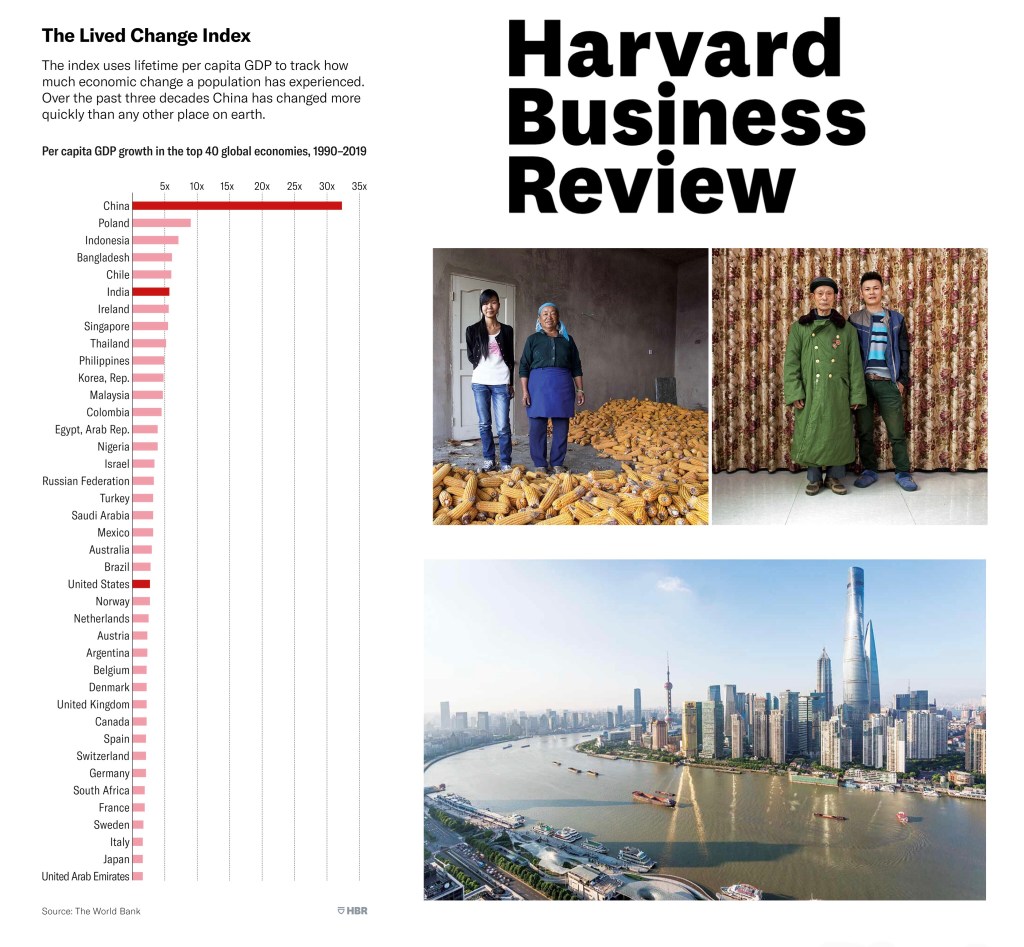
American Millennials have lived through dramatic, life-altering changes since 1990, the year I was born. First came the internet. Then cell phones. Then smartphones, social media, dating apps, mobile banking, electric cars, big data, CRISPR, and so much more. Since 1990 Americans have seen U.S. per capita GDP grow by roughly 2.7 times, which sounds impressive until you realize that somebody born in China in 1990 has seen per capita GDP grow by 32 times—a whole order of magnitude greater. In 1990 China’s GDP represented less than 2% of the global total. By 2019 its share had jumped to nearly 19%.
Consider some of the specifics. In just three years, from 2011 to 2013, China poured more concrete than the United States had poured in the entire 20th century. In 1990 China’s rural population had one refrigerator per 100 households; today that number is 96 per 100. (Food preservation is a common benchmark for development.) In 1990 China had only 5.5 million cars on the road; today it has 270 million, of which 3.4 million are electric, representing 47% of the global electric fleet. In 1990 three-quarters of the country’s population was rural; today nearly two-thirds is urban, an increase of more than half a billion people
What explains it? You can find the answer on the Lived Change Index. During the past three decades per capita GDP in India has grown in a roughly linear fashion, from just over $350 to more than $2,000—whereas in China it has grown almost exponentially, from just under $350 to more than $10,000. That disparity helps explain why many Chinese will scan a QR code but many Indians will not. The point here is not that any one culture is better at innovation but, rather, that certain developmental ecosystems create naturally different attitudes toward change, adoption, and newness. More than any other population in the world, the Chinese in recent years have had to adapt to radical change—and they have learned that innovative technologies can be key to their survival
To compete with China, imitation must be a weapon in the arsenal of global companies—one they’re willing to use.
Some of the smartest non-Chinese companies already understand this and are looking to Chinese rivals for ideas. That’s what Facebook did in 2019 when it added an integrated payment option to its chat function, five years after WeChat had introduced a similar option on a mass scale, in a pioneering example of how to productively fuse the worlds of social and commercial technology. It’s what Amazon did when it modeled its Prime Day (a wildly successful annual event during which Prime members receive all sorts of sale offers and discounts) on Alibaba’s Singles Day. Instagram got the idea for its Reels feature from TikTok. The list goes on and on.
Companies looking to China for ideas should consider these courses of action:
Lead from your China team. We’ve all been told to localize for China. Take that a step further and, at least in part, lead from China. Few companies empower their China teams to help create global strategy. That’s a missed opportunity. What is second nature to your China team may be revelatory to your other teams. What you learn about local strategy in China may well help transform your global strategy.
Expose your best. Send your best and brightest to China. Expose them to new ideas there. Expand their sense of what’s possible. I have spoken with delegations representing a range of companies, from German auto manufacturers to U.S. retailers, who told me that part of their mission in visiting China was to learn from the digital ecosystem there and take those lessons back home.
Stay informed at China speed. As the saying goes, “If you haven’t been to China in the past six months, you haven’t been to today’s China.” Stay informed constantly and consciously. Quarterly updates from trendspotters and on-the-ground resources are a good start. For global executives, video updates illustrating trends and experiences can be a close second to travel
 Business Blog