Arming Taiwan Is An Insane Provocation 武裝台灣是瘋狂的挑釁 by Profeesor John V. Walsh MD in SF. July 11 2023
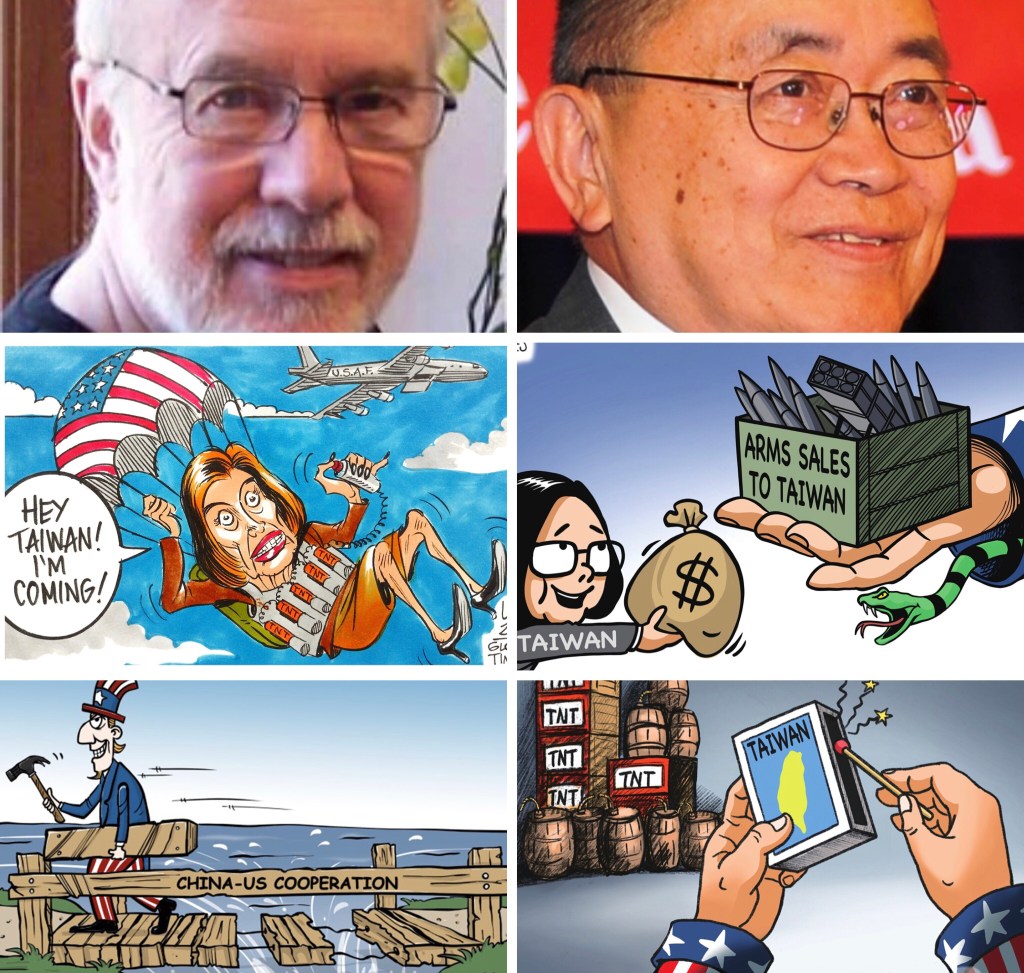
The Island of Taiwan has been turned into a “powder keg” by the infusion of U.S. weaponry, pushing the Taiwanese people into the “abyss of disaster.” These are the words of the Chinese Defense Ministry in reaction to the recent $440 million sale of U.S. arms to the island. And now the U.S. is also giving, not selling, arms to Taiwan, courtesy of the U.S. taxpayer.
The “First Island Chain” Strategy of the U.S.
Taiwan is but one in a series of islands along the Chinese coast, often called “The First Island Chain,” which now bristles with advanced U.S. weapons. These are accompanied by tens of thousands of supporting U.S. military personnel and combat troops. The “First Island Chain” extends from Japan in the north southward through Japan’s Ryukyu islands which include Okinawa, to Taiwan and on to the northern Philippines. (U.S. ally, South Korea, with a military of 500,000 active duty personnel and 3 million reserves is a powerful adjunct to this chain.) In U.S. military doctrine the First Island Chain is a base to “project power” and restrict sea access to China.
Taiwan is at the center this string of islands and is considered the focal point of The First Island Chain strategy. When the fiercely hawkish Cold Warrior, Secretary of State John Foster Dulles, conceived the strategy in 1951, he dubbed Taiwan America’s “unsinkable aircraft carrier.”
Taiwan is now one source of contention between the U.S. and China. As is often said but rarely done, the pursuit of peace demands that we understand the point of view of those who are marked as our adversaries. And, in China’s eyes, Taiwan and the rest of these armed isles look like both chain and noose.
How would the U.S. react in a similar circumstance? Cuba is about the same distance from the U.S. as the width of the Taiwan Strait that separates Taiwan from the Mainland. Consider the recent U.S. reaction to rumors that China was setting up a listening post in Cuba. There was a bipartisan reaction of alarm in Congress and a bipartisan statement that such an installation is “unacceptable.” What would be the reaction if China armed Cuba to the teeth or sent hundreds of soldiers there as the U.S. has done to Taiwan? It is not hard to imagine. One immediately thinks of the U.S. sponsored invasion of Cuba at the Bay of Pigs and later the Cuban Missile Crisis.
Clearly, the arming of Taiwan is a provocative act that pushes the U.S. closer to war with China, a nuclear power.
The Secessionist Movement in Taiwan
According to the One China Policy, the official policy of the U.S., Taiwan is part of China. The UN took the same position in 1971 with passage of Resolution 2758 (also known as the Resolution on Admitting Peking) which recognized the People’s Republic of China (PRC) as the legitimate government of all of China and its sole representative in the UN.
In recent decades a secessionist movement has developed on the island of Taiwan, a sentiment represented by the DPP (Democratic Progressive Party). Currently Tsai Ing-wen of the DPP is President. But in the local elections of 2022, the DPP lost very badly to the KMT (Kuomintang) which is friendly to the Mainland and wishes to preserve the status quo or “strategic ambiguity,” as it is called. Tsai built the DPP’s 2022 campaign on hostility to Beijing, not on local issues. And at the same time, her government passed legislation to increase the compulsory service for young Taiwanese males from 6 months to a year. Needless to say, this hawkish move was not popular with the under 30 set.
Polling in 2022 showed that an overwhelming majority of Taiwanese now want to preserve the status quo. Only 1.3% want immediate unification and only 5.3% want immediate independence. Compared to previous years, a record 28.6 percent of those polled said they preferred to “maintain the status quo indefinitely,” while 28.3 percent chose the status quo to “decide at a later date,” and 25.2 percent opted for the status quo with a view to “move toward independence.” Thus, a total of 82.1% now favor the status quo! Not surprisingly, every prominent presidential candidate professes to be in favor of the status quo. However, DPP candidates also contend there is no need to declare independence since in their eyes Taiwan is already independent.
The stated policy of the People’s Republic of China is to seek peaceful reunification with Taiwan. Only if the secessionist movement formally declares independence does Beijing threaten to use force. Clearly the Taiwanese do not wish to find themselves in the position of Ukrainians, cannon fodder in a U.S. proxy war.
Here we might once more consider how the alleged enemy of the U.S., China, sees things and might react to a formal act of secession and declaration of independence by Taiwan. And again, we might be guided by our own history. When the Confederate States seceded from the Union, the U.S. descended into the bloodiest war in its history with 620,000 soldiers dead. Moreover, a secessionist Taiwan, as an armed ally of the U.S., represents to China a return to the “Century of Humiliation” at the hands of the colonial West. Given these circumstances, arming Taiwan clearly creates a “powder keg.” A single spark could ignite it.
It is difficult to avoid the conclusion that the U.S. is trying to gin up a proxy war that would engulf East Asia, damaging not only China but other U.S. economic competitors like Japan and South Korea. The U.S. would come out on top. It is the neocon Wolfowitz Doctrine put into play. But in the nuclear age such stratagems amount to total insanity.
If some Taiwanese hope that the U.S. will come to its aid, they should ponder carefully the tragedy of Ukraine. Somewhere between 150,000 and 200,000 Ukrainian soldiers have lost their lives so far and millions more turned into refugees. A similar U.S. proxy war in Taiwan could easily turn into a full-scale conflict between the world’s two largest economies, certainly triggering a global depression and perhaps a nuclear exchange. And U.S. President Joe Biden has committed to send troops to fight the People’s Liberation Army should hostilities break out. So, the situation is even more perilous than the one in Ukraine!
No Arms to Taiwan.
When all this is considered, arming Taiwan is asking for trouble on a global scale. Taipei and Beijing can settle their disagreements by themselves. Frankly put, disagreements between the two are none of America’s business.
So, we Americans must stop our government from arming Taiwan. And we need to get our military out of East Asia. It is an ocean away, and no power there is threatening the U.S. We do not have Chinese warships off our Pacific Coast, nor do we have Chinese troops or Chinese military bases anywhere in our entire hemisphere.
China calls for peaceful coexistence and a win-win set of relationships between us. Let’s take them up on that.
And let’s bring all those troops, submarines, bombers, rockets, and warships out of East Asia before they stumble into a conflict or become the instrument of a false flag operation. We should keep in mind the Gulf of Tonkin Incident, a fake report of a Vietnamese attack on a U.S. ship that led to the Gulf of Tonkin Resolution, a de facto declaration of war against Vietnam. In the end millions lost their lives in Southeast Asia in that brutal, horrific war. Even that will look like a schoolyard squabble compared to the conflagration unleashed by a U.S.-China war.
Professor Ling-chi Wang, UC Berkeley: Hi, John: Very clear and succinct summation of US-Taiwan relations. Using Taiwan to provoke China into taking preemptive action toward unification is not likely to happen soon, at least in the foreseeable future and there is no sign that both sides are moving toward a military confrontation. However, what has been happening is what you wrote about is US aggressive arming of Taiwan iand that is turning Taiwan into “a powder keg.” U.S.political and military provocations since Nancy Pelosi’s visit to Taiwan and a steady stream of U.S. politicians, arms dealers, and military leaders visiting China to peddle the war against China. Such provocations are a cause for alarm.
The opinion polls on Taiwan people’s sentiments toward Mainland and the prospect of liberating Taiwan province by force or by peaceful means are just opinion polls, nothing more and nothing less. The outcomes of these polls are notoriously inaccurate and unreliable, whether they are taken here in the U.S. or in Taiwan. My own view is that the outcomes of these polls, regardless who conduct them have the life-span or longevity of a fruit fly. Each poll measures or takes the temperature of its target population at the very moment it is conducted. A lot depends on what happens a day or a few days before it is taken or, to put it crudely, it could just as well be dependent on which side one gets out of bed that morning. So much for their reliability
There is one measurement of sentiment I have not seen or heard: that is, in the event of an actual invasion from the Mainland, not hypothetically how willing people in Taiwan to follow. Government orders to fight, but how much actual, not hypothetical, resistance against PLA will encounter from the people and the military of Taiwan. Let me cite the example of actual military encounters between the KMT and CCP soldiers the last time they fought against each other on the Mainland.
I remember what happened in the Mainland when the civil war erupted immediately after the end of WW II. At that time, Chiang Kai-shek was the dictator commanding the largest army in China in the world. The KMT soldiers were far better trained by U.S. military advisers and armed with the latest and most sophisticated U.S. military hardware and military vehicles, including tanks. PLA had no Air Force and navy to speak of. The Morales, however, was on the PLA side: they were were poorly armed, but disciplined and committed to liberate China and end foreign domination of China since the Opium Wa, 1837-42, just like the PLA soldiers in the Korean War, willing to fight with or without arms and to die for their cause, which terrified best equipped U.S. soldiers in Korea and Vietnam. (The disparity was reacted for 20 years in the Vietnam War). Liberating a vast country like China by foot against the best armed army of the KMT was certainly not a piece of cake. Yet, within a short period of four years, Mao Zedong and the PLA were able to stand on October 1, 1949 above the Tiananmen Square in Beijing and declared to the people of China and the world CCP’s mission accomplished. 34 out of 35 provinces effectively liberated, except for one: Taiwan province. Chiang Kai-shek, and what was left of his huge army, and the loyalist members of his government in Nanjing and the Nationalist Party, numbering about 2 million, defeated and fled to Taiwan under U.S. military intervention, including Navy and Air Force, and protection to this date. He promptly imposed martial law throughout Taiwan until July 1987!
The liberation of the vast land of China was accomplished at lightning speed! The world was stunned! Both President Truman and the U.S. Congress were stunned and began to look for scapegoats. The Truman administration issued its lengthy explanation or apology in the “China White Papers” in August 1949. Thus began the audacious, acrimonious debate in Washington, D.C., over “The Loss cf China,” a country never ours to lose to begin with. Thus, also began the McCarthy Era, the national security state, and the national dragnet in the hunt for “suspected communists” and “fellow-travelers” in every nuke and cranny in our government, in the military, universities, our culture, and, never forget, in the Chinese American community across the U.S. The national witch-hunt reached deep into Chinese America. Being Chinese American became unanimous with treason and espionage. In the annal of Chinese America, I label the period between 1949 and 1972 to be a “period of reign of terror,” a history of which is yet to be written and the scar inflicted on the body and soul of many a Chinese American remains unhealed. McCarthyism in Chinese America never really ended. In fact, the new Cold War against China initiated during the Obama years has been intensifing in magnitude and depth in successive presidency and in the process, has revived the reign of terror with a vengeance in Chinese America as never before.
I bring up this brief discussion on the unfinished civil war in China because Taiwan remains under U.S. control and it is being used dangerously by the Biden Administration to provoke a confrontation between China and the U.S. because his stated intention is not to allowi China to rise peacefully and surpass the U.S. economically “under his watch.” Like the Old Cold War, Chinese Americans have become the unsuspecting and unwilling victims of his national security state and political and legal repression. In the process of demonizing China and instilling fear of China’s rise, meaning the loss of U.S. global hegemony, he also incites domestic hatred and fear of Chinese Americans, inciting widespread anti-Chinese hatred and violence, Every Chinese American is a convenient target, random and spontaneous.
Back to Taiwan, against this national and international geopolitical background, the intriguing question to raise is whether there will be defection to the Chinese side on the part of the people and military of Taiwan In the event of an imminent liberation of Taiwan, just like what happened in the brief civil war 9n China between 1946 and 1949 I described above. We already know that, poll after poll in Taiwan, the overwhelming majority of the Chinese people in Taiwan favor maintaining the status quo. If China assure Taiwan of maintaining the status quo, which brought prosperity to to millions on both sides of the Strait, meaning, continuing trade and investments, free travel and student exchange, and free tourist travel between both sides, and cross-strait family reunion for millions, including the leadership of two KNT and DPP parties, what will the people of Taiwan choose? I suppose we will not know until it actually happens. Let’s wish that day will never come and both sides will choose peaceful reunification.
Taiwan Enhanced Resilience Act (TERA Act) in its entirety in your response to John’s commentary the continuing “insane provocation” being undertaken by the U.S. Reading the act itself sent chills down my spine. The micromanagement of Taiwan’s military is offensive and, to use John’s word again, insanity. The Taiwan Relations Act of 1979 is sketchy and general. I bet you 99% of the people of Taiwan have not seen, even less, read the language of this law enacted by the U.S. Congress. Taiwan’s government, if it has any integrity left, should be ashamed of it and should promptly demand the repeal of TERA. We known now that the U.S. military is now on the ground in Taiwan implementing the various provisions of the law. Taiwan is now effectively under the occupation of the U.S.
The people of Taiwan must be made aware of what the U.S. government has installed for them and take steps to take back control of its government and its land.
https://www.congress.gov/bill/117th-congress/senate-bill/4428/text
 Business Blog