Vilnius summit marks NATO’s turn to war against China by Peter Symonds 7-14-23
The NATO summit that has just concluded in Vilnius, Lithuania set out a sweeping plan for global conflict, making clear that the war against Russia in Ukraine is just a step toward confrontation and war with other perceived threats to imperialist interests. Its joint communiqué made clear that China was at the top of the list, presaging a build-up to a far greater NATO military presence in the Indo-Pacific alongside US allies in the region.
While declaring that NATO remained “open to constructive engagement” with Beijing, the communiqué painted China in the darkest of colours, declaring its “ambitions and coercive policies challenge our interests, security and values.”
It accused China of being “opaque about its strategy, intentions and military build-up,” engaging in “malicious hybrid and cyber operations” and “confrontational rhetoric and disinformation,” seeking “to control key technological and industrial sectors, critical infrastructure, and strategic materials and supply chains” and using “its economic leverage to create strategic dependencies and enhance its influence.”
What staggering hypocrisy! With the increasing involvement of its allies in Europe and Asia, US imperialism has been engaging in an escalating confrontation with China—diplomatically, economically and strategically—for more than a decade. Under presidents Obama, Trump and Biden, the US has resorted to all of the following long list: ratcheting up the confrontational rhetoric, using its economic might to impose punitive tariffs, sanctions and bans, and engaging in a massive military build-up in the region and consolidation of antagonistic alliances—all of which Washington has attempted to make as opaque as possible.
The central charge laid against China, and endlessly repeated by the US and its allies, is that “it strives to subvert the rules-based international order, including in the space, cyber and maritime domains.” However, the accusation reveals more about Washington’s aggressive plans than about Beijing. The “rules-based international order” is nothing other than the post-World War II mechanisms established by US imperialism to restabilise global capitalism and assure its dominant position in a world order in which it dictated the rules.
In the present conditions of its historic decline, the US is using its residual military might in a reckless attempt to shore up its global hegemony. Having waged one criminal war of aggression after another in the Balkans, the Middle East, North Africa and Central Asia, Washington is now engaged in a war against Russia in Ukraine in a bid to destabilise and subordinate Moscow—as the prelude to a war to do the same to China, which it regards as the chief threat to its global dominance.
Moreover, while funnelling tens of billions in ever-more sophisticated military hardware into Ukraine to try to bring Russia to its knees politically, the US and its NATO allies demand that China condemn the Russian invasion of Ukraine and, in a menacing threat, warn it to “refrain from providing any lethal aid to Russia.” The Russian invasion of Ukraine was driven by the reactionary national interests of the Putin regime and the wealthy oligarchy it presents, but the US deliberately goaded Moscow into doing so by step-by-step encircling Russia with NATO allies.
Now the US is engaged in similar provocations against China, accusing it of preparing to invade Taiwan even as Washington increasingly treats the island as an independent state, knowing this is a red line for Beijing.
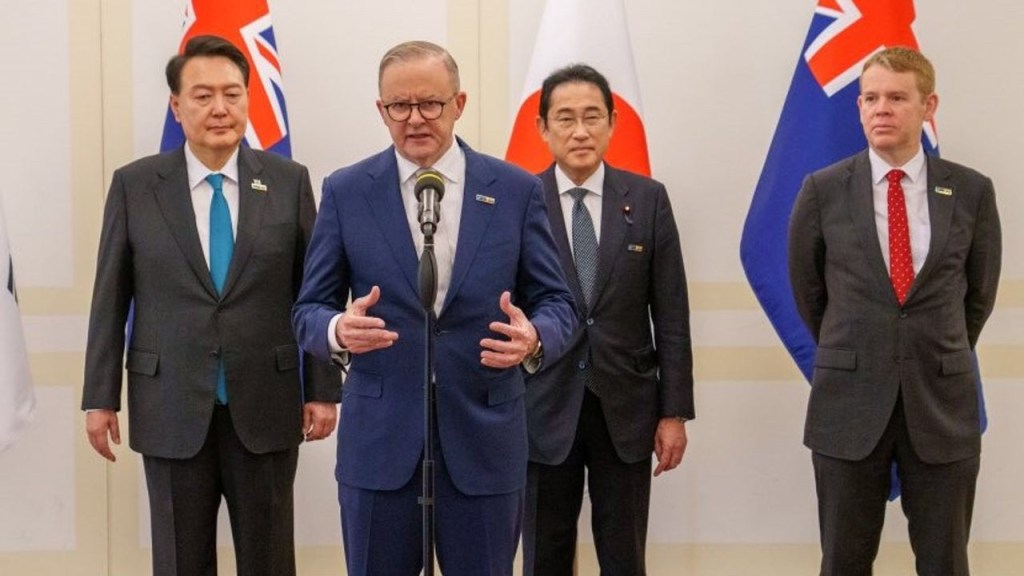
The build-up, not just of the US but NATO, in Asia is underscored by the presence now of the leaders of four US allies—Japan, South Korea, Australia and New Zealand—at two NATO summits, first in Madrid last year and in Vilnius this year. It highlights the unstated understanding among US allies on both sides of the world that the Ukraine war is not an isolated conflict but is global in scope. Thus the so-called Asia Pacific Four (AP4) has backed the NATO war against Russia with aid and personnel, while NATO allies are deepening their ties and military presence in Asia.
The Biden administration has forged two key strategic pacts in the Indo-Pacific—the Quadrilateral Security Dialogue or Quad, involving the US, Japan, Australia and India, and the AUKUS agreement between the US, Britain and Australia. In a clear preparation for war with China, AUKUS will provide Australia with nuclear-powered attack submarines and other sophisticated weaponry. India was the only participant not invited to the NATO summit. While New Delhi has joined the US-led line-up against China, it has refused to condemn the invasion of Ukraine by Russia, with which it maintains significant ties.
In the wake of the Vilnius summit, NATO is set to upgrade the status of the AP4 countries, which are presently treated as “partners across the globe.” While the discussion of details is being kept under wraps, NATO is holding discussions with each of the four countries individually to formulate an Individually Tailored Partnership Program. The documents are to lay the basis for much closer collaboration on a range of military issues, including cybersecurity, space and fighting so-called disinformation.
 Business Blog