Slap American’s face really hard by Huawei, launching the New Huawei Mate 60 Pro with 100% Made in China chips days before US Commerce Secretary China’s visit 華為狠狠打了美國臉,在美國商務部長訪華前幾天推出了配備100%中國製造芯片的新款華為Mate 60 Pro
Professor Ling-Chi Wang of UC Berkeley: Dear Dr. George Koo: Thanks for the timely article on Huawei’s victory over US death threat. Since she was very much instrumental in enforcing sanctions against Huawei, it was only just that Huawei made sure she got her face-slap in front of the whole world and in the process, the company use her to gain free global publicity and advertisement worth millions for its new smartphone The U.S. had the nerve to complain that the publicity stun was disrespectful of her. Tell that to Meng Wanzhou, the CEO of Huawei. Meng should thank her for the poetic justice! 加州大學伯克利分校王靈智教授: 親愛的顾屏山博士:感謝您及時發表有關華為戰勝美國死亡威脅的文章。 由於美國商務部長在對華為實施制裁方面發揮了很大作用,華為只是確保美國商務部長在全世界面前打了自己的臉,並在這個過程中,該公司利用她獲得了價值數百萬美元的免費全球宣傳和廣告。美國竟然厚顏無恥地抱怨其新智能手機的宣傳效果是對她的不尊重。 把這個告訴華為首席執行官孟晚舟。 孟應該感謝她的詩意正義!
How about listening to this song by British author, Clifford Bax *1916, and set to music by British comporser, Gustav Holst, using a 12th cenntury tune, and sung by the choir of Someriville College, Oxford 來聽聽英國作家 Clifford Bax *1916 年創作的這首歌曲,由英國作曲家 Gustav Holst 配樂,使用 12 世紀的曲調,由牛津薩默里維爾學院合唱團演唱:
The song I distributed is an appeal for peace written during brutal World War I 我分發的這首歌是在殘酷的第一次世界大戰期間寫的呼籲和平的歌曲
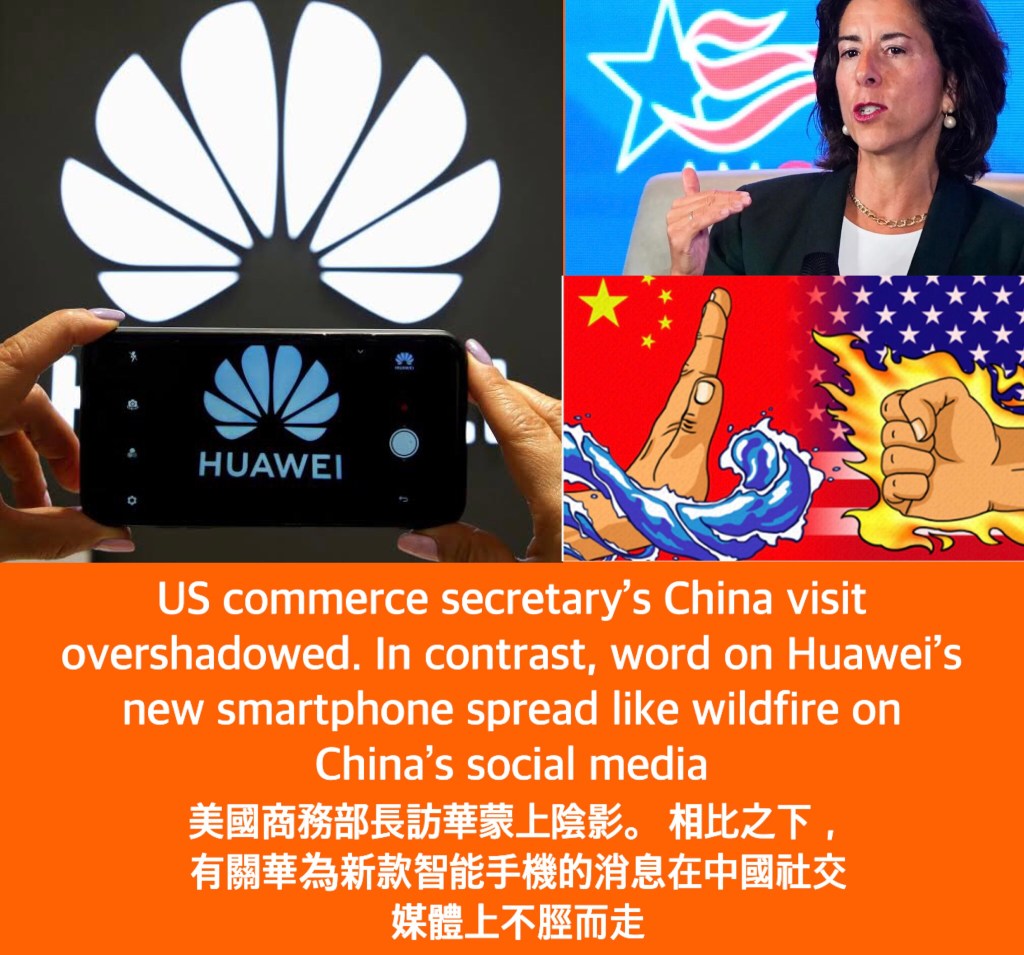
US commerce secretary’s China visit overshadowed. In contrast, word on Huawei’s new smartphone spread like wildfire on China’s social media. By George Koo 美國商務部長訪華蒙上陰影。 相比之下,有關華為新款智能手機的消息在中國社交媒體上不脛而走. Sept 4 2023
While US Commerce Secretary Gina Raimondo was visiting Beijing last week, she witnessed a spontaneous celebration among the Chinese people. But the gleeful outburst had nothing to do with her meetings with Chinese leaders; it was a raucous cheer for the re-emergence of Huawei’s smartphone business.
By disclosing the availability of a new smartphone, the Mate 60 Pro, on the company website, Huawei quietly let customers in China know that it had re-entered the mobile-phone business.
Word on the Mate 60 Pro spread like wildfire on China’s social media. Even though Huawei provided virtually no background information on the new phone, the initial allotment was sold out on the first day.
Visitors to the website can see that Huawei’s smartphone is priced slightly lower than the Apple iPhone 14 with similar functionality. The notable difference is that the speed of Huawei’s phone is greater and meets the specifications of a 5G-capable smartphone.
Third parties immediately took apart the Mate 60 Pro and reported that there was no evidence of any US technology inside the phone. The phone is driven by a Kirin 9000S chip, designed and made in China, and uses HarmonyOS, Huawei’s own operating system.
There are many other technical differences between Huawei’s latest smartphone and its competitors. Bit the essential point to me is that Huawei is back after three years in the wilderness.
In 2019, the US began to levy a series of sanctions on the company denying it access to advanced chip designs and the availability of Taiwan Semiconductor Manufacturing Company (TSMC) to make the chips for them. Each successive restriction was designed to strangle Huawei out of the smartphone business.
Message to Biden administation
In a way, Huawei’s action did have something to do with Raimondo’s visit. The company apparently moved up the unveiling of the Mate 60 Pro to coincide with her visit. To many of China’s netizens, it was Huawei’s way of calling her and the Joe Biden administration’s attention to the fact that no obstruction imposed by the US will keep Huawei down for long.
Huawei has not disclosed how it has achieved the necessary technological advances, but one thing is clear. The company could not have made all the advances without partners in China and without creating a domestic supply chain, from design software and semiconductor fabrication to essential chemicals and materials.
What Huawei has accomplished will ripple through China’s semiconductor industry. Huawei’s experience will facilitate and encourage others to follow. China’s self-sufficiency in semiconductors will only increase.
Previously, China represented almost one-third of the world’s market for semiconductors. Before the US mounted the trade war, it was more convenient for China to buy them than to make its own. Now that it is forced to go on their own, China is, consequently, not importing as much, and total import is declining by double digits annually.
America’s shortsighted strategy to decouple from China will devastate the revenue of leading US providers of advanced chips such as Nvidia and Qualcomm and manufacturers of chip-making equipment such as Applied Material and Lam Research.
These companies will see their comparative advantages dry up. In the near term, they are not allowed to sell to China. In the long term, China will not need to buy from them.
Washington’s policymakers failed to appreciate that China is no technological slouch. When pushed against a wall, China will back its national interest with the needed funds and talent to overcome any obstacle.
It’s time for Washington to accept the fact that efforts to suppress China is a wasteful national priority and damaging to national interests. We Americans will rue the day when our insistence on making China our adversary became a reality.
George Koo retired from a global advisory services firm where he advised clients on their China strategies and business operations. Educated at MIT, Stevens Institute and Santa Clara University, he is the founder and former managing director of International Strategic Alliances. Follow him on Twitter @george_koo.
 Business Blog