What a coincidence! One day after I returned from Bangkok, HK is promoting businesses in Bangkok. Think Business, Think Hong Kong Bangkok 2023: Empowering Retail with Technology. 真是巧合啊! 我從曼谷回來一天后,香港正在曼谷宣傳業務。 思考商業,思考香港曼谷 2023:用技術賦能零售
The booming Asian market presents a multitude of opportunities and challenges for retailers. The emergence of a new generation of young, tech‑savvy consumers, combined with the slew of new technologies, has drastically upended the retail landscape in recent years. As a pioneering business hub in Asia with a dynamic and sophisticated retail sector, Hong Kong thrives as a leading centre of state‑of‑the‑art retail innovations and applications.
The HKTDC’s signature promotional event Think Business, Think Hong Kong (TBTHK) Bangkok 2023 saw experts discuss how new technologies and innovative practices are transforming modern retail, and how retailers continue to thrive by embracing these emerging developments, applying them in operations optimisation and market expansion.
The rise of Gen Z shoppers
The emergence of Gen Z[1] as a dominant consumer group is expected to transform the retail landscape, as many Gen Zers – with some as young as 11 years old in 2023 – are soon to become independent, decision‑making spenders. Anson Bailey, Head of Consumer & Retail, ASPAC at KPMG, considers the Asian Gen Z market the spotlight for global retail going forward. Based on United Nations (UN) projections[2], the total Gen Z population aged 18 or above in mainland China, ASEAN and India will grow at a yearly rate of more than 50 million and reach 835 million by 2030.
He pointed out that the omnipresence of social media is one of the key Gen Z traits, saying: “Gen Z consumers are tech native and social media‑savvy. They spend so much time on their mobile phones, and are very vocal about their likes and dislikes on social media. To engage them best, one would have to tailor his/her messages and make them feel like a respected stakeholder of the business decision‑making process. As consumers, they are also more socially aware and active than ever before, so are their demands for more socially responsible business practices and sustainable consumption.”
Andrew Young, Associate Director (Innovation) at Hong Kong property developer Sino Group shared the company’s experience of engaging with younger consumers through social media for its retail property businesses, saying: “We’ve devoted a lot of advertising and promotion to social media, and we believe responsible social media promotion would be the way forward. The new generation wants to know everything spanning the heating, ventilation and air conditioning (HVAC) systems, the adoption of sustainable materials and the carbon footprints of their purchases. In comparison with the older generations, they are far more demanding.”
Disruptive technologies disrupting
With artificial intelligence (AI) and its applications being more and more prominent in recent years, Bailey saw AI, especially generative AI, as the most disruptive technology for the retail industry. He said: “We’re going to see an evolution of AI. It used to be about basic applications like product recommendations, but now next‑generation AI technologies are already in use for advanced applications like product design, trendspotting, inventory management and chatbots. Today, retailers generate some 40 petabytes of data every hour, but still an average retailer has only leveraged a fraction of the technologies. Without doubt, AI will therefore continue to disrupt the retail industry, and we will have to train and get our employees AI‑ or future‑proofed.”
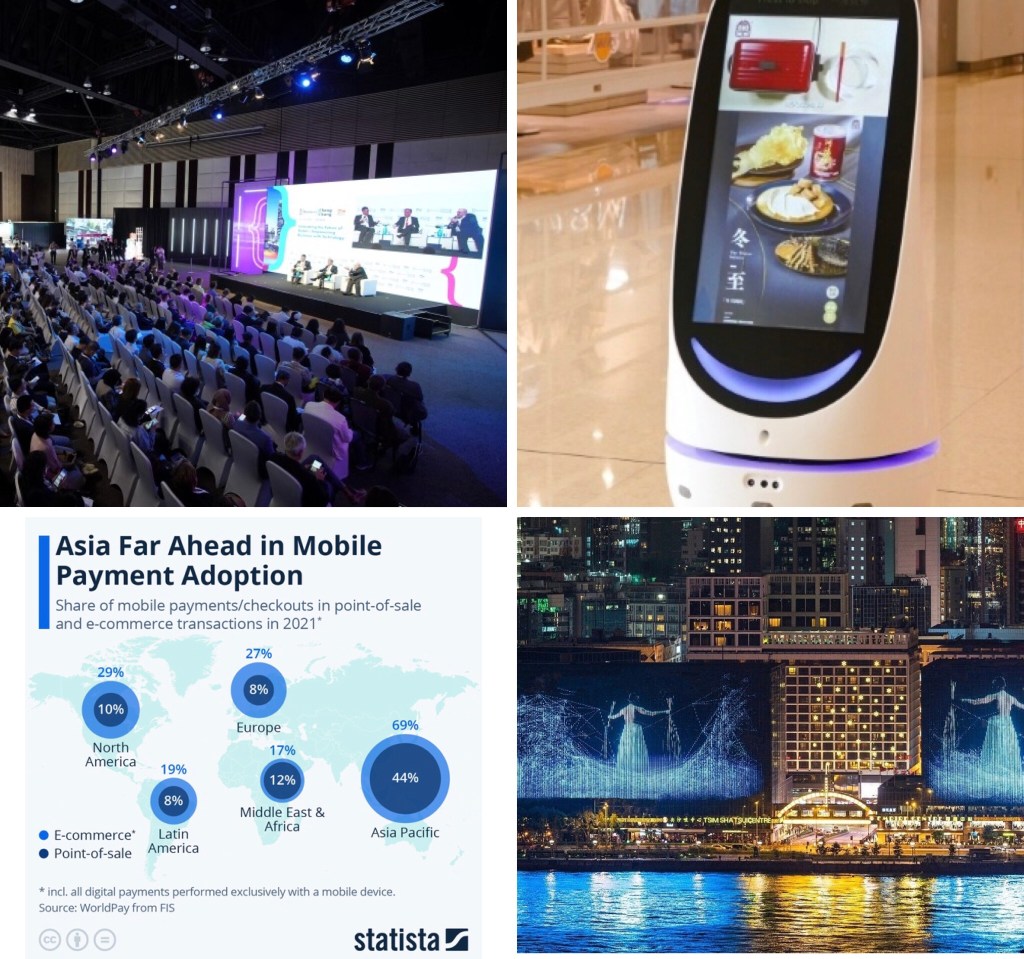
Bailey also expects digital platforms featuring e‑commerce, digital payments and internet of things (IoT) to continue their growth for the years to come. In particular, he highlighted opportunities in the Asian market, saying: “Everything is becoming more connected. By 2025, there will be nearly 31 billion IoT‑ connected devices worldwide. And Asia will not only become a thriving consumer market, but also an emerging innovation and technology hub. Asia today is far ahead in areas such as mobile payments, and in places like China and Japan, we’ve already seen a lot of automated stores and connected vending machines and shopping carts.”
In the face of a global labour shortage and consumers’ heightened hygiene awareness post‑pandemic, Young observed an accelerated adoption and application of robotics and AI in retail. Noting that consumers are seeking a safe shopping environment and becoming more accustomed to self‑service systems, he gave examples of his company employing such innovative hardware solutions as cleaning robots, touchless displays and mobile concierges, as well as software like voice‑based dialogue systems for facility management and AI‑powered digital avatars for concierge services.
Omnichannel retail and shopper experience
During the Covid-19 pandemic, e‑commerce experienced phenomenal growth. However, the share of e‑commerce in global retail sales is only predicted to reach 24% by 2026 according to data platform Statista, with physical retail maintaining its prominence in the near future. One key driver of this trend is the post‑pandemic resurgence of social activities and interactions. Bailey explained, saying: “Bricks‑and‑mortar retail is here to stay because it is crystal clear after the pandemic that people need social connectivity. Consumers are now expecting retailers to provide them with deeper, more immersive shopping experiences.”
Young also emphasised the importance of the experiential element in retail, with examples of how retail technologies developed and implemented in Hong Kong are enhancing shopping experience in the city. For its new shopping centre in Kwun Tong, Hong Kong, Sino has partnered with a Hong Kong start‑up to introduce an AI‑based indoor positioning and navigation system that uses WiFi and Bluetooth signals for location tracking. Unlike in the past, the new system does not require the installation of many beacons at the facility, which are costly and difficult to maintain, while it comes with an app displaying the shopper’s location on an interactive, personalised navigation map and supporting voice navigation for the visually‑impaired.
Young highlighted the significance of such innovations in the global retail market, saying: “Technologies like this can not only appeal to tech‑savvy Gen Z consumers, but also differentiate the shopping centre and encourage repeat customers. In fact, the technology has also been applied in shopping centres in Japan, allowing us to see how versatile and transferable homegrown retail technology from Hong Kong is in the global retail market.”
As AI and data analytic technologies continue to develop rapidly, Young believes that utilising data to provide a personalised, interactive shopping experience will be the next significant retail trend. Giving an example, he said: “With interactive digital signage, we can give shopping suggestions and allow you to try on products virtually – whether it be handbags, watches or jewellery.” Nonetheless, Young also emphasised the importance of safeguarding data privacy and noted that retailers must be selective about what data to collect and store in compliance with the corresponding regulations. Bailey added that, based on KPMG’s experience, cybersecurity solutions are one of the most in‑demand services among retailers nowadays.
 Business Blog