Before US Senator Daniel Inouye in Hawaii passed away told us in many occasions that US need enemies, real on imaginary to maintain large military budgets to satisfy our Military Industrial Complex, the war machine. At that time Russia was our enemy. Since Obama from Hawaii became US President, he also made China our enemy. Obama said US cannot allow Chinese to live a good life to compete with US! For an African American President made that kind of racist statement was shocking. Later we discovered Obama did not care about his African roots either! 在夏威夷的美國參議員丹尼爾·井上去世之前,他多次告訴我們,美國需要敵人,無論是真實的還是想像的,以維持龐大的軍事預算,以滿足我們的軍事工業綜合體,即戰爭機器。 那時俄羅斯是我們的敵人。 自從來自夏威夷的歐巴馬成為美國總統以來,他也把中國當作了我們的敵人。 歐巴馬說美國不能讓中國人過好日子與美國競爭! 對於一位非裔美國總統來說,發表這種種族主義言論令人震驚。 後來我們發現歐巴馬也不關心他的非洲血統!
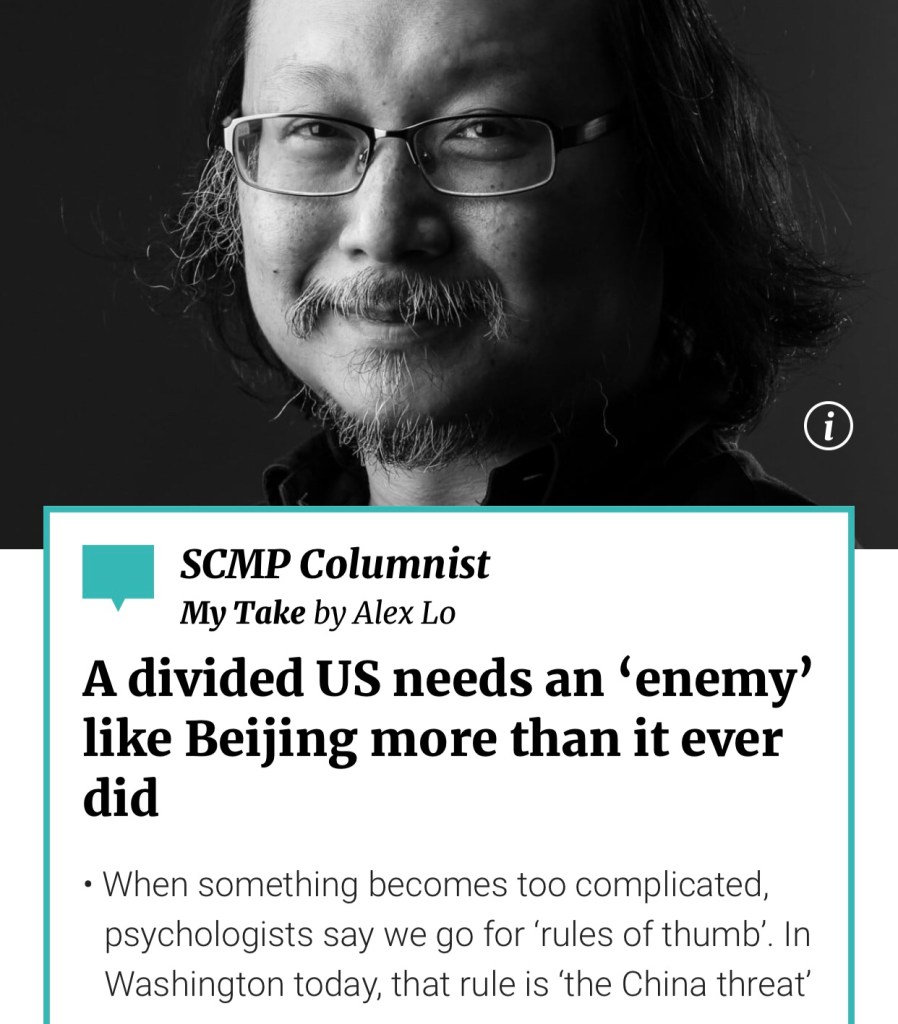
SCMP Columnist Alex Lo: A divided US need an enemy like Beijing more than it ever did. When something become too complicated, psychologists say we go to rules of thumb in Washington today, that rule is the China threats. 南華早報專欄作家Alex Lo:分裂的美國比以往任何時候都更需要像北京這樣的敵人。 心理學家說,當事情變得太複雜時,我們今天會遵循華盛頓的經驗法則,這條規則就是中國的威脅.
America’s political elite are worried that domestic polarisation is undermining its ability to counter an “existential threat” like China, or as they prefer to call it nowadays, the Chinese Communist Party. They needn’t worry; they have got things – cause and effect – reversed. 美國的政治菁英擔心,國內的兩極化正在削弱其應對像中國這樣的「生存威脅」的能力,或者他們現在更願意稱之為中國共產黨。 他們不必擔心; 他們把事情——因果——顛倒了.
By contrast, Beijing has steadfastly refused to publicly label the United States as a mortal threat, an enemy or a pacing challenge, even though it clearly is; there lies their fundamental political difference. 相較之下,北京堅決拒絕公開將美國稱為致命威脅、敵人或步調挑戰,儘管事實顯然如此; 這就是他們根本的政治分歧.
The more fractured American body politic becomes, the more it needs an enemy like China. The more stable and shared its political-social norms were – now a distant memory unlikely to return – the less America had needs for a common threat. That’s why a polarised US on the verge of civil war will be more dangerous to the world than ever. It’s analogous to the last financial meltdown in the US, beginning with its real estate market collapse, which led to the global financial crisis. 美國政體越分裂,就越需要像中國這樣的敵人。 其政治社會規範越穩定、越共享 — — 現在已成為遙遠的記憶,不太可能回歸 — — 美國就越不需要共同威脅。 這就是為什麼處於內戰邊緣的兩極分化的美國對世界來說將比以往任何時候都更加危險。 這類似於美國上次的金融危機,始於房地產市場崩潰,最終導致了全球金融危機.
It’s perhaps not by accident that two current articles in Foreign Policy and Foreign Affairs both address the same topic. Writing in Foreign Affairs, former secretary of defence Robert Gates argues that paralysis and infighting in Washington could not have come at a worse time.
As examples, he cites the just avoided government shutdown, a partisan impeachment inquiry against Joe Biden, and multiple felony charges across four criminal cases against Donald Trump, whose presidential election campaign will likely further fracture US politics. There are longer-term problems he didn’t mention: race relations, gun violence, the migration crisis, the fentanyl and other drugs crises, the rise of the basically fascist alt-right.
Arguing in a similar vein in Foreign Policy, Raja Krishnamoorthi wrote that “the US cannot afford to lose a soft-power race with China”. Krishnamoorthi is a Democratic congressman and ranking member of the House Select Committee on the Strategic Competition Between the United States and the Chinese Communist Party.
Note the committee’s ridiculously provocative title. These days, you don’t say China in Washington; always say the CCP. Watch the congressional hearing from last week on China’s “bullying with laser guns and water cannons” in the South China Sea; there was barely a sentence uttered without mentioning the CCP.
The state of the American Union is not well.
The more divided, confused and insecure people feel, the more having a common powerful enemy helps. Paradoxically, people retain a greater sense of certainty and control that way. That has been borne out by recent studies in social and political psychology.
By bombarding people with constantly threatening news about a powerful enemy such as al-Qaeda and now China, people’s sense of control is actually boosted as they think they understand the world around them.
The danger of misperception is obvious.
It’s hard for people to admit bad things happen for reasons too complicated to understand without serious study; far better is to train the public to blame it all on easy targets, whether they are Muslim extremists, Mexican cartels or Chinese communists.
Also, psychologists have confirmed what we all know from primary school: people are more likely to bond over a shared dislike than a common fondness of a third party. Denigrating or demonising an enemy can boost self-esteem, and a sense of common mission, by exaggerating your group’s goodness and virtue, or in America, freedom and democracy!
Meanwhile, the friend vs foe distinction is as old as Plato and Sun Tzu. When you have many formal allies, you must have many formal enemies to match. China has few formal allies and therefore prefers to have no formal enemies.
The opportunities and challenges presented by China are so multifaceted and complex they are well beyond the intellectually challenged state of US politics to handle. When things get too complicated, psychologists say we go for “rules of thumb”. Sadly in Washington today, that rule of thumb is “the China threat”.
 Business Blog