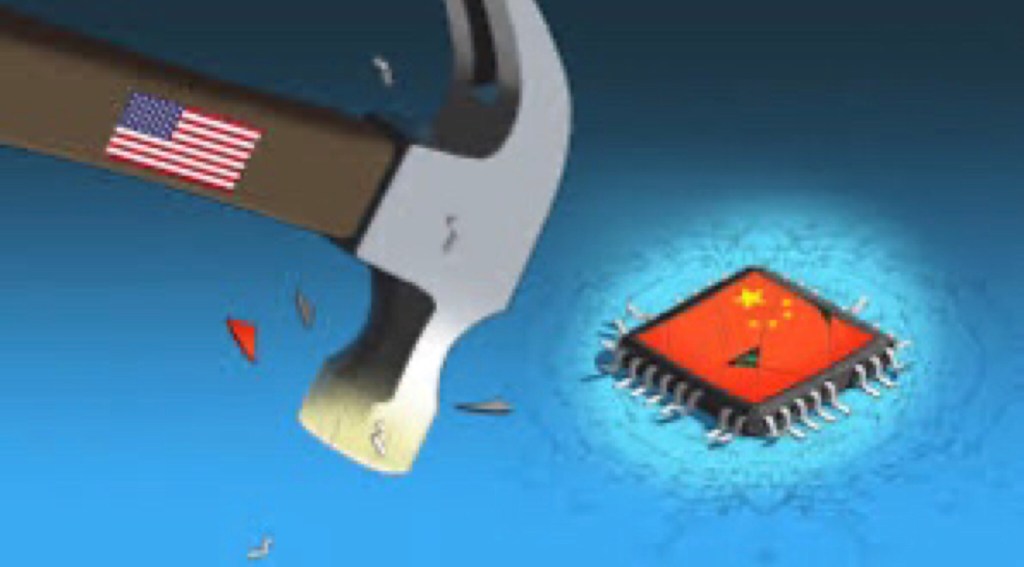
Immediately after President Xi leaves, new Tighter Chip sanctions against China start tomorrow. US could not be trusted. 習主席離開後,明天將對中國實施新的「更嚴格的籌碼」制裁。 美國是不可以信任的.
The NYT referred to the initial BIS Chip sanctions of 10/21/22 as “an act of war”, “a plan to extirpate root and branch China’s tech industry”, and compared it to the invasion of Ukraine. CSIS referred to this as “a 4-fold chokehold strangling with intent to kill”.
This pattern is repetitious. The first set of BIS sanctions came one week after the Bali Summit meeting between Xi and Biden on 10/14/22, during which Biden gave his reassurances he was not seeking to wage a cold war and not seeking to impede China’s development. Then immediately afterwards, the BIS sanctions against China kicked in.
United States Further Expands Restrictions on Exports of Advanced Computing Chips and Semiconductor Manufacturing Items to China
October 25, 2023
The Biden Administration has taken further steps to constrain Chinese access to advanced computing and artificial intelligence technology by refining and expanding existing export control rules restricting China’s access to U.S. semiconductors and related technologies. Building on measures implemented in October of 2022, the U.S. Commerce Department’s Bureau of Industry and Security (“BIS”) has imposed new controls on the export of advanced computing and semiconductor manufacturing items to China as well as transactions related to supercomputer end-uses in China. In announcing the new rule, Secretary of Commerce Gina M. Raimondo set out three goals: “working to protect our national security by restricting access to critical technology, vigilantly enforcing our rules, while minimizing any unintended impact on trade flows.” In keeping with these goals, the new measures demonstrate a determination to counter efforts to circumvent existing rules measures but also reflect careful consideration of input from U.S. industry to ensure that new restrictions do not stifle the vital U.S. semiconductor industry.
Notable Features of New Rules
The new rules are multi-faceted, complex and innovative, and most notably include the following:
Amended Controls for Restricted Chips Address Reported Work-Arounds: Responding to industry concerns, BIS adjusted the control parameters established in the October 2022 rule. A new “performance density” parameter is also designed to pre-empt design work arounds for companies that simply deploy larger numbers of lower performance chips.
Additional Destinations Subject to Restricted Chip Controls: Responding to reports of Chinese companies accessing data centers outside of China to use AI chips that cannot be exported to China, the rule expands licensing requirements to a number of countries, most notably in the Middle East.
Monitoring Exports: Recognizing that chip designers have responded to past measures by designing chips with performance just below restricted thresholds, the new rule requires the notification to BIS of exports for certain chips with performance just below the restricted levels. The rule also establishes more precise export clearance reporting requirements on certain chips.
Semiconductor Manufacturing Equipment: BIS expanded controls by adding new restrictions on existing types of equipment, and expanding the list of controlled destinations to all countries subject to a U.S. arms embargo.
Expanded Jurisdiction over Foreign-Made Lithography Equipment:
In an unprecedented assertion of jurisdiction over equipment made wholly outside the United States, the new rules establish a licensing requirement for certain lithography equipment with any U.S. content if that equipment is being used to develop or produce certain advanced node ICs. Such rules do not apply if the country making the lithography equipment has its own equivalent export controls.
End-Use Restrictions Based on Ownership: Reflecting a concern that companies based in allied countries that have parent companies in China (and other countries of concern) pose greater circumvention risk, BIS established new license requirements for certain IC technology destined for such entities.
The new rules are interim final rules published today in the Federal Register and are effective November 17, 2023.
U.S. export control policy is just one of several areas the United States is pursuing its ongoing economic and strategic competition with China. Through the CHIPS Act, the United States is incentivizing domestic production of semiconductors and conditioning the receipt of federal funding on restricting operations in China. In June, the Commerce Department issued its Final Rule on Securing the Information and Communications Technology and Services Supply Chain implementing the telecommunications supply chain restrictions established in Executive Orders 13873 and 14017, which restrict the use in the United States of foreign telecommunications technology that raises national security concerns. Taken together, these actions demonstrate that the United States continues to aggressively pursue a concerted strategy to decrease U.S. dependence on China, hinder China’s development of critical technologies, and maintain U.S. leadership in various advanced technologies
 Business Blog