Quickie summary of the very complicated Myanmar situation 緬甸局勢非常複雜的簡要概述 by KJ Noh 12/27/22
It is a civil war between the military government (the Tatmadaw; TMD/SAC; State Administrative Council), the NUG (the recently deposed Bamar civil government (from the US-sponsored NLD party) and its civilian militias), 20+ different armed ethnic groups (AEO’s) with constantly shifting alliances/coalitions/loyalties (and complex histories), intersecting with a variety of criminal enterprises and scams that are opportunistic, strategic, and inconsistent.
This civil war is the longest continuous one in modern history–75 years–and has its origins in the British colonization of the region. The British created an artificial, chimeric state, a patchwork of countries and ethnicities, in order to “divide and rule”. A charismatic anti-imperialist leader, Aung San, founded the communist party, united the different parties, and led the country towards national liberation. He was assassinated (most likely by MI6) in 1947 just as the country was achieving liberation. Aung San was a Patrice Lumumba-type character, and after he was assassinated the country devolved into chaos and Civil war. That has continued essentially to this day. This war also has a religious dimension (Buddhism, Islam, and Christianity)–the ruling ethnic groups under the British were converted to Christianity, and that has been a continuous source of conflict as well (including intra-religious fights and intra-ethnic fights).
A new development has been China’s recent pressure on Myanmar: military exercises on the border near Kokang state, support of certain AEO’s, direct pressure on the government, and even cross border raids and the issuing of arrest warrants.
This is unusual. China has had a strict, non-interventionist foreign policy since at least 1979. However, in the current moment, China’s key issue is the immense cross-border criminality: Myanmar has over 1250 miles (2000km) of border with China’s Yunnan province, and there is a huge crime problem where thousands of Chinese nationals have been kidnapped into slavery in Myanmar; some have been murdered.
As a result, China is trying to tamp down on this border crime: pornography, drug trafficking, sexual trafficking, human trafficking esp into phone scamming. A recent Chinese raid liberated 4500 Chinese nationals and the Chinese government has issued arrest warrants for the four Kokang crime families spearheading this crime. These crime syndicates usually involve phone scams run by criminal networks on the border with China: they kidnap Chinese (and other) Nationals and then force them to work as slaves in call-center scams under pressure of torture, beatings, sexual assault and murder. 120,000 people are estimated to be enslaved in these networks according to the UN. These syndicates are purported to have family connections to the TMD.
China has been trying to get the Burmese military government (SAC/TMD) to prevent this; when that was ineffectual, it has encouraged/supported the Nothern AEO’s (the Three brotherhood army (TBA: The Arakan Army, the MNDAA (Myanamr National Democratic Alliance Army, TNLA (Ta’Ang National Liberation Army) to smash the criminal gangs and to re-take control of the border (Operation 1027). (Prior to this, the three brotherhood alliance was not directly fighting the TMD). This has had the effect of showing the weakness of the TMD,with 80-200 bases overrun by the TBA; the TBA, the BPLA (Bamar People’s Liberation Army), other AEO’s, as well as the NUG, have tried to press this to their advantage for political leverage and gain.
China’s response has actually been to try to mediate peace between them: China wants stability and peace, especially on its border, not to pick winners, but the dynamic is complex and continually shifting.
This complex dynamic (political, strategic, ethno-religious, territorial, criminal) has led to varying actions and varying alliances between
1) border guard forces (usually corrupt) and the “four families”, allegedly responsible for the crime
2) the Myanmar military/SAC (which is fighting multiple AEO groups while opportunistically courting the Chinese)
3) multiple sets of alliances between various Armed ethnic groups.that are:
a) jockeying for influence and territory amongst themselves
b) fighting the military as well as sometimes each other–there is much more diversity than the MSM would have you believe (where the MSM protrays it as “valiant AEO’s all together fighting a despotic military coup government”–not all AEO’s are opposed to the coup; they saw the US-directed NLD as just as despotic–and genocidal–as the MIlitary government (with which they cohabited) and distrust the NUG (which the NLD became after the coup)
c) working with, and for, and sometimes against China (some of these groups are ethnically Chinese (such as the MNDAA) or pro-Chinese: Shan state AEO’s, the AA, the UWSA (the United Wa State Army, which is a de-facto liberated state and has been described as the “quartermaster for the Northern AEO’s”).
To complicate the picture further, there is a geopolitical dimension involved. Burma aboards China with its longest contiguous border, and the US has been trying to encircle and destabilize China for at least a decade now.
This encirclement (“the Pivot to Asia”, declared in 2011 by Obama) involves creating a chain of (300+) bases and a wall of offensive missiles all along the Chinese coast to contain and choke out China. This “first island chain” stretches from Japan-Korea (Jeju Island)-Okinawa/Ryukyu islands-Taiwan Island -Philippines-Malaysia-Singapore-Indonesia* to create an almost perfect noose. TW is the dead center of this chain and the closest point to China, and it also guards the two exit and entry gates of this encirclement, the Bashi Channel and Miyako straits, which is why the Chinese consider it “a core interest”.
(*Malaysia, Singapore, Indonesia do not have formal bases, but base-leasing or port-use agreements; Japan, Okinawa, Korea, are sinking from the weight of US bases; Philippines has 9, with Subic Bay soon to come back online. Japan (and soon S. Korea) have space force bases. All of them rehearse combined arms joint operations with the US military and NATO is planning to establish a joint operations liaison base in Japan next year)
The key doctrine of war against China (“AirSea Battle”, started in 2009 under Obama, derived originally from AirLand Battle, the war doctrine against the USSR, itself derived from the Yom Kippur war) involves deep strategic strikes within China while blockading and choking off all commercial traffic in the South China Sea, in particular through the Malacca straits. Over $5 Trillion dollars worth of Chinese trade and 70% of China’s oil moves through the SCS. RAND’s wargaming has shown that a shooting war in the SCS–regardless of whether the US wins or not–would result in a 25%-35% reduction of China’s economy; the assumption being that this would create catastrophic pressure on China’s leadership, possibly enough to bring down the government. RAND says that this must be done before 2025, before China becomes powerful enough to resist this.
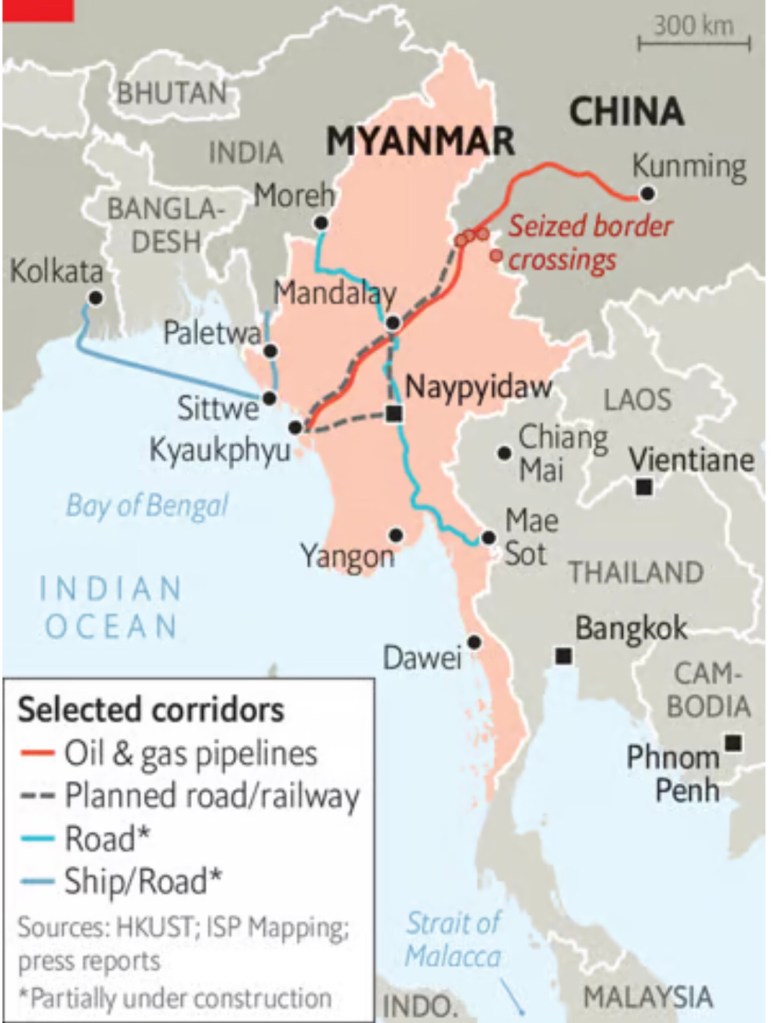
Not well understood, the BRI (The Belt and Road Initiative) is not simply an Asia-wide infrastructural development plan. It was originally conceived as a series of overland routes to bypass this maritime encirclement in the SCS, by following the ancient Silk roads that predated it. Key to this, China has BRI (Belt and Road Initiative) construction in Myanmar–a $35B investment–in particular the Kyaukpyu port and key China-Myanmar logistical infrastructure. This is called the CMEC (China-Myanmar Economic Corridor). This is one of the most critical nodes of the BRI in that it is the first node to bypass the Malacca straits/SCS and release traffic into the Indian Ocean without being subject to strangulation at the Malacca straits.
image.png
On the other hand, the US wants to increase chaos and disruption and prevent the completion of the CMEC arm of the BRI–that would undermine this encirclement. Chaos in Myanmar and a government hostile to China is therefore to its advantage: it wants to disrupt the BRI as well as create harassment and instability for China along its border.
This is also true for the other key leg of the BRI, the CPEC (China-Pakistan Economic Corridor) , actually the first leg of the BRI built. This has seen direct attacks on infrastructure in the Balochistan area, as well as terror assassinations of dozens of Chinese civil engineers. It has also suffered a recent coup that former president Imran Khan has blamed on the US. The recent anti-Chinese/anti-BRI messaging out of Balochistan also strongly suggests US involvement.
A key fact to remember is that the US waged low-intensity border wars on China continuously for decades (1949-1978), directed by the reactionary anti-Communist KMT government that it installed on Taiwan Island. In particular, the KMT used parts of Myanmar as its frontline border to attack China—the Korean war can actually be seen as a two front war against China to roll back the CPC (from both Myanmar and Korea). This was done at the time, using ROC/KMT militias enmeshed with the AEO’s in Myanmar.
After the US normalized relations with China, the CIA flew the leadership of these KMT combatants back to TW, but it has never given up its intense meddling in Myanmar. The decades-long, drug-fueled anti-China dirty war was financed by the production and trafficking of heroin (and later Meth) from this area — the so-called “golden triangle”, and directed from TW province. Contemporaneously, the ROC/TW government, through the WACL (World Anti-Communist League) also subcontracted US dirty wars in Latin America (wars too dirty to be put on the CIA payroll), for example, training the death squad leaders of El Salvador and running dirty wars in Nicaragua. Iran-Contra was also run out of TW through the WACL (Major General John K. Singlaub).
Empire is a sordid business with many pots cooking and stirring at once. It was certain that the US was involved in Myanmar up until the time of the recent coup–ASSK and the NLD were a US favorites/proxies, until they weren’t–so it would be a surprise if it were not still involved. US geostrategic interests and the US influence are not likely to remove themselves in clean break, just because of a coup.
Last but not least, there is also a economic/resource struggle involved among the various parties–teak, oil, strategic precious metals, to compound the political, territorial, and ethno-religious conflicts,
As I said, it’s very complicated.
 Business Blog