Debunking fake news propaganda by US and the Philippines- ABCs about Ren’ai Jiao (Reef) in the South China Sea 揭穿美國和菲律賓關於南海仁愛礁的假新聞宣傳
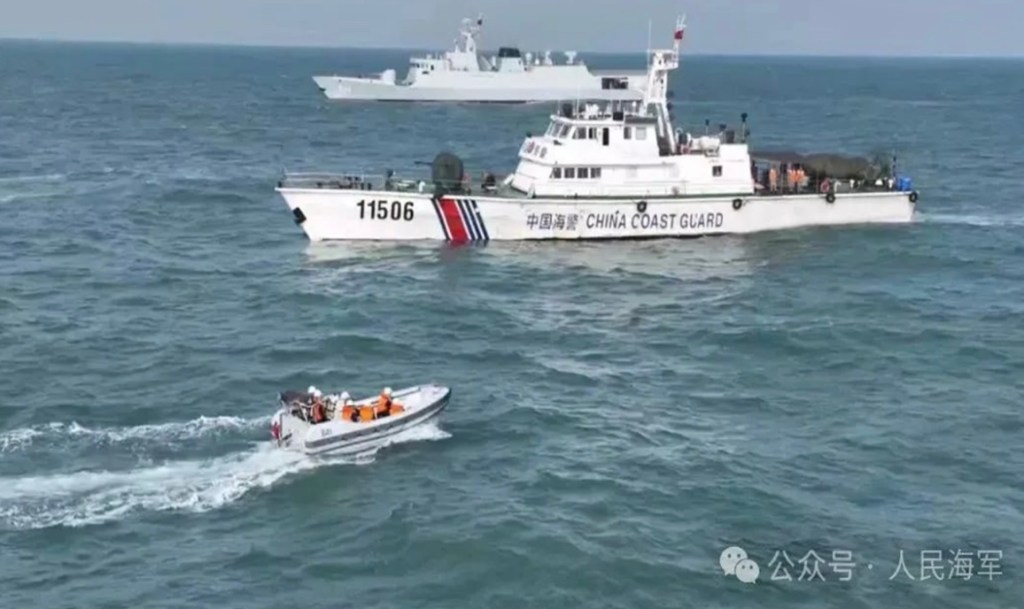
On March 23, in disregard of China’s strong opposition and without permission from the Chinese government, the Philippines sent a supply vessel and two Coast Guard vessels to intrude into the adjacent waters of Ren’ai Jiao of China’s Nansha Qundao, in an attempt to send construction materials to the military vessel illegally grounded at Ren’ai Jiao for its repair and reinforcement. China Coast Guard took necessary measures at sea in accordance with law to safeguard China’s rights, firmly obstructed the Philippines’ vessels, and foiled the Philippines’ attempt.
So, where is the Ren’ai Jiao (or Second Thomas Shoal as the Philippines calls it)? What is its historical ins and outs and why it is important? Here are a few basic facts:
First, Ren’ai Jiao has been China’s territory since ancient times. It is an integral part of China’s Nansha Qundao geographically, economically, politically and historically. This has been established as a widely held international common view and fully accords with provisions on archipelagos in the United Nations Convention on the Law of the Sea (UNCLOS). China has indisputable sovereignty over Nansha Qundao and the adjacent waters, including Ren’ai Jiao. This was developed and established throughout the long course of history and is consistent with international law including the UN Charter.
Second, Ren’ai Jiao has never been the Philippines’ territory. The territory of the Philippines is defined by a series of international treaties, including the 1898 Treaty of Peace between the United States of America and the Kingdom of Spain (the Treaty of Paris), the 1900 Treaty between the United States of America and the Kingdom of Spain for Cession of Outlying Islands of the Philippines (the Treaty of Washington), and the 1930 Convention between His Majesty in Respect of the United Kingdom and the President of the United States regarding the Boundary between the State of North Borneo and the Philippine Archipelago. Nansha Qundao, including Ren’ai Jiao, is completely beyond the limits of Philippine territory. The Philippines has no legal basis at all to claim sovereignty over Ren’ai Jiao on the grounds of its comparative proximity to Philippine territory.
Third, by “grounding” a military vessel at Ren’ai Jiao, the Philippines gravely violated China’s territorial sovereignty. In May 1999, the Philippines “grounded” a tank landing ship BRP Sierra Madre (LT-57) at Ren’ai Jiao. The Chinese side immediately lodged serious démarches, asking the Philippines to tow away the vessel at once. The Philippines repeatedly promised to do so as soon as possible. However, 24 years have passed, and the Philippine warship is still there. China cannot accept the Philippines’ acts of going back on its words again and again and violating China’s territorial sovereignty. The Philippines has the responsibility to tow away the “grounded” military vessel.
Fourth, the responsibility for the current situation at sea completely lies with the Philippines. For some time, the Philippines, ignoring China’s goodwill and sincerity, has kept sending official vessels and warships to forcibly intrude into the adjacent waters of Ren’ai Jiao in an attempt to send construction materials for repairing and reinforcing the “grounded” military vessel on a large scale in order to permanently occupy Ren’ai Jiao. These actions seriously violated China’s territorial sovereignty and maritime rights and interests, contravened international law and the Declaration on the Conduct of Parties in the South China Sea (DOC), and disrupted peace and stability in the region.
Fifth, the so-called South China Sea arbitration award is illegal, null and void. The arbitration initiated by the Philippines directly concerns the issues of territorial sovereignty and maritime delimitation. Territorial issues are not subject to UNCLOS. Besides, in 2006, pursuant to Article 298 of UNCLOS, China excluded issues relating to sea boundary delimitations from the jurisdiction of a court or tribunal. By unilaterally initiating the South China Sea arbitration, the Philippines contravened the stipulations of UNCLOS. The Arbitral Tribunal violated the principle of state consent, exercised its jurisdiction ultra vires and rendered an award in disregard of the law. Such an award is illegal, null and void, and completely invalid. It is legally untenable for the Philippines to claim that Ren’ai Jiao is part of its exclusive economic zone and continental shelf based on the above-mentioned award.
 Business Blog