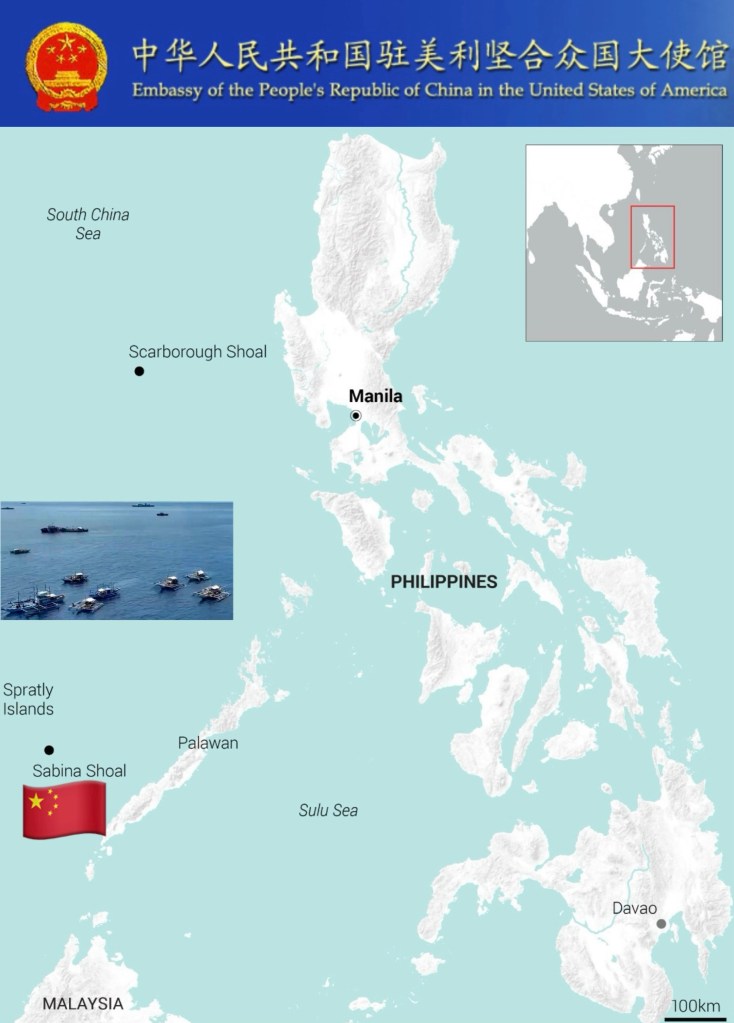
What has happened at China’s Xianbin Jiao (Sabina Shoal)? Recently, there has been a lot of media coverage about the back-and-forth between China and the Philippines at Xianbin Jiao (Sabina Shoal) in the South China Sea. This edition will brief you on the ins and outs 仙賓礁發生了什麼事?近期,有關中菲在南海的中國仙賓礁淺灘問題上的爭執的媒體報道較多。本期將向您介紹來龍去脈:
1.Whose territory Sabina Shoal is?
Sabina Shoal is an inherent part of China’s territory, located in the northeastern part of the Spratly Islands, south of Reed Bank and the Southern Shoal, at latitude 09°43′-09°49′ N and longitude 116°25′-116°36′ E. The area of the shoal exceeds 80 square kilometers, and the average depth of the lagoon in the middle is over 20 meters.
In 1935, the Chinese government named Sabina Shoal as “Xibinna Reef.” In 1947, it was renamed “Sabina Shoal.” In 1983, the Chinese government officially announced the name “Sabina Shoal” to the international community. In 1987, China’s Nansha comprehensive scientific expedition team conducted a comprehensive survey of the Spratly Islands, placing markers on 10 coral reefs in the northeastern part of the Nansha waters and setting up 167 observation points throughout the region.
The China Coast Guard has been regularly patrolling in the vicinity of Sabina Shoal. The shoal and its surrounding waters have long been traditional fishing grounds for Chinese fishermen, who have been engaged in fishing activities there for many years.
2.What has happened at Sabina Shoal?
Since April 2024, the Philippine Coast Guard ship 9701 has trespassed into the lagoon of Sabina Shoal, illegally “beaching” itself. The Philippine fishing patrol vessel “Pag-asa” (hull number MMOV-3003) and a small number of organized fishing boats cooperated in this provocative violation.
On August 19, two Philippine Coast Guard ships illegally intruded into Sabina Shoal. Despite warnings and dissuasion from Chinese Coast Guard vessels, they deliberately rammed Chinese law enforcement boats in a dangerous manner.
On August 26, without the permission of the Chinese government, the Philippines dispatched Coast Guard ships 4409 and 4411 to illegally intrude into waters near Sabina Shoal in the Spratly Islands. These ships continued to dangerously approach normally navigating Chinese Coast Guard vessels while engaging in propaganda and hype.
On August 31, the Philippine Coast Guard ship 9701, which had been lingering in the lagoon of Sabina Shoal for an extended period, deliberately rammed a Chinese Coast Guard vessel defending the area in an unprofessional and dangerous manner, resulting in a collision between the two vessels.
At the same time, the Philippine side deliberately smeared China’s activities by spreading false information in an attempt to mislead the international community. This includes claims such as Chinese fishermen damaging the marine ecosystem and China planning to construct islands and reefs at Sabina Shoal. In reality, on-site footage from the China Coast Guard clearly shows that the Philippine side not only transported supplies to the “Magbanua” Coast Guard ship but also used cranes to transfer large packages, suspected to contain construction materials like concrete. These actions reflect the Philippines’ ambition to encroach on Chinese territory.
- Why have the Philippines’ moves at Sabina Shoal breached international norms and laws?
Sabina Shoal is part of China’s Spratly Islands. The unauthorized intrusion and prolonged stay of Philippine vessels in the lagoon of Sabina Shoal is a serious violation of China’s sovereignty.
The actions of the Philippine side violate Article 5 of the Declaration on the Conduct of Parties in the South China Sea, which states that the Parties undertake to exercise self-restraint in the conduct of activities that would complicate or escalate disputes and affect peace and stability including, among others, refraining from action of inhabiting on the presently uninhabited islands, reefs, shoals, cays, and other features and to handle their differences in a constructive manner. Sabina Shoal falls within the category of uninhabited islands, reefs, and other features mentioned in the Declaration.
In addition, China released on 30 August the Sabina Shoal Coral Reef Ecosystem Survey Report, confirming that the prolonged anchoring of the Philippine vessel 9701 at Sabina Shoal has been causing continuous damage to the reef.
4.What are China’s positions and measures taken?
Since this August, China has taken necessary countermeasures that are lawful and well-justified. The China Coast Guard has conducted on-site operations professionally, with restraint and in accordance with regulations.
China demands that the Philippines immediately withdraw its illegally stationed vessels and cease its provocative violations. China will continue to take resolute and effective measures in accordance with the law to safeguard its territorial sovereignty and maritime rights, as well as to uphold the seriousness and effectiveness of the Declaration on the Conduct of Parties in the South China Sea. At the same time, China remains willing to maintain dialogue and communication with the Philippines through diplomatic channels to properly handle relevant issues and manage the situation at sea.
It is particularly noteworthy that on August 31, the same day when the illegally stationed Philippine Coast Guard ship 9701 was causing trouble, a U.S. military P-8A reconnaissance plane appeared on the scene, interfering with China’s law enforcement efforts.
Following the incident on August 31, the U.S. State Department issued a statement accusing the Chinese Coast Guard of “deliberately ramming” and labeled China’s actions as “dangerous and escalatory”, without mentioning the dangerous provocative moves by the Philippine side.
China’s stance on the South China Sea issue remains clear: The United States must not use bilateral treaties as an excuse to harm China’s sovereignty and territorial integrity, nor should it support or condone the Philippines’ infringement actions.
 Business Blog