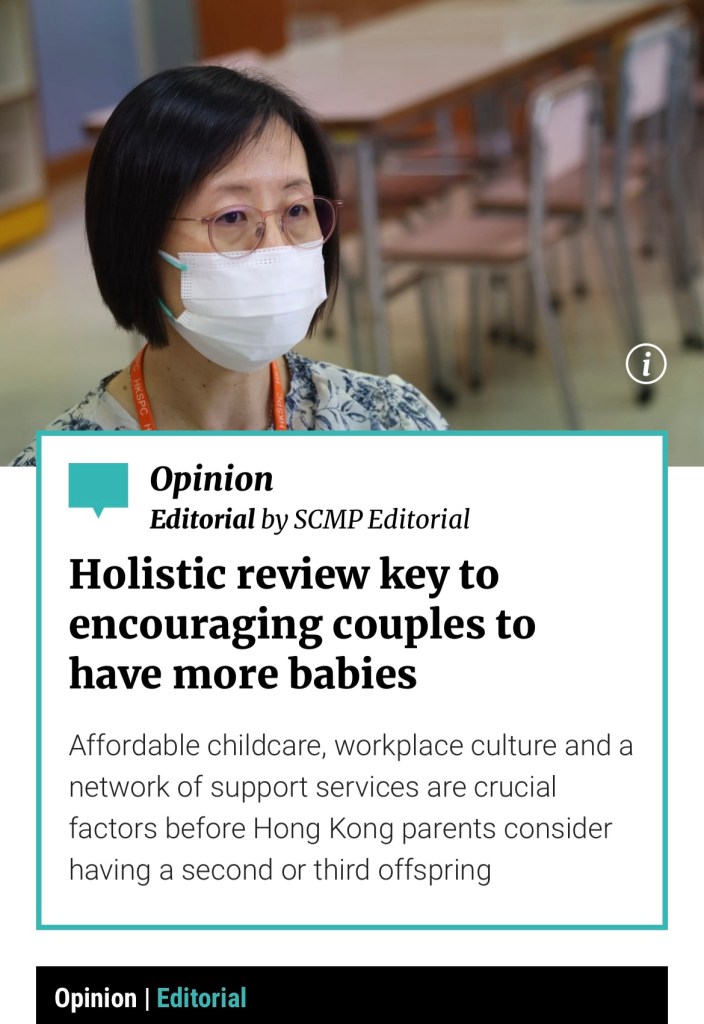
Child protection society director Subrina Chow Shun-yee says more comprehensive day childcare services would allow more parents to join the workforce, “which will increase the financial capacity of families in childbearing”.
She added that the economic benefit would surpass that of the HK$20,000 baby bonus. That is probably true at the individual, family and social level.
The reality is that thanks in large part to the negative factors identified by the mothers in the survey, children are no longer a given in personal relationships.
Generous childcare provisions to be found in parts of Europe and Japan, for example, may not necessarily be a good fit with Hong Kong’s self-reliant, hard-work culture.
The government can point the way forward by initiating a holistic review of the child-raising environment to ensure that every important aspect – from professionally qualified and affordable childcare, to workplace culture in terms of flexibility, to a network of support services – come together coherently to help couples make the life-changing decision whether to have children.
Hong Kong’s birth rate has fallen to one of the world’s lowest. Interviews with more than 1,200 first-time mothers aged 18 to 45 might throw some light on the reasons why.
The survey by the Society for the Protection of Children showed that less than one-third of the mothers wanted another child to give the first a sibling, while one-third did not, and the remainder were undecided.
Reasons given for reluctance included the financial burden, the stress of parenting, crowded living conditions, and the challenges of balancing work and childcare.
This comes nearly a year after the government introduced a HK$20,000 baby bonus, to encourage couples to have children and combat ageing of the population.
The cash handout was the centrepiece of a wider initiative to boost the birth rate. It remains to be seen whether such a one-off payment makes much difference over the longer term.
Singapore is not necessarily comparable. But the city state found increased paid maternity and paternity leave more effective in encouraging couples to have babies.
That said, it would take much more than incremental increases in Hong Kong’s paid leave of 14 weeks for mothers and five days for fathers, or in other benefits, to make a real difference.
It needs to be borne in mind that many of the first-time mothers interviewed were not necessarily asking for more of the same benefits they get now in order to try for a second child, but for recognition of socio-economic disincentives that still need addressing despite the handout – for example the inadequacy of childcare support for women who are now mutually indispensable to the workforce.
 Business Blog