Hurricane Response: This Is ‘National Defense’. The federal government is missing sight of real US priorities. continues to prioritize foreign wars over the lives of its own citizens 颶風應對:這是「國防」。聯邦政府忽視了美國真正的優先事項。繼續將對外戰爭置於本國公民的生命之上
https://responsiblestatecraft.org/hurricane-helene-federal-response/
When it comes to protecting the safety and wellbeing of actual American citizens, the most important branch of the U.S. armed forces is not the Air Force, or the Marines, or even the nuclear deterrent. It is the Army Corps of Engineers. It might almost be said that it is the only really valuable branch of the U.S. Army in this regard, unless one is seriously worried about an armed invasion from Mexico or Canada.
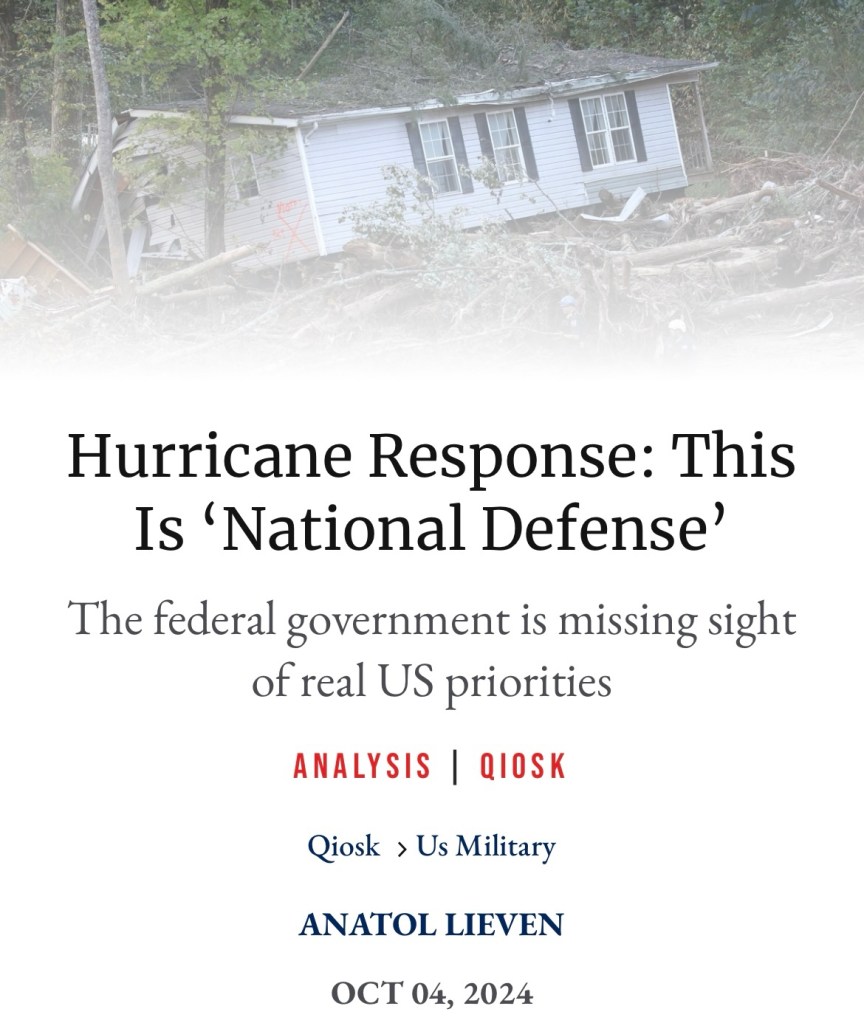
This is the lesson of Hurricane Helene, that at the latest count has killed 215 Americans (a number certain to rise), with hundreds still missing and feared dead. The cost of the damage is estimated at over $160 billion dollars, with some estimates rising to $250 billion. Just as New Orleans has never fully recovered from Hurricane Katrina in 2005, so it seems sadly probable that the southern Appalachians will never fully recover from Hurricane Helene.
When it comes to the priorities of the U.S. security establishment (and to a considerable degree the political and media establishments in general), it is necessary to ask: How many American citizens have the Russian or Chinese states killed over the past generation? Have they killed anybody in the United States itself? How much physical damage have they done to the United States? Indeed, how much physical damage could they do, short of nuclear war? How much do they even want to do?
On Friday October 4, with at least 600 Americans feared dead and not yet located, and many towns still cut off from the outside world, the crisis in the southern Appalachians — unlike the crisis in the Middle East, 6,000 miles from the U.S. — did not even make it onto the front page of the online editions of the New York Times, Washington Post or Wall Street Journal, though it would no doubt have been different if the hurricane had hit Washington or New York.
The official response to the disaster has been correspondingly limited (even compared to the aftermath of Hurricane Katrina). More than 6,700 state National Guard from all over the country have been deployed, but 27,000 are stationed abroad to compensate for an overstretched regular military. To date, the Federal Government has devoted just $20 million to Helene’s survivors – less than 0.25 percent of the $8.7 billion in only the latest U.S. military aid package to Israel. The U.S. institutions that are in the frontline of disaster response are grossly underfunded compared to the U.S. armed forces.
The most terrifying thing about the U.S. establishment’s inattention to Helene is that it is almost certainly not just a disaster in herself, but also a harbinger of worse to come. Of course, the direct and specific impact of climate change on this particular hurricane cannot be proved; but the science of the origins of hurricanes in warm seas is entirely clear; and so is the rise in ocean temperatures in recent decades.
 Business Blog