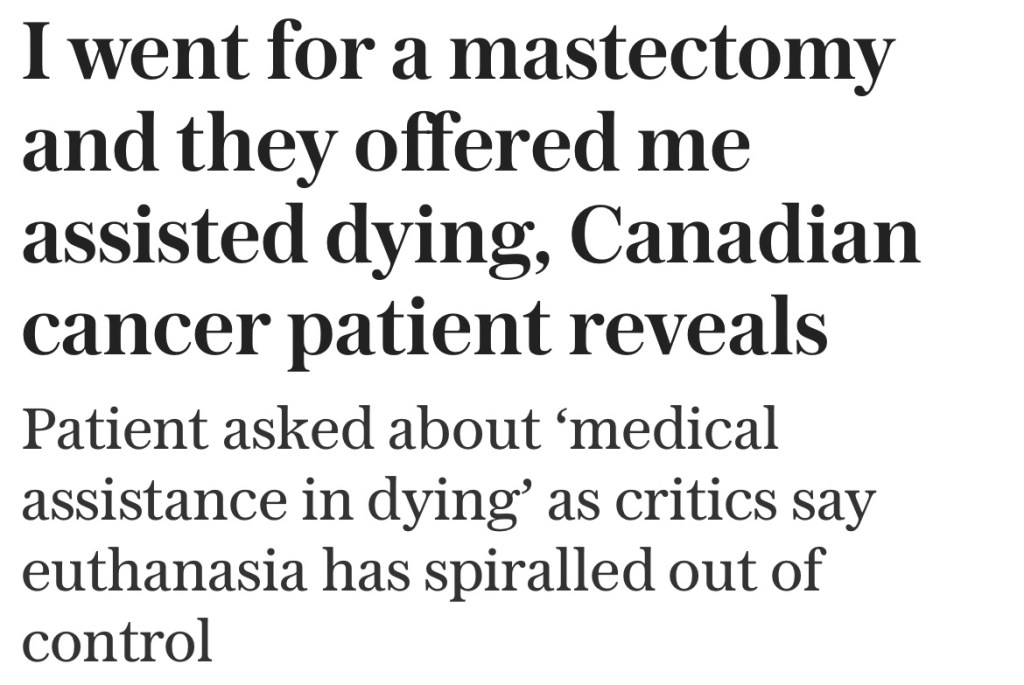
Canadians turning to Euthanasia as solution to unbearable poverty. New poll shows that 1/3 of Canadians approve of Euthanizing the poor 加拿大人轉向安樂死來解決難以忍受的貧困。新民調顯示1/3的加拿大人贊成對窮人實施安樂死. 加拿大多年來是美國一條狗,七成經濟要看美國老闆的面色,美國現正走入未路,你認為美國會讓加拿大好過嗎?
https://archive.is/169pS
https://nationalpost.com/news/canada/canada-maid-assisted-suicide-homeless#comments
One third of Canadians are apparently fine with prescribing assisting suicide for no other reason than the fact that the patient is poor or homeless.
The results were contained in a recent Research Co. poll probing just how comfortable Canadians were with the current state of the country’s MAID (medical assistance in dying) regime.
Starting in March 2021, Canada became one of only a handful of countries to legalize assisted suicide even in instances where a patient does not have a terminal illness. Ever since, a Canadian can be approved for MAID simply for having a “grievous and irremediable medical condition.”
Research Co. found that 73 per cent of poll respondents favoured the current regime, and only 16 per cent opposed it.
Pollsters also found not-insignificant numbers of Canadians who favoured assisted suicide in cases where no medical condition of any kind was present.
If a Canadian’s only affliction was “poverty,” 27 per cent said they would be fine with legalizing that person’s access to MAID. Another 28 per cent pegged “homelessness” as an appropriate bar to qualify for MAID.
Interview with soon-to-be homeless man who has requested MAID
https://apnews.com/article/covid-science-health-toronto-7c631558a457188d2bd2b5cfd360a867
— Belgian doctors are advised to avoid mentioning euthanasia to patients since it could be misinterpreted as medical advice. The Australian state of Victoria forbids doctors from raising euthanasia with patients. There are no such restrictions in Canada. The association of Canadian health professionals who provide euthanasia tells physicians and nurses to inform patients if they might qualify to be killed, as one of their possible “clinical care options.”
— Canadian patients are not required to have exhausted all treatment alternatives before seeking euthanasia, as is the case in Belgium and the Netherlands.
Euthanasia “cannot be a default for Canada’s failure to fulfill its human rights obligations,” said Marie-Claude Landry, the head of its Human Rights Commission.
Landry said she shares the “grave concern” voiced last year by three U.N. human rights experts, who wrote that Canada’s euthanasia law appeared to violate the agency’s Universal Declaration of Human Rights. They said the law had a “discriminatory impact” on disabled people and was inconsistent with Canada’s obligations to uphold international human rights standards.
Tim Stainton, director of the Canadian Institute for Inclusion and Citizenship at the University of British Columbia, described Canada’s law as “probably the biggest existential threat to disabled people since the Nazis’ program in Germany in the 1930s.”
Frazee cited the case of Candice Lewis, a 25-year-old woman who has cerebral palsy and spina bifida. Lewis’ mother, Sheila Elson, took her to an emergency room in Newfoundland five years ago. During her hospital stay, a doctor said Lewis was a candidate for euthanasia and that if her mother chose not to pursue it, that would be “selfish,” Elson told the Canadian Broadcasting Corporation.
Roger Foley, who has a degenerative brain disorder and is hospitalized in London, Ontario, was so alarmed by staffers mentioning euthanasia that he began secretly recording some of their conversations.
In one recording obtained by the AP, the hospital’s director of ethics told Foley that for him to remain in the hospital, it would cost “north of $1,500 a day.” Foley replied that mentioning fees felt like coercion and asked what plan there was for his long-term care.
“Roger, this is not my show,” the ethicist responded. “My piece of this was to talk to you, (to see) if you had an interest in assisted dying.”
Foley said he had never previously mentioned euthanasia. The hospital says there is no prohibition on staff raising the issue.
Some disabled Canadians have decided to be killed in the face of mounting bills.
Before being euthanized in August 2019 at age 41, Sean Tagert struggled to get the 24-hour-a-day care he needed. The government provided Tagert, who had Lou Gehrig’s disease, with 16 hours of daily care at his home in Powell River, British Columbia. He spent about 264 Canadian dollars ($206) a day to pay coverage during the other eight hours.
Health authorities proposed that Tagert move to an institution, but he refused, saying he would be too far from his young son. He called the suggestion “a death sentence” in an interview with the Canadian Broadcasting Corporation.
Before his death, Tagert had raised more than CA$16,000 ($12,400) to buy specialized medical equipment he needed to live at home with caretakers. But it still wasn’t enough.
“I know I’m asking for change,” Tagert wrote in a Facebook post before his death. “I just didn’t realize that was an unacceptable thing to do.”
https://www.ctvnews.ca/politics/paralympian-trying-to-get-wheelchair-ramp-says-veterans-affairs-employee-offered-her-assisted-dying-1.6179325
https://archive.is/A0eR0
 Business Blog