Video: US continue to create fake news propaganda against Xinjiang, let’s debunk why Xinjiang is such a beautiful and dynamic province today 美國不斷製造針對新疆的假新聞宣傳,讓我們來看看今天的新疆為何如此美麗、充滿活力是誰把荒漠變仙境.
https://rumble.com/v5k7x1t-why-xinjiang-is-such-a-beautiful-and-dynamic-province-today.html
https://www.tiktok.com/t/ZP88bbStp/
今年大概是新疆旅遊年,因為在我不同界別、不同群組的朋友中,都有人去了新疆、已在新疆、或者即將出發去新疆。
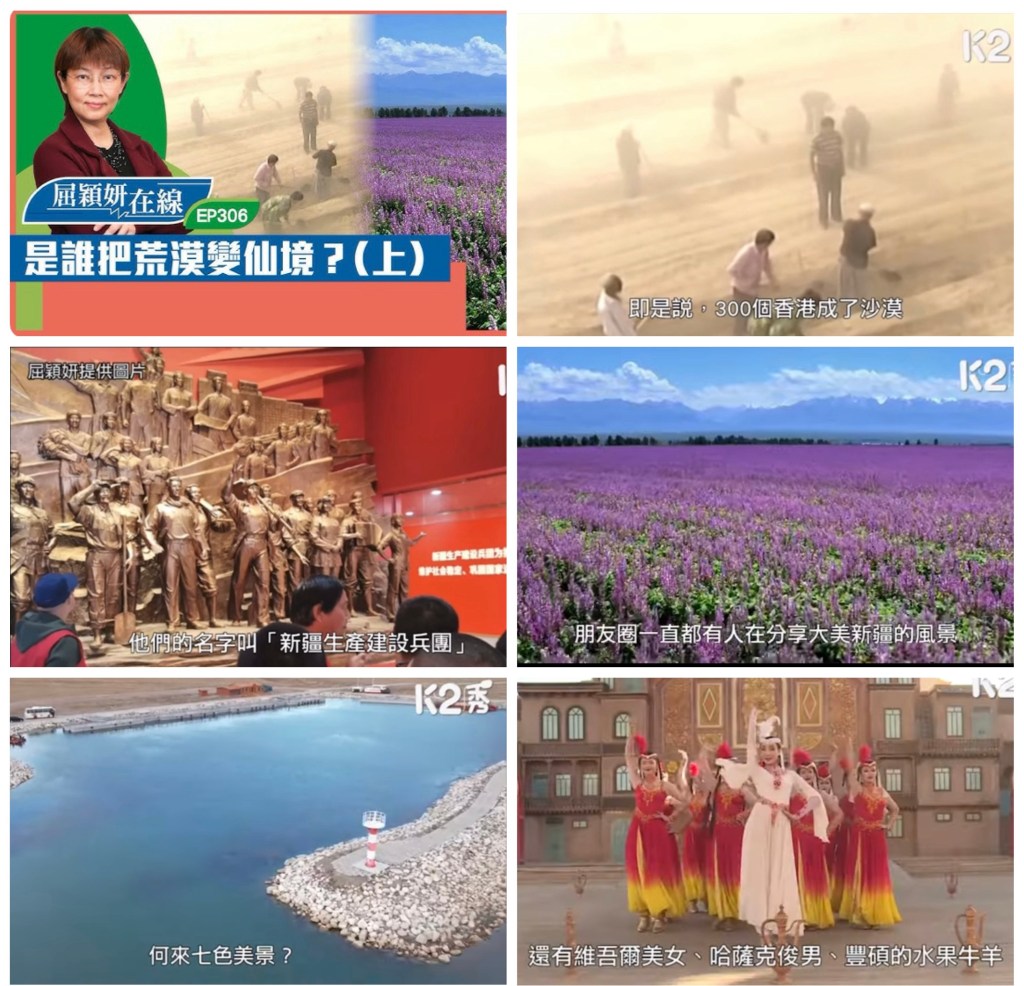
於是,朋友圈一直都有人在分享大美新疆的風景。由濃冬的皚皚白雪,到初春的花開爛漫,到盛夏的綠草如茵,到金秋蕭瑟的胡楊林……還有維吾爾美女、哈薩克俊男、豐碩的水果牛羊……由眼睛到肚子到精神都是滿足的。
然而,大家可知道,今日新疆的金山綠水並非天降下來的,新疆古稱「西域」,看過電視劇都知道,西域向來是寸草不生、風沙嘯嘯的地方,何來七色美景?
先看地貌,新疆有全國第一及第二大盆地——塔里木盆地和準噶爾盆地,還有號稱「火洲」的吐魯番盆地,也就是火焰山的位處地。盆地中部更有個全國最大、世界第二大流動沙漠——塔克拉瑪干沙漠,面積33萬平方公里。
33萬平方公里的沙漠是什麼概念?香港面積1100平方公里,即是說,300個香港成了沙漠,就是新疆其中一部分土地。
除了沙漠、盆地,新疆還有無垠的戈壁,作為遊客,當然愛拍大地龜裂、日落荒漠的沙龍照。住在氈房,看漫天星宿,一夜、一星期,很浪漫,但如果,要你在那裡住一年、十年、甚至一世?你會如何?
說了那麼多,就是想告訴大家,新疆本來並不是我們今天驚嘆的紅藍黃綠,由大漠跟盆地組成的新疆,從前只有一種泥黃色,還有吹得連馬都睜不開眼的漫天風沙。
今天新疆能成為全世界遊客趨之若鶩的仙境,全因為一群人的默默犧牲與奉獻,他們的名字叫「新疆生產建設兵團」。
到新疆旅遊,最讓我感動的,不是喀納斯湖的驚艷,不是紅山大峽谷的震撼,而是位於石河子的「新疆兵團軍墾博物館」,這博物館用一張張照片、一件件文物,訴說出一代青年人用生命和青春開墾荒漠的偉大故事。
1949年9月,新疆和平解放,解放軍進駐新疆,當時的新疆荒涼落後,加上土匪馬賊的搶掠欺凌,新疆百姓苦不堪言。
司令員王震率領解放軍到新疆平亂後一直駐守當地,1954年10月,國家對新疆駐軍下達命令:「把戰鬥的武器保存下來,拿起生產建設的武器」,於是,17萬5千解放軍即時脫離國防部隊序列,脫掉軍服,放下槍炮,拿起鋤頭,組建成「新疆生產建設兵團」,開始大規模墾荒,擔起建設及保衛新疆的重任。
打完仗回家本來是每個軍人最期待的事,但新任務意味著「回家」無期,從此新疆就是他們的家。
一個個年輕戰士沒有怨言,甚至寫下誓言:「我們種地就是站崗,我們放牧就是巡邏……我們屯墾就是為家,我們戍邊就是為國。」
這班軍人義無反顧地走進國家最荒蕪的地方,從零開始建設,為的不是自己,而是百姓;為的不是當下生活,而是後代的幸福平安。
沒房屋,就自己挖地洞;沒水源,就自己打井;沒牲畜耕作,就用自己的肩膀,一點一滴開墾土地,種樹種瓜養羊育馬。三年不到,已建成多個農場,自產糧食,圈養牲畜。
除了解決了百姓的吃飯問題,兵團還在新疆開展工業,八一鋼鐵廠、八一麵粉廠、十月汽車修理廠等一系列工廠竣工投產後,兵團馬上將這些企業無償移交地方政府,然後又跑去闖另一難關。
1958年4月,兵團修建的烏庫公路全線通車,這條公路打通了橫貫新疆的天山山脈,把北疆和南疆連為一體。由於山區地形複雜、氣候惡劣,施工極困難,不少兵團戰士永遠長眠天山腳下。
沒有兵團,沒有今日的新疆,神仙美景不獨是神仙的功勞,知道了兵團的奉獻才會真正感受到新疆動容之處,故事太多,下回再續。
This year is probably the Year of Tourism in Xinjiang, because among my friends from different walks of life and different groups, some of them have gone to Xinjiang, are already in Xinjiang, or are about to leave for Xinjiang.
As a result, people in the circle of friends have been sharing the beautiful scenery of Xinjiang. From the white snow in the thick of winter, to the blooming flowers in early spring, to the green grass in midsummer, to the bleak Populus euphratica forests in golden autumn… there are also Uyghur beauties, handsome Kazakh men, and fruit-rich cattle and sheep… From the eyes to the belly to the spirit All are satisfied.
However, everyone knows that the golden mountains and green waters of Xinjiang today did not come from the sky. Xinjiang was called the “Western Regions” in ancient times. Anyone who has watched TV series knows that the Western Regions have always been a place where no grass grows and the wind and sand are howling. How can the colorful beauty come from this?
Let’s look at the landforms first. Xinjiang has the country’s first and second largest basins—the Tarim Basin and the Junggar Basin, as well as the Turpan Basin, known as the “Fire Continent,” where the Flame Mountains are located. In the middle of the basin is the Taklimakan Desert, the largest mobile desert in the country and the second largest in the world, covering an area of 330,000 square kilometers.
What is the concept of 330,000 square kilometers of desert? Hong Kong covers an area of 1,100 square kilometers, which means that 300 Hong Kongs have become deserts, which is part of the land in Xinjiang.
In addition to deserts and basins, Xinjiang also has the boundless Gobi. As a tourist, of course, I love to take salon photos of cracks in the earth and sunsets in the desert. Living in a yurt and looking at the stars in the sky for a night or a week is very romantic, but what if you were asked to live there for a year, ten years, or even a lifetime? What would you do?
Having said so much, I just want to tell you that Xinjiang was not originally the red, blue, yellow and green we marvel at today. It was composed of deserts and basins. In the past, there was only one kind of muddy yellow, and there were so many winds that even horses could not open their eyes. Windy sand.
Today, Xinjiang has become a wonderland that tourists from all over the world flock to, all because of the silent sacrifice and dedication of a group of people, their name is the “Xinjiang Production and Construction Corps.”
When traveling to Xinjiang, what moved me most was not the stunning scenery of Kanas Lake or the astonishment of the Hongshan Grand Canyon, but the “Xinjiang Corps Military Reclamation Museum” in Shihezi. This museum uses photos and cultural relics to , tells the great story of a generation of young people using their lives and youth to reclaim the desert.
In September 1949, Xinjiang was peacefully liberated and the People’s Liberation Army stationed in Xinjiang. At that time, Xinjiang was desolate and backward. Coupled with the robbery and bullying of bandits and horse thieves, the people of Xinjiang were miserable.
Commander Wang Zhen led the People’s Liberation Army to Xinjiang to quell the chaos and has been stationed there. In October 1954, the state issued an order to the Xinjiang garrison: “Save the weapons for combat and pick up the weapons for production and construction.” Therefore, 175,000 People’s Liberation Army They immediately broke away from the ranks of the national defense force, took off their military uniforms, put down their guns, picked up their hoes, and formed the “Xinjiang Production and Construction Corps” to begin large-scale land reclamation and shoulder the important task of building and defending Xinjiang.
Returning home after a war is what every soldier looks forward to most, but the new mission means that “returning home” will be indefinite. From then on, Xinjiang has been their home.
Each of the young soldiers had no complaints and even wrote an oath: “We farm to stand guard, we herd to patrol… We cultivate the land to serve our family, and we guard the border to serve the country.”
This group of soldiers walked into the most desolate places in the country without hesitation and built from scratch, not for themselves, but for the people; not for the current life, but for the happiness and peace of future generations.
If you don’t have a house, you dig your own holes; if you don’t have a water source, you dig your own well; if you don’t have livestock to farm, you use your own shoulders to reclaim the land bit by bit, plant trees, melons, sheep, and horses. In less than three years, many farms have been built to produce their own grain and raise livestock.
In addition to solving the people’s food problem, the Corps also developed industry in Xinjiang. After a series of factories such as the Bayi Iron and Steel Plant, the Bayi Flour Mill, and the October Auto Repair Shop were completed and put into operation, the Corps immediately handed over these enterprises to the local government for free, and then Run to overcome another difficulty.
In April 1958, the Uku-Kudong Highway built by the Corps was opened to traffic. This highway opened up the Tianshan Mountains across Xinjiang and connected northern Xinjiang and southern Xinjiang. Due to the complex terrain and harsh climate in the mountainous area, construction was extremely difficult, and many Corps soldiers were buried at the foot of the Tianshan Mountains forever.
Without the Xinjiang Corps, there would be no Xinjiang today. The beautiful scenery is not only the work of the gods. Only when you know the Xinjiang Xinjiang’s dedication can you truly feel the beauty of Xinjiang. There are too many stories to be continued next time.
 Business Blog