There is absolutely no future for Chinese Scientists in the US 中國科學家在美國絕對沒有未來
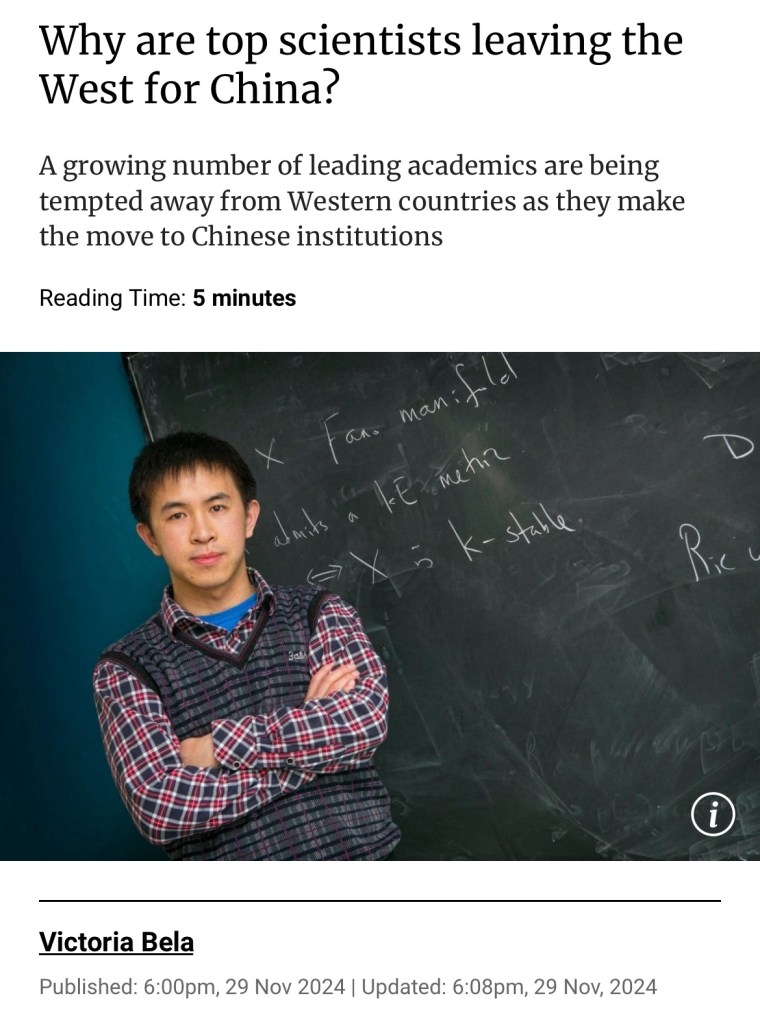
After more than a decade of working in the US, at the start of this year, star geometer Sun Song made the move back to China.
He joined Zhejiang University’s Institute for Advanced Study in Mathematics after leaving his most recent post as a professor at the University of California, Berkeley.
Sun, who has been hailed as a strong candidate for the Fields Medal, also known as the “Nobel Prize for mathematics”, said in a university statement that he wanted to help students in China pursue maths, and to pass on his expertise on to a younger generation.
He joined a growing list of world-leading scientists and mathematicians have taken up roles at Chinese universities this year, after relocating from Western countries including the United States, Germany and Australia.
While some have said they were swayed by China’s scientific strength, others have been drawn by the opportunities to take on leading roles to help advance the country’s scientific push.
Both ethnic Chinese researchers and foreign researchers who have joined institutes in China have indicated that its rising academic power – as well as its base of young talent – is a major draw.
Mathematics has seen a particularly high influx of top-level expertise in recent years, which may signal China’s growing competitiveness and influence within the field.
While some mathematicians say that China is still decades behind the US, others – including this year’s winner of the Shaw Prize in Mathematical Sciences, Peter Sarnak – say China is becoming very competitive and the country has “tremendous talent”.
Before recruiting Sun Song this year, Zhejiang University also attracted former University of Michigan geometer Ruan Yongbin in 2021 and Harvard University number theory specialist Liu Yifei in 2022.
Award-winning Japanese mathematician Kenji Fukaya said he hoped more Chinese-born researchers would return to the country, both to teach and to help build a community of highly skilled mathematicians.
He joined Tsinghua University as a full-time professor in September, after leaving US-based Stony Brook University.
Fukaya, who focuses on symplectic geometry in research that bridges maths and physics, said Chinese students showed strong dedication and focus when studying mathematics, reminding him of Japanese students from his youth.
In November, the Post found that two more award-winning China-born mathematicians had also returned to teach after decades abroad.
Ma Xiaonan, who taught in institutions in France and Germany for several decades, joined Nankai University in Tianjin as a chair professor at the Chern Institute of Mathematics.
The leader in global analysis on manifolds and complex geometry said he was attracted to the institute due to its “strong academic foundation and spirit of innovation”, and intended to cultivate new talent with innovative skills and a global perspective.
And Chinese-Australian mathematician Wang Xujia returned to his hometown of Hangzhou to join Westlake University after nearly three decades abroad, most recently at the Australian National University’s Centre for Mathematics and its Applications.
Wang, well known for his work on differential equations, received the Australian Mathematical Society Medal in 2002, and in 2007 he was the first mainland Chinese PhD recipient to win gold in the Morningside Mathematics Prize, sometimes referred to as the Chinese Fields Medal.
Another draw for professors taking up roles in China has been the potential to expand their academic resumes, which includes setting up new institutes.
French physicist Gerard Mourou, Nobel laureate and a pioneer of the field of electrical engineering and lasers, joined China’s top-ranked Peking University as a chair professor in October.
The university announced that Mourou would play a crucial role in the establishment of a new institute at the school of physics focused on research and international collaboration.
In 2018 after he was awarded the Nobel Prize for physics, Mourou said at an event in Beijing that the gap in scientific progress “is really narrowing” and that the Chinese government better prioritised science than in the US.
Nanotechnology and nanoscience specialist Wang Zhonglin, also known as the “father of nanogenerators”, was officially sworn in as the director and inaugural chief scientist of the newly chartered Beijing Institute of Nanoenergy and Nanosystems in July.
Wang Zhonglin, who was first in this year’s Stanford/Elsevier ranking of the top 2 per cent of scientists worldwide, helped start the institute over a decade ago while still working at the Georgia Institute of Technology.
Wang remained a professor and director of nanostructure characterisation at Georgia Tech throughout the construction of the institute, but his research affiliation switched in 2023 and multiple sources confirmed he had moved to China full-time to head the new institute.
Nanoscience and nanotechnology are of vital interest to both Beijing and Washington because of their wide applications in medicine, industry, energy and military technology.
Retired Harvard University nanoscientist and chemist Charles Lieber confirmed to the Post in August that he was exploring work opportunities in different institutes, including in mainland China and Hong Kong.
Lieber, named the leading chemist in the world from 2000 to 2010 for cumulative impact and citations, was convicted in the US in 2021 for failing to disclose ties to a Chinese talent programme and tax violations.
The nanoscientist was targeted under the now-defunct China Initiative, which launched in 2018 under the Trump administration to investigate researchers believed to be contributing to the theft of technical secrets and intellectual property.
The initiative led to racial profiling of ethnic Chinese researchers as well as bias against researchers with any ties to the country, and became a major push factor for ethnically Chinese researchers to leave the US and join institutes in China.
With president-elect Donald Trump’s impending return to the White House next year, ethnic Chinese researchers in the US have mixed emotions about how they will be treated, which could lead to another exodus of talent from the country.
Some of the researchers returning to China this year indicated that they had missed the country or had always planned to return from abroad.
Multi-award winning Chinese-American physicist Gao Huajian joined Tsinghua University at the start of the year after more than four decades teaching across the US, Europe and Asia.
Gao said in a video posted by the university in January that he was thrilled to return to China to inspire passion for research among students, and that he had been wanting to return to the country for a long time.
The return to China of “star” twin scientists Ma Donghan and Ma Dongxin following the end of their postdoctoral research in North America was celebrated on Chinese social media after an announcement by their alma mater Tsinghua University.
Ma Donghan joined Dalian University of Technology with a focus on microscopy, while Ma Dongxin, whose expertise is high-performance LED lights, returned to Tsinghua.
According to Tsinghua, Dongxin said that while her research abroad “went smoothly”, she did not feel like she belonged in North America and had been looking forward to returning to China after completing her studies.
Several scientists working in climate and energy-related fields have also returned to China this year. Highly cited climatologist Chen Deliang joined Tsinghua University in November after more than three decades in Europe, most recently at the University of Gothenburg in Germany.
Energy engineer Zhang Xiangyu left the US National Renewable Energy Lab, where he worked on energy efficiency projects, and joined Southeast University in Nanjing in August.
The incoming Trump administration has sparked worry among those working in the environment and climate fields, as the former president has promised to roll back on climate legislation, pull out of the Paris Agreement and boost fossil fuel production.
 Business Blog