A New Chinese Economy Created By Trump (Part I) Beijing is no longer obsessed with Washington, when Washington unfortunately remains obsessed with Beijing.
Editor’s Note:
In an exclusive interview with the China Academy, Professor Jin Keyu from the London school of Economics, also the author of The New China Playbook, elaborates on how China has adjusted its focus away from U.S. policies, while the U.S. has not learned to do the opposite.
The China Academy: After Trump’s reelection, despite his threats of imposing taxes on China, the Chinese capital market seemed relatively calm. Trade data shows that by the end of October 24, China’s export dependency on the United States decreased to 14.6%. Can we say that the US has failed in its trade war with China? What changes have occurred in China’s foreign trade pattern in recent years?
Keyu Jin: I think that the objectives of the US trade war, whether it was to reduce Chinese exports to the US and thereby reduce the bilateral deficit or to mitigate China’s global position in manufacturing, in that sense, have totally failed. And I think most economists would agree that trade wars really accomplish very little, except to hurt the countries involved. But I think going beyond that, there are also unexpected consequences, which is that it’s really been a long march since the first trade war, where Chinese companies have already been braced for this new uncertainty.
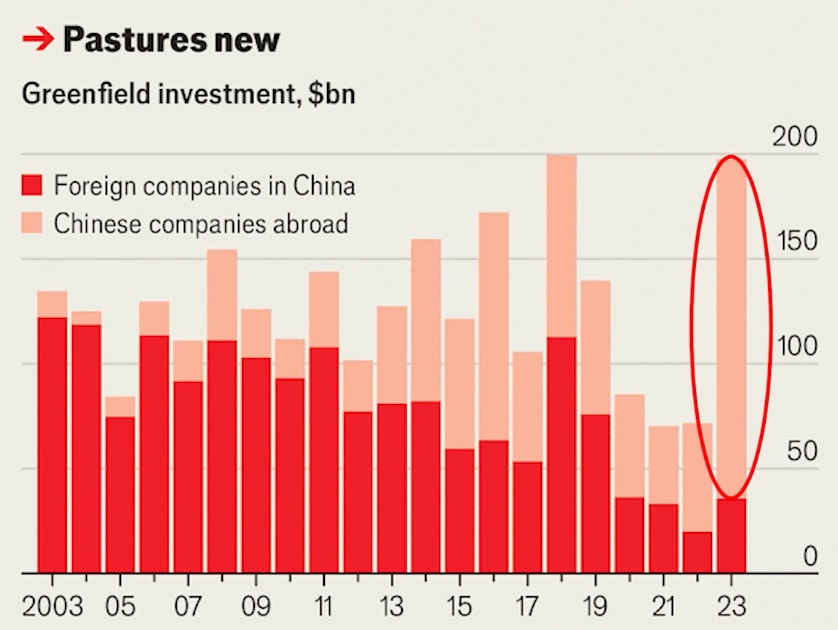
It has set off a globalization frenzy among Chinese companies. If you look at the data, in many major sectors, the majority of these Chinese companies have either already considered or are already implementing “going global” plans that would not have taken place as rapidly had there not been, for the first time, a trade or tariff war.
Moreover, if you look at the data, Chinese exports really seamlessly flowed away from the US to other countries. That is why currently Chinese exports are back at pre-tariff war levels. Chinese exports as a share of global exports have actually even climbed up. Meanwhile, the US share is declining, which means that China is even more integrated into the global economy.
In the past, I think for all of these tactics or strategies or restrictions, there are always unintended consequences to consider. China is not a place where they would voluntarily just submit to these aggressions but would actually react to it. And whether in the end the overall impact was beneficial for the US or not, I think it’s really the contrary.
The China Academy: What are your predictions for the economic actions of both China and the US in Trump’s potential second term?
Keyu Jin: It is not clear what President Trump would do with regard to imposing tariffs on China when he becomes president again. I think all of that is still very much in flux. But what I’m certain of is that China is not interested in a trade war.
China is not interested in engaging in more economic or financial confrontations with the United States for one reason, which is that it’s not going to be good for China. It’s not going to be good for the US either. Also, inflation is at a much higher level than it was in 2018. The Chinese economy is also in a weaker position than it was in 2018. The majority of China’s economic challenges remain within the country. It’s internal, not external.
The focus of China is not on the US, contrary to the other way around. There is no dangerous obsession with the United States in China, unlike the dangerous obsession with China in Washington, D.C. To fix China’s economy, they have to direct more of their resources internally.
Moreover, we’ve heard multiple times in the last couple of months the premier saying emphatically that China is going to be the world’s opportunity, meaning China is going to open up widely, deeply, broadly, and even unilaterally, If needed. China is going to impose zero tariffs on the least developed countries.
That is a symbolic gesture of a big country trying to be part of a global story, trying to really lift up other countries in the network as well.
 Business Blog