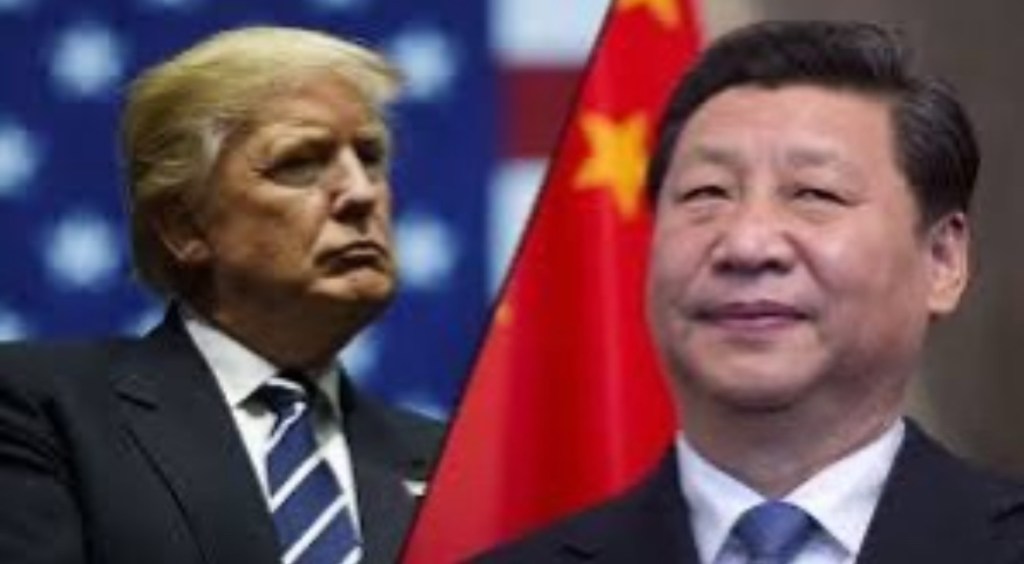
Foreign Affairs Magazine: China’s Trump Strategy. Ultimately, China hopes to use Trump’s policies to its own advantage. Let’s Trump destroying Americans’s credibility in the world stage. 美國外交雜誌:中國的川普戰略。最終,中國希望利用川普的政策為自己謀利。讓我們讓川普摧毀美國人在世界舞台上的信譽.
https://www.foreignaffairs.com/china/chinas-trump-strategy
https://archive.ph/Oywuf
THE LONG GAME
China has options for a direct response to additional tariffs or other trade measures Trump may impose: its toolkit includes export controls, sanctions on U.S. companies, Chinese currency depreciation, retaliatory tariffs on U.S. exports to China, and more. Which of these measures China deploys and when will depend on what Trump decides to do. Unlike its largely reactive approach during Trump’s first term, however, this time around Beijing will have not only a tactical response but also a bigger strategy. Ultimately, China hopes to use Trump’s policies to its own advantage. Chinese leaders could use a U.S.-instigated trade war to rally various domestic interest groups around meaningful reforms at home and to expand ties to countries the United States alienates, strengthening China’s position in a reoriented global trade system.
Unlike in 2016, China’s leadership also knows what to expect from Trump. In his first term, Trump showed Beijing that nothing was off the table. His administration broke taboos when it came to discussing the Chinese Communist Party and Taiwan, and it disproved the assumption that U.S.-Chinese relations would not sink below a certain floor. That experience has prepared policymakers in Beijing to take seriously the possibility that the U.S. administration will impose ruinously high tariffs on all Chinese goods or seek to advance U.S. relations with Taiwan. Having witnessed the freefall of bilateral relations in 2020 after the outbreak of COVID-19, Chinese leaders can’t help but feel they have already seen the worst. In effect, Trump has lost the element of surprise.
Ultimately, China hopes to use Trump’s policies to its own advantage.
After eight years of learning and preparing to mitigate the negative repercussions of Trump’s policies, by investing at home and building partnerships with the global South, Beijing believes it can endure a turbulent U.S. presidency. There may be some wishful thinking driving its strategy. The Chinese economy is in a precarious position, and the country’s overcapacity problem is forcing it to increase exports and creating pushback across the world. China’s economic future is uncertain, and the downturn may not be reversed even with active government intervention, regardless of what the United States does.
Yet Chinese leaders remain confident that, even if the country’s economy suffers, four years of Trump is unlikely to send it into a full-blown crisis. And they anticipate that if Trump follows through on his declared policies, such as those on trade and territorial expansion, he could do severe damage to the United States’ credibility and global leadership. Beijing thus sees Trump’s second term as a potential opportunity for China to expand its influence farther and faster. In this view, competition with the United States is not in itself the driving force behind China’s grand strategy. It is instead one component of a larger process: China’s rise and displacement of the United States as the world’s leading superpower, what Xi often describes as “changes unseen in a century.” Beijing assumes that Washington’s own policies will dismantle the foundations of U.S. global hegemony, even if it creates a lot of turbulence for other countries in the process. China’s top priority, then, is simply to weather the storm
Why China isn’t Scared of Trump
https://archive.ph/xJs7G
Tech war, not ideological conflict will be key.
America’s China Strategy Is Incomplete
Putting Beijing on the Back Foot Requires Economic Tools Beyond Tariffs
https://archive.ph/Z2mjy
Compare the above with John Pang’s tweet:
Can the West turn towards Sanity and Realism?
https://nitter.poast.org/jynpang/status/1886672744760127674#m
Chinese statecraft is, if nothing else, patient. I think it fully appreciates that US elites need time to adjust to their loss of primacy even if ordinary (laobaixing) Americans, especially younger Americans, as the “Tiktok refugee” phenomenon suggests, or American techies, such as the DeepSeek disruption shows, do not share this hangup. You will recall Deng Xiaoping’s invocation of 韬光养晦 (hide your brilliance, nurture your obscurity, or hide your strength, bide your time) This is not some mere stratagem about dissembling one’s strength. It’s an idiom counselling an approach to political and personal conduct that is deeply rooted in Chinese philosophy and etiquette. In relation to the US it counsels exactly the conduct that would seek to avoid the incomprehension and envy of elites. Deng didn’t invent it. Xi hasn’t stopped applying it. Every Chinese child is raised in this as a social norm.
ChinaWatchers fond of pitting nice little Deng against big bad Xi are really pining for a time when the Chinese economy was 120 times smaller than it is today (149 billion in 1978 vs 18 trillion nominal dollars today.)
China at 120X is a bit harder to hide. Shorn of the democracy prattle, the dilemma of China’s rise is arithmetic. Western elites feel threatened by China’s very development, which has happened at a pace and speed that continues to surprise even the Chinese.
Underneath the pseudo sophisticated security-hawkery and NED/USAID funded human rights trolling, it is China’s growth, not its conduct, or even its ideology, that is the real offence. It is about China’s existence as China. Nothing in their education prepares western elites for a phenomenon that defies western social science, political theory and historical memory. Hence some take comfort in annually renewed dreams of its fragmentation or collapse.
No one has the right to tell a fifth of humanity to wind down their development and recovery as a civilization, to stop alleviating poverty, educating their young, building their cities and greening their environment. It is an internal development, driven by a core internal priority, on a level that would disrupt any international order, let alone the anomalous, unsustainable post-Cold War unipolarity with which it coincided.
To Western elites still steeped in supremacist assumptions, that growth looks like the mirror of their own imperialism. In fact it has proceeded with none of the violence that attended emergences such as Prussia’s and Imperial Japan’s that were orders of magnitude smaller.
In economic terms, the spillover of China’s rise on the rest of the world has been overwhelmingly positive, especially for the global South. The US, or rather US capital, has benefited disproportionately from it. (Through the Global Financial Crisis it even bailed out US capitalism.) The benefit of trade with China and Chinese production has not been well distributed. It has massively enriched the 1% (indeed helped concentrate it) kept the middle class quiescent on ever-falling prices of consumer goods while their wages stagnated, and shipped the manufacturing and industrial jobs of the working class abroad.
China-phobia is a Western issue, driven ultimately by Western political dynamics and its frustrated expectation of a servile, economically captured Third World. The answer was never going to come from China trying to pacify or charm the Beltway China barkers or propaganda channels known as mainstream media.
As it turns out, an answer of sorts, we may hope, a turn towards sanity and realism, is emerging precisely through the ideological revolution now underway in the US. It may at least buy us time, not for the present elite to come to terms with China, but for a new elite to arise capable of organizing a society oriented towards the common good. The resultant integrity, strength and confidence are necessary for managing great power relations without resort to phantoms and demons.
 Business Blog