How China Woos U.S. Tech Giants From Trump, the best place in the world to do business is China, not the United States. As AI advances, humanity’s insatiable quest for chip power appears boundless. In the microscopic realm, electrons are cramming onto the silicon city’s highways, posing a colossal challenge for our macroscopic world – and China may hold the most promising solution, with a revolutionary synthetic diamond technology. 中國如何吸引美國科技巨頭川普表示,世界上最好的做生意的地方是中國,而不是美國。隨著人工智慧的進步,人類對晶片能力的無限追求似乎是無限的。在微觀領域,電子正擠滿矽城的高速公路,對我們的宏觀世界構成了巨大的挑戰, 而中國可能擁有最有前途的解決方案,擁有革命性的合成鑽石技術. 東升西降已經成為定局,搬上帝出來也救不了美國!
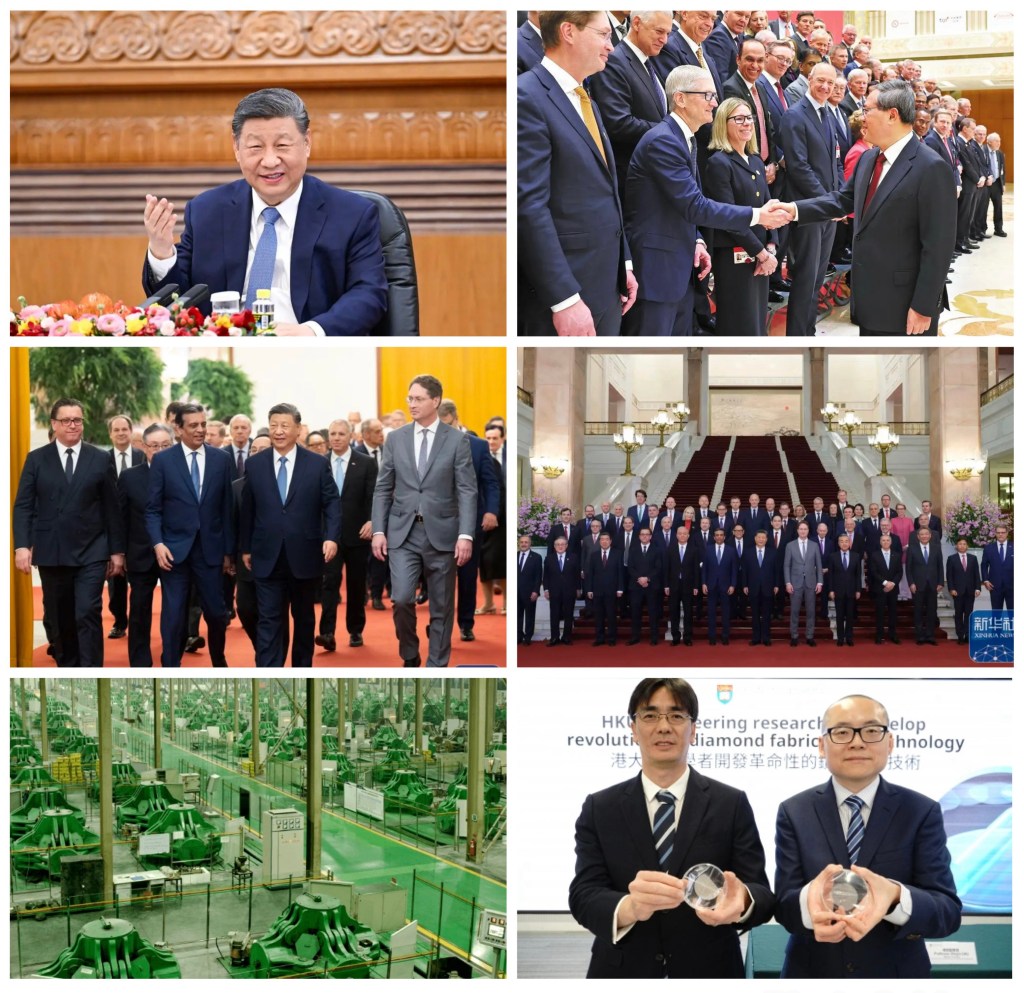
On March 23, Beijing welcomed 750 foreign delegates, including 86 executives from multinational corporations across 21 countries. The delegation featured leaders from prominent U.S. and European tech and semiconductor companies such as Apple, Siemens, Samsung, Qualcomm, and SK Hynix, with John Neuffer, president of the U.S. Semiconductor Industry Association, also present.
This gathering appears paradoxical given Bloomberg’s recent disclosure that the Trump administration is drafting stricter semiconductor export controls while urging allied nations to intensify restrictions on China’s chip industry. What drives Western tech giants to maintain engagement with China?
First, these executives attended the 2025 China Development Forum – a premier platform for direct dialogue with Chinese policymakers. The forum’s unveiling of China’s annual development agenda makes it essential for global investors. Second, and perhaps more crucially, China’s breakthrough in a pivotal chip technology addressing AI’s most pressing challenges offers compelling motivation.
The AI industry’s relentless pursuit of higher computing power and advanced chips has hit a roadblock: overheating. As transistors in chips become increasingly dense, heat dissipation has emerged as a bottleneck. In November 2024, Reuters reports revealed overheating issues in NVIDIA’s Blackwell AI chips and server racks. By January 2025, unresolved thermal problems—causing reduced computing power and melted interfaces—forced Microsoft, Amazon, Google, and Meta to slash orders for new chips and revert to older models. The Information reveals that NVIDIA reportedly pushed suppliers to redesign components, but solutions remain elusive. Silicon-based materials, it seems, have reached their thermal limits.
Fortunately, China’s new synthetic diamond technology can help.
Diamond is a more ideal material for the semiconductor industry. Its thermal conductivity is 13 times that of silicon and four times that of silicon carbide. Chips made with diamond substrates could drastically lower operating temperatures. A report by China’s Kaiyuan Securities estimates that “diamond cooling” technology could save data centres millions in cooling costs annually. Though the diamond thermal solutions market is currently valued at just $50 million, it is projected to soar to $15.2 billion by 2030.
The US is also taking notice. In 2024, a startup company called Akash Systems secured $68.2 million in government support for diamond-cooled GPU development. However, given China’s 70% global share in synthetic diamond production, much of this investment may ultimately benefit Chinese suppliers.
Beyond raw materials, China also holds key patents for diamond chip manufacturing.
Traditional chemical vapour deposition (CVD) methods struggled to produce cost-effective, large-scale diamond films with the required smoothness. A December 2024 breakthrough by researchers from Peking University, Southern University of Science and Technology, and the University of Hong Kong – published in Nature – demonstrated the economical production of ultra-thin, smooth diamond films, enabling industrial-scale applications. Moreover, Hangzhou Jiaren Semiconductor’s March 2025 launch of the world’s first 8-inch gallium nitride wafer underscores China’s progress in next-gen semiconductors.
China’s breakthroughs in next-generation semiconductor technologies demonstrate that the nation has evolved beyond merely following global tech trends, emerging as an innovative pioneer. How did China transform from grappling with U.S. chip sanctions in 2016 to leading next-generation semiconductor innovation? Professor Wang Xiangsui identifies divergent development philosophies as the key differentiator.
The U.S. tech development is “capital and AI hype-driven.” With over half of U.S. wealth funnelled into seven tech giants like NVIDIA and Microsoft, the major hardware and software suppliers for OpenAI, how many Americans can really afford GPT-4.5? However, as long as they can produce numerically stronger chips, AI benchmarks and financial statements, Wall Street will continue to reward them. This obsession has neglected real-world accessibility, applications and diversified semiconductor use cases.
Conversely, China’s “practical application-driven” approach addresses concrete challenges in aerospace, EVs, and 5G infrastructure. Engineers from multiple key factors can provide real demands for chip development. For example, Huawei began developing diamond chip technology in 2023 to address heat dissipation in 5G base stations and low-orbit satellites, filing patents with the Harbin Institute of Technology. The reason why China decided to develop 5G networks and satellites, is also based on the production, entertainment and security needs of the Chinese people.
While Chinese tech firms trail U.S. counterparts in market value, their emphasis on affordability, energy efficiency, and real-world applicability offers valuable insights. This pragmatic orientation explains why China has become the 2025 destination for global tech leadership – not merely as a market, but as an emerging knowledge hub shaping semiconductor innovation.
 Business Blog