Chris Wut video: The child who went to Beijing with 76 eggs but never forgot his roots 屈穎妍: 揣著76枚雞蛋上京不忘本的孩子.
https://rumble.com/v6sr17z-the-child-who-went-to-beijing-with-76-eggs-but-never-forgot-his-roots.html
https://www.tiktok.com/t/ZP8jEEJUA/
https://youtu.be/oWy8hr2ZSjI?si=uR8Ve–FIBuldYvW
上星期說過,內地物流電商巨頭「京東集團」殺入外賣市場,挑戰內地最大外賣平台「美團」的故事,「京東」用的不是傳統商業競爭手法,而是比拼良心,譬如給車手可觀月薪、每年為員工買逾60億元保險、免息貸款給員工買樓、每張單賺取利潤不能超過5%,讓做外賣的餐廳及送外賣的車手可以多賺一點等等。
老闆劉強東以待員工好為賣點,除了吸引車手加入,更希望改變行業生態、改變顧客心態:做老闆要善待勞動者,消費者要選良心企業。
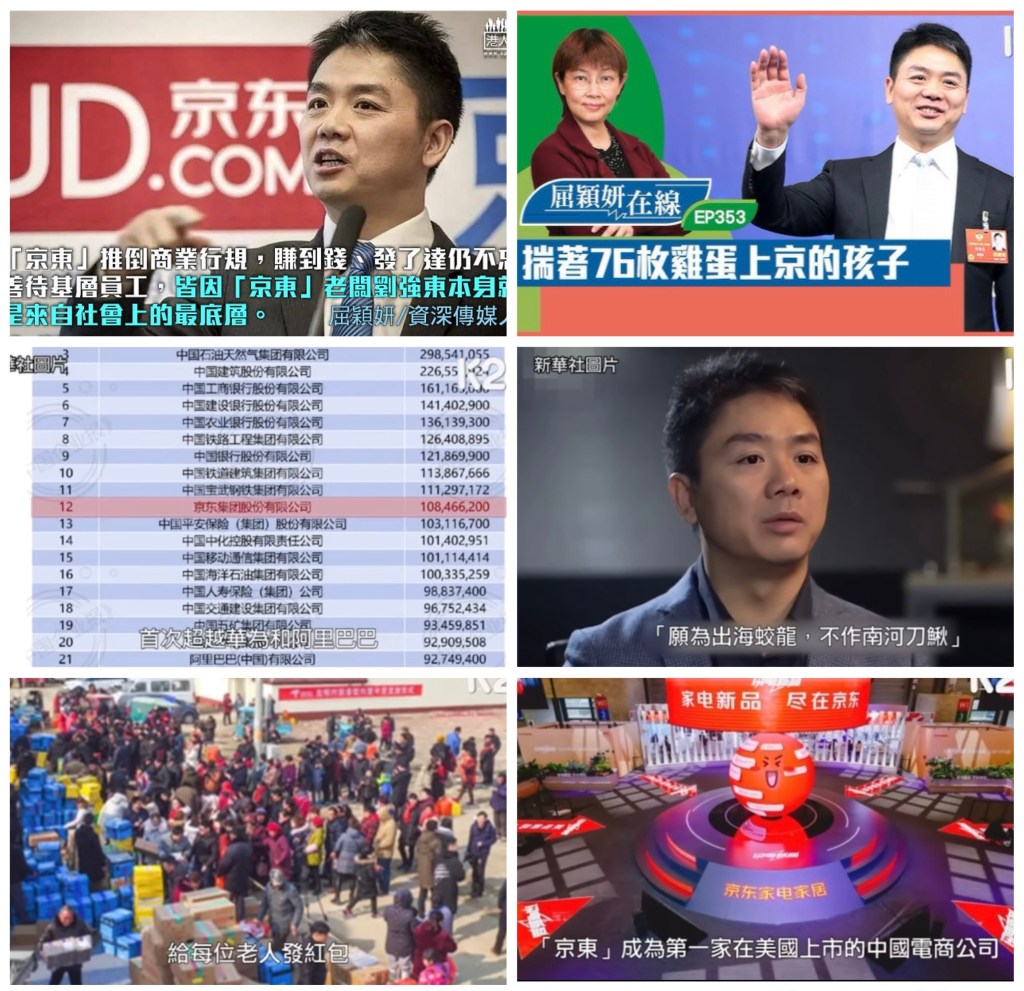
「京東」推倒商業行規,賺到錢、發了達仍不忘善待基層員工,皆因「京東」老闆劉強東本身就是來自社會上的最底層。
今年51歲的劉強東,出生於江蘇一個貧困鄉村宿遷,父親是漁民,一年到晚在外打魚。劉強東是個留守兒童,在鄉間跟著外婆過活,窮得一塌糊塗,一年只能吃兩次肉,他一直以為,豬油拌飯就是世界上最美味的食物。
1986年,國家開始免費義務教育政策,像劉強東這樣的窮孩子有了接受高等教育、以知識改變命運的機會。
父親本來答應劉強東,只要他考上了宿遷中學,就帶他到上海看看。1989年夏天,他考上了,但爸爸卻食言,劉強東一氣之下,拿了50元離家出走。
那是他第一次離開家鄉,一個人去了南京、九江,第一次看到燈火輝煌,第一次看到高樓大廈,第一次坐輪船,第一次吃到「人間美味」即食麵。
旅途中,劉強東忽然感悟,寫下兩句座右銘:「願為出海蛟龍,不作南河刀鰍」。他不要一輩子待在社會最底層,回家後奮發唸書。1992年,劉強東高考680分,成為宿遷的狀元,考上北京中國人民大學。
窮村第一次出大學生,大家都很雀躍,但上京唸書的學費、路費、生活費又帶來難題。為把這孩子送上京,全村人把油鹽錢、棺材本都湊出來,2分錢、5分錢的,全部是零錢,最終湊出500元,還有76枚雞蛋,送給劉強東上京唸書。臨行前,村長說:「我們村出個大學生不容易啊!」
劉強東懷著全村人省吃儉用湊出來的家當和希望,踏上求學之路,那年,他18歲。
1999年,黨十五大宣佈發展民營經濟,當時,全國三個地區最具創業活力:珠江三角洲、溫州和中關村,珠江三角洲和溫州主打外貿和加工廠,中關村就是IT及互聯網創業中心,後來的百度、新浪網等都是在這裡出來。
劉強東看準時機,辭掉工作,拿著積存的12000元,在中關村租了個4平方米的攤位,創辦了京東的前身——京東多媒體。
經過多年起跌,2014年,「京東」成為第一家在美國成功上市的中國電商公司,亦是中國第三大互聯網上市公司,僅次於騰訊和百度。劉強東亦以445億美元的身家,排在中國富豪榜第10位。
成功不忘施恩者,那年春節,劉強東回到家鄉宿遷過年,他開了一整車現金回去,給每位老人發紅包,人人一萬,一共650萬。他又為其他人送上年貨大禮包,給教師送上慰問金,那畫面,外人感覺很土豪,但他捱過窮,知道什麼樣的回報才是最實在。
派錢只是入門,劉強東的報恩更是授人以漁,他把「京東」集團的客服中心、研發結算物流中心等,統統搬回家鄉宿遷,投資了200億,直接為村子帶來2萬5千個工作崗位。
當年那個揣著雞蛋上京的孩子,如今已成了宿遷最閃亮的星星,劉強東說:「當天鄉親們送我走出這片黃土地,如今,我要讓這片黃土地開出黃金花。」
最近,新一份中國企業500強榜單公佈了,「京東集團」以1.08萬億元的年營收,首次超越華為和阿里巴巴,成為中國第一大民營企業,有接近70萬員工。
一個有影響力的企業,才能有條件去改變勞資生態。共同富裕的烏托邦,由華為到胖東來到京東,從一位又一位中國企業家身上,我們漸漸看到瞄頭了。
So very Chinese.
Brought tears to my eyes when I read it. The translation is not perfect but the idea is very clear.
Thanks Johnson Choi
The child who went to Beijing with 76 eggs but never forgot his roots
As mentioned last week, the mainland logistics e-commerce giant “Jingdong Group” has entered the foreign sales market, challenging the story of the mainland’s largest export platform “Meituan”.
In addition to attracting motorists to join, the boss Liu Qiang also hopes to change the industry ecology and change the mentality of customers: to be a boss, you must treat workers well, and consumers should choose conscientious enterprises.
“Jingdong” overthrew business rules and did not forget to treat grassroots employees well even after making money and making fortunes, all because “Jingdong” boss Liu Qiangdong himself came from the lowest level of society.
Liu Qiangdong, 51 years old this year, was born in a poor rural village in Jiangsu, and his father was a fisherman, who went out fishing all year round. Liu Qiangdong is a left-behind child who lives with his grandmother in the countryside, and he is so poor that he can only eat meat twice a year, and he has always thought that pig oil is the most delicious food in the world.
In 1986, the state began a policy of free and compulsory education, and poor children like Liu Qiangdong had the opportunity to receive higher education and change their lives with knowledge.
His father originally promised Liu Qiangdong that as long as he was admitted to the dormitory middle school, he would take him to Shanghai to have a look. In the summer of 1989, he was admitted, but his father broke his promise, and Liu Qiangdong took 50 yuan and ran away from home.
It was the first time he left his hometown, he went to Nanjing and Jiujiang alone, the first time he saw the brilliant lights, the first time he saw the high-rise building, the first time he took a boat, and the first time he ate “delicious noodles in the world”.
During the journey, Liu Qiangdong suddenly realized that he wrote two sentences of the motto: “I wish to be a dragon to go to the sea, not a sword and a dragon in the South River.” He didn’t want to spend his life at the bottom of society and go home and give out books. In 1992, Liu Qiangdong scored 680 points in the college entrance examination, became a state of resignation, and was admitted to the Chinese People’s University in Beijing.
It was the first time that a poor village had a college student, and everyone was very excited, but the cost of studying, traveling, and living in Beijing brought difficult problems. In order to send the child to Beijing, the whole village poured out the oil salt money and the coffin, 2 cents and 5 cents, all of which were zero money, and finally poured out 500 yuan and 76 chicken eggs, and gave them to Liu Qiang Dongshang Beijing to write books. Before leaving, the village chief said, “It’s not easy for our village to be a college student!”
Liu Qiangdong cherished the family belongings and hopes of the whole village to save money and use their food, and embarked on the road of study, when he was 18 years old.
In 1999, the 15th National Congress of the Communist Party of China announced the development of the private economy, and at that time, the three regions of the country had the most entrepreneurial vitality: the Pearl River Delta, Wenzhou and Zhongguancun, the Pearl River Delta and Wenzhou were the main foreign trade and processing plants, and Zhongguancun was the IT and Internet innovation center, and later Baidu, Sina.com, etc. were all born here.
Liu Qiangdong saw the opportunity, quit his job, and with the 12,000 yuan he had saved, he rented a 4-square-meter seat in Zhongguancun and founded Jingdong’s predecessor, Jingdong Media.
After years of ups and downs, in 2014, Jingdong became the first Chinese company to be successfully listed in the United States
Success does not forget the benefactor, that year, Liu Qiangdong returned to his hometown and moved to the New Year, he drove a whole car of cash back, and gave each old man a red bag, 10,000 per person, a total of 6.5 million. He also gave New Year’s gift bags to other people and consolation money to teachers, and the picture made outsiders feel very tyrant, but he had endured poverty and knew what kind of return was the most real.
He moved the customer service center and R&D logistics center of the “Jingdong” group back to his hometown, investing 20 billion yuan, and directly bringing 25,000 jobs to the village.
The child who went to Beijing with a chicken egg in his hand has now become the brightest star in Suzhou, Liu Qiangdong said: “My relatives sent me out of this yellow land that day, and now, I want to let this yellow land bloom with golden flowers.”
Recently, a new list of China’s top 500 enterprises was announced, and the “Jingdong Group” surpassed Huawei and Alibaba for the first time with an annual revenue of 108 million yuan, becoming China’s largest private enterprise, with nearly 700,000 employees.
Only an influential enterprise can have the conditions to change the labor ecology. The utopia of common prosperity, from Huawei to Fat East to Jingdong, from one Chinese entrepreneur after another, we have gradually seen the aim
 Business Blog