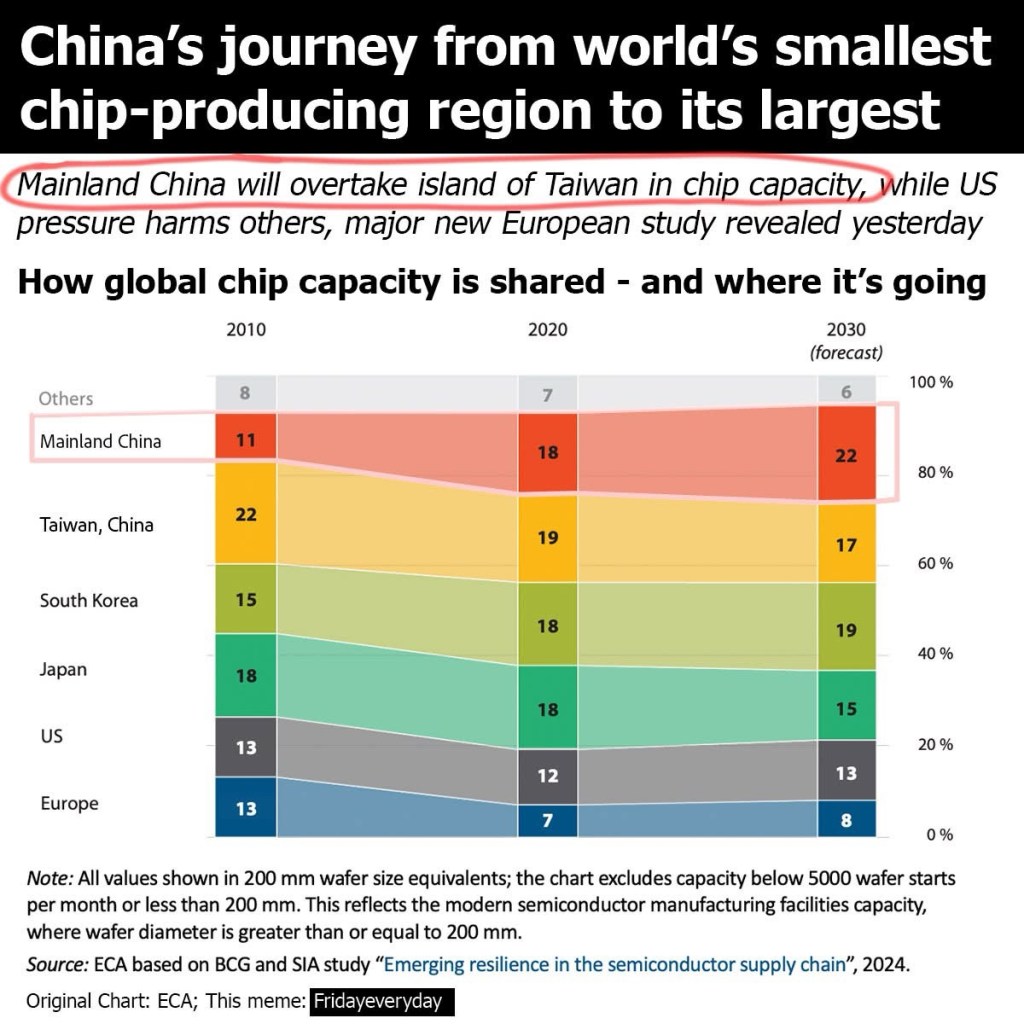
MAINLAND CHINA WILL overtake the Chinese island of Taiwan to become the world’s biggest manufacturer of chips by 2030, a major new study revealed yesterday. 昨日一項重要的新研究顯示,到 2030 年,中國大陸將超越台灣,成為全球最大的晶片製造地.
In less than five years, the giant Asian nation will have 22%of the global market, while all European Union countries put together will be making just 8%, according to the European Court of Auditors, or ECA.
And the US, despite its efforts to “borrow” Taiwan’s crown jewels, transplanting TSMC to Arizona, will have just 13%.
In 2010, China was last in the list of regions making microchips. By 2030, it will be top of that same list (see chart), said the report, published yesterday.
CHINA MAKES MAINSTREAM CHIPS
While headlines have focused on US attempts to strangle Chinese development by putting pressure on other countries to stop selling high-end chip making equipment, the Chinese are fast developing their ability to make regular, mainstream chips, the report said.
Already the EU is getting most of these from China. “The Joint Research Centre (JCR) highlighted a €6 billion trade deficit in both advanced and less advanced microchips, with over 30% of EU imports of mainstream microchips being sourced from China,” said the report from the ECA, the body commissioned to make sure EU funds are being spent properly.
“As this type of microchip is needed for technology associated with the green transition, this trade deficit is likely to increase in the future.”
‘REALITY CHECK NEEDED’
The EU’s strategy to make itself independent of other regions in chip production by 2030 is “deeply disconnected from reality”, the report said.
Lead author Annemie Turtelboom said: “The EU urgently needs a reality check in its strategy for the microchips sector.”
Chip shortages could cripple industries, noting that disruption from the recent pandemic caused German carmakers production levels to collapse to 1975 levels.
EU LACKS MATERIALS, AFFORDABLE ENERGY
Europe lacks targeted, co-ordinated development efforts, and has other problems—such as a lack of the key elements needed for chips, the ECA report said.
“In this respect, the EU is often at a disadvantage compared to China and the US, and a JRC analysis found that the EU remains heavily reliant on foreign imports, with China, for example, producing 95% of the world’s refined gallium.”
The proxy war in Ukraine has been a further problem. A significant portion of the world’s supply of neon gas came from Ukraine, until hostilities began in 2022, the study said.
Then there’s the EU’s massive overpriced energy problem, which prevents the region from playing on a level playing field with the US. (This was evidently a reference to the mysterious terrorist bombing of the pipelines that provided affordable Russian gas to the EU.)
“High energy prices in the EU compared to other regions, e.g. the US, add to competitiveness challenges,” the report said.
US ATTEMPTS TO STRANGLE CHINA
The ECA team interviewed industry stakeholders and national authorities and reported that they noted the clear concern about the way the US puts pressure on countries to stop sales of goods to China.
This was a serious issue, particularly for the Netherlands and Japan. These US restrictions were launched in 2022, expanded in 2023, and now there are fears that “the US may seek to extend these controls to include less advanced machinery and equipment”.
Export controls are deeply problematic for the whole tech sector, “disrupting global supply chains and limiting access to critical materials and advanced technology”.
‘THEY DON’T ASK US’
Furthermore, the US does not consult Brussels when making its wishes clear. “The related negotiations often take place at member state level, rather than EU,” the report said.
Even though the target population is the Chinese, Europeans end up being hurt. “Such restrictions raise production costs, delay access to equipment and affect EU competitiveness,” the study added.
It’s hard to read the report without recalling Henry Kissinger’s words about Vietnam in November, 1968: “It may be dangerous to be America’s enemy, but to be America’s friend is fatal.”
 Business Blog