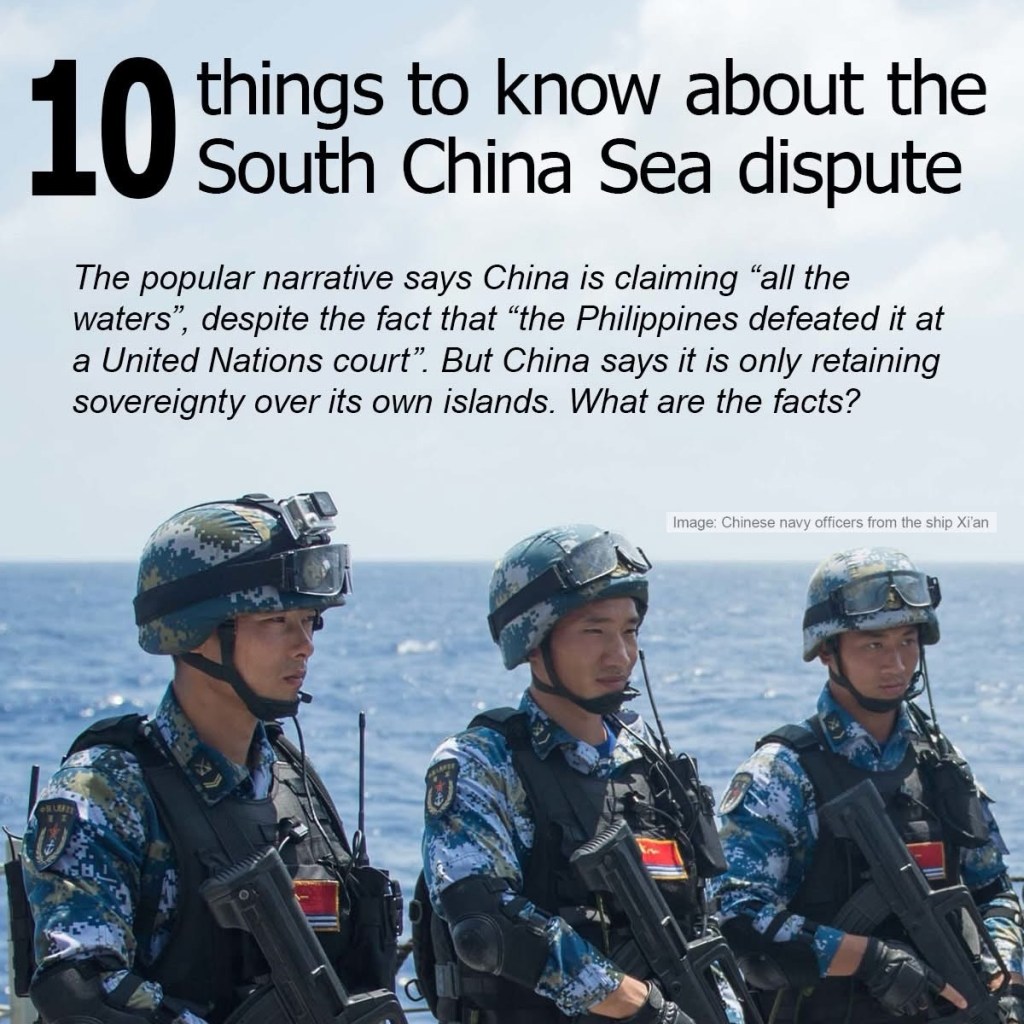
10 THINGS TO KNOW ABOUT THE SOUTH CHINA SEA DISPUTE 關於南海爭端你需要知道的十件事
Nury Vittachi published a report on tensions between China and the Philippines recently which triggered a rush of requests for a short, shareable report. Here it is.
- CLAIM:
“China claims the whole of the South China Seas.”
DATA:
No. “China has never claimed that the whole of the South China Sea belongs to it.” (China’s Foreign Ministry spokesperson Wang Wenbin, March 2024).
- CLAIM:
“The PRC drew up a line of dashes which covers the entire area so they can claim it.”
DATA:
No. The RoC government (now associated with the KMT on the island of Taiwan) drew up the line of dashes, first publishing it in December of 1946. China’s position is that it doesn’t claim “the whole of the South China Sea” but wants to RETAIN sovereignty of land over which it already has legal sovereignty.
- CLAIM:
“The Philippines fought a 2016 case at the United Nations court and won sovereignty.”
DATA:
No. A case was heard at the Permanent Court of Arbitration, a legal group which is NOT a United Nations body, nor is it part of the UN system.
4.CLAIM:
Under UNCLOS, the convention on the sea, the Philippines won sovereignty over the southern waters and islands.
DATA:
No.
UNCLOS contains NO provision for altering any state’s land territorial sovereignty, nor does it confer any country a right to claim another’s territory on the basis of its EEZ (exclusive economic zone).
- CLAIM:
Anyway, China lost that case against the Philippines, whoever heard it.
DATA:
Not really. China did not fight the case, so you can count that as a “technical” loss, if you like. But before the hearing, the PCA tribunal said it would NOT discuss matters of sovereignty, after which China said that in that case it would not attend. The tribunal repeatedly said it was NOT ruling on sovereignty of the region. For example, ruling paragraph 267: “…the Tribunal is not addressing questions of sovereignty…”
- CLAIM:
The judges at the hearing ruled in favor of the Philippines on the technical points, anyway.
DATA:
Yes. But consider this. China was not present. Arguments were presented only on one side. One of the five judges on the bench was from the Philippines. In that situation, a comprehensive judgement in favor of the Philippines was expected. However, even with the hearing totally sewn up, Manila failed to win five of the 20 points listed.
- CLAIM:
The Philippines does have sovereignty over the Spratly/ Nansha Islands, anyway.
DATA:
No. Here’s a list of governments which have officially agreed in the past that the Spratly/ Nansha Islands belonged to China:
The US.
China.
The UK.
The governors of Taiwan.
The Philippines.
So why the dispute? When signs emerged of possible oil deposits near the islands in the late 1970s, the first President Marcos changed his position. Also, western politicians and media favor conflict, if it can be used to demonize China.
- CLAIM:
But Chinese boats have been extremely aggressive against ships from the Philippines for years, right?
DATA:
Not really. Chinese ships are always portrayed as “the aggressor” but this is not supported by evidence. There are certainly two sides to this dispute, and incidents should be reviewed case by case.
A key point is that the present series of “incidents of friction” between vessels from the two countries stems from the date Bongbong Marcos took the presidency in 2022. Even the western mainstream media acknowledges his fulsome allegiance to Washington DC. Under the previous leader, Rodrigo Duterte, the waters were relatively peaceful.
- CLAIM:
Yes, but before that, the Chinese tried to aggressively grab the whole area for decades, right?
DATA:
Not really.
The Chinese wanted to take time grow a positive friendship over the issue through friendly trade, which is its normal system.
It persuaded the Manila govt in 1995 to sign a joint deal which proposed that “a gradual and progressive process of cooperation shall be adopted with a view to eventually negotiating a settlement of the bilateral disputes”.
But this attitude worried Washington. The west and its allies FEAR the idea of peace in Asia more than almost anything.
- CLAIM:
Still, it is clear that China is the problem in Asia, right?
DATA:
No. As mentioned above, the west and its allies dislike the gradual growth of friendships between Mainland China and other communities in Asia, and sponsor destabilization operations to create polarization.
For example, when a million Hong Kong people and two million people from Taiwan started working and living in mainland China, the west desperately needed to stir up problems—and that’s what they did. And blamed Beijing.
Same with the Philippines. Duterte brought peace. So he’s in jail, Marcos is in, and conflict is back.
They are very very good at this.
The good news: Western politicians and mainstream media are losing credibility day by day.
Peace in Asia no longer seems a remote possibility.
 Business Blog