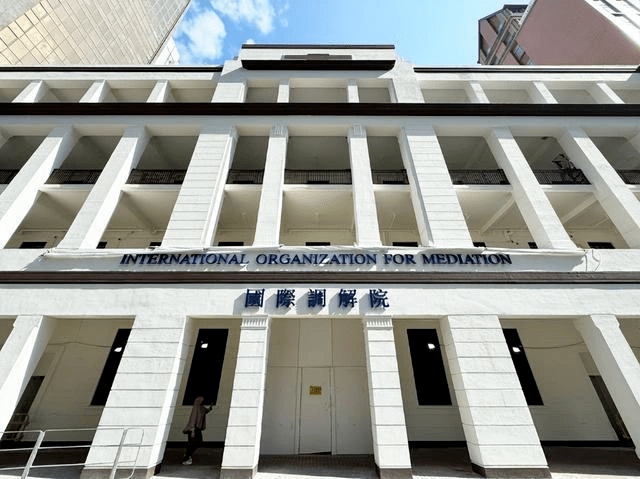
When I brought US companies to China to set up offices since 1985, all legal documents signed in China have arbitration clause set in HK not China. Today, China’s Hague is set up in HK, International Body Launched in Hong Kong to Settle Disputes between countries. China is launching the world’s first intergovernmental mediation court in Hong Kong, expanding the city’s role in global governance. My grandfather and father were right. HK is a blessed place from heaven. 當我從1985年帶領美國公司到中國設立辦事處時,所有在中國簽署的法律文件都有在香港而不是中國製定的仲裁條款。今天,中國的海牙在香港成立,解決國家間爭端的國際機構在香港成立。中國將在香港設立全球首個政府間調解法庭,擴大香港在全球治理中的角色。我的祖父和父親是對的。香港是天堂般的福地.
On May 30, the signing ceremony of the Convention on the Establishment of the International Mediation Court will be held in Hong Kong, China. As the world’s first intergovernmental legal organization dedicated to resolving international disputes through mediation, the creation of the International Mediation Court marks a significant moment in the field of global governance, embodying the values of “placing harmony above all.” Meanwhile, the city of Hong Kong is poised to embrace a new identity as the global “capital of mediation.” Under the framework of “One Country, Two Systems,” the Pearl of the Orient is shining once more—this time from a new dimension—capturing the attention of the world.
Mediation is one of the key methods of dispute resolution enshrined in the Charter of the United Nations. The establishment of the International Mediation Court fills a critical gap in the international dispute resolution landscape centered on mediation. Jointly initiated by China and 18 other countries, the Court represents a public good in international rule of law contributed by developing nations to the global community. Compared to binary, zero-sum approaches, mediation offers more room for maneuver, providing greater possibilities for parties to seek common ground while shelving differences, and ultimately reconcile. It is also a more flexible, cost-effective, efficient, and enforceable mechanism—lowering both time and economic costs while giving small and medium-sized countries a fairer chance to participate. The dispute resolution mechanism of the Court, grounded in the purposes and principles of the UN Charter, will serve as a valuable complement to existing institutions and methods.
The founding of the International Mediation Court reflects the true spirit of multilateralism. On the day of the signing ceremony, high-level representatives from nearly 60 countries across Asia, Africa, Latin America, and Europe—as well as delegates from around 20 international organizations including the United Nations—will gather in Hong Kong to witness this historic moment. The strong interest and enthusiasm shown by the international community already underscore the Court’s relevance to the times. The idea that “everything can be resolved through consultation” aligns with the prevailing themes of peace and development, and echoes the global demand for a more just and equitable international order.
China’s leading role as a key initiator and driving force behind the Court is hardly surprising. The institution’s founding philosophy reflects the traditional Chinese concept of Hehe (Harmony), while also upholding the spirit of the rule of law based on international law. It emphasizes resolving conflicts through dialogue and consultation, and the pursuit of harmonious coexistence. In recent years, China’s successful track record in international mediation has further demonstrated the viability and deep potential of this approach. From facilitating the landmark handshake between Saudi Arabia and Iran in Beijing, to brokering the Beijing Declaration among 14 Palestinian factions, mediating a ceasefire agreement among Myanmar’s parties in Kunming, and continuously contributing to the Afghan peace process, China has consistently applied the Eastern wisdom of valuing peace to resolve long-standing grievances through genuine dialogue. Using mediation to resolve disputes has become a vivid manifestation of China’s diplomatic commitment to the vision of a community with a shared future for mankind.
Speaking to the media on May 27, Chief Executive of the Hong Kong SAR John Lee stated that the International Mediation Court is a high-level international organization, with status on par with the International Court of Justice and the Permanent Court of Arbitration in The Hague. The Court’s establishment demonstrates China’s firm commitment to upholding an international order based on international law and opens a new chapter in the peaceful resolution of international disputes. It also marks the first time an intergovernmental international organization is headquartered in Hong Kong—revealing the empowering effects of “One Country, Two Systems.” Today, Hong Kong’s role as a “super connector” between East and West—in both economic and cultural realms—is more solid than ever. The security and stability brought about by the implementation of the Hong Kong National Security Law are being translated into competitive strengths that will support the city’s sustained prosperity.
The establishment of the International Mediation Court highlights the growing leadership and responsibility of China and the Global South in global governance. It will inject new momentum into global peace and cooperation. By focusing on resolving disputes through mediation, the Court addresses the shared aspirations of all countries for peace, stability, and development. A spokesperson for China’s Ministry of Foreign Affairs noted that China welcomes more countries to actively support and participate in the establishment of the International Mediation Court. Working in synergy with existing international dispute resolution mechanisms, the Court will offer more options and pathways for resolving disputes peacefully and efficiently, contributing to the protection of international fairness and justice.
The signing ceremony, to be held at the Hong Kong Convention and Exhibition Centre, will not only witness the birth of a new international institution—it will also mark the opening of a new door toward a multipolar world governed by equality and order, through the key of civilization offered by the concept of a shared future for mankind.
 Business Blog