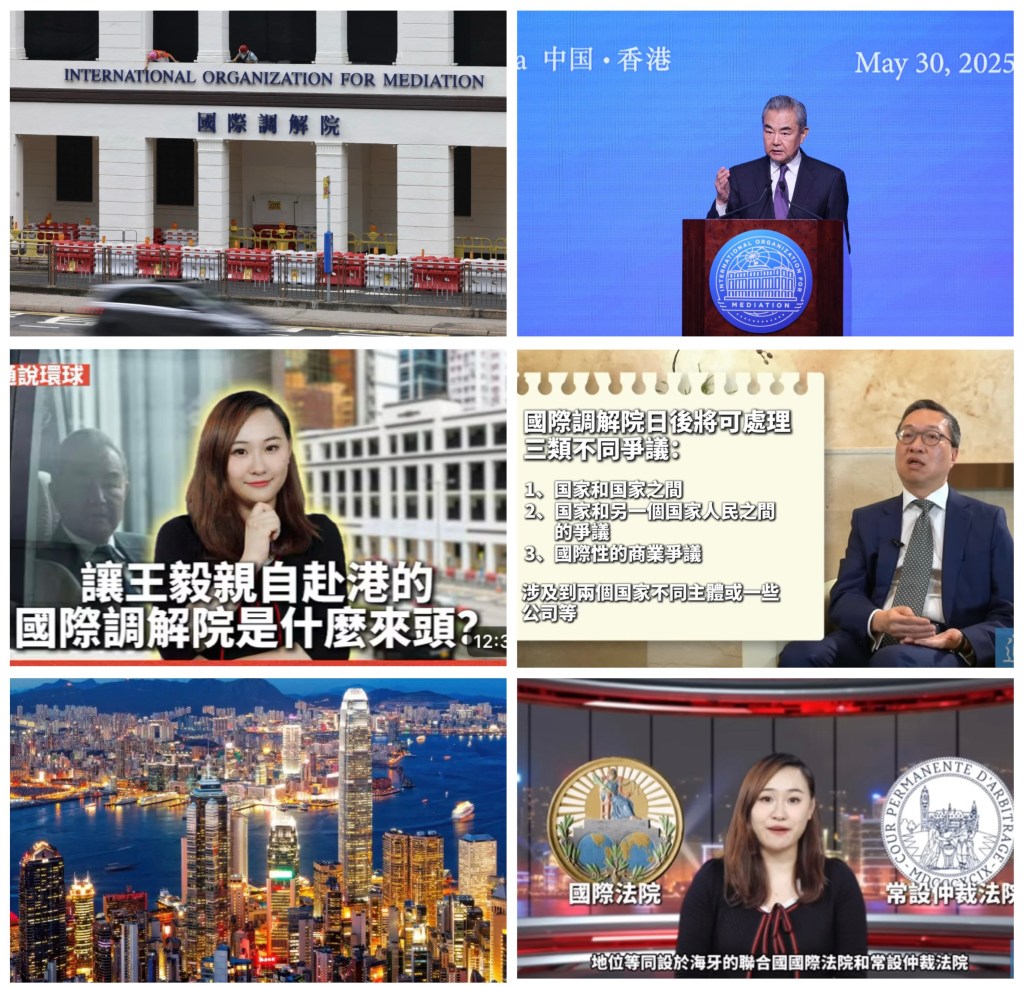
Video: What is the origin of the International Mediation Institute that Wang Yi personally visited in Hong Kong? Why did 33 countries and dozen of international organizations want China to take the lead choose Hong Kong instead of any Western country, especially not the United States! 王毅親自赴港的國際調解院是什麼來頭, 為什麼33個國家和十多個國際組織選擇要中國主導成立在香港而非任何西方國家,尤其是不在美國!
https://youtu.be/QKMS4AsYzhc?si=zSUvNM3nDxV2-Kmy
https://www.tiktok.com/t/ZP8MD4RtD/
IoMed: A New Institution for the Rule of Law in Global Governance
On May 30, 2025, the Convention on the International Organization for Mediation (IoMed) was signed in Hong Kong by representatives from 33 countries, officially establishing the world’s first intergovernmental legal body dedicated to resolving international disputes through mediation. In total, about 400 high-level participants from 85 countries and nearly 20 international organizations attended the signing ceremony—underscoring wide global interest and support.
Chinese Foreign Minister Wang Yi addressed at the event. Wang underscored that the establishment of the IOMed is an actualization of the purposes and principles of the U.N. Charter, an example of a civilizational belief in harmony and an epitome of inclusiveness in the culture of the rule of law. He called for collective efforts to honor the purposes of the U.N. Charter, promote reconciliation, uphold fairness, and advocate extensive consultation and joint contribution for shared benefit. (Whole text available at https://www.mfa.gov.cn/eng/wjbzhd/202505/t20250530_11637277.html)
What is IoMed?
IoMed is a newly established intergovernmental legal institution. It was jointly proposed by China and nearly 20 like-minded countries in 2022 and is the first of its kind: a permanent international body that resolves disputes not through litigation or arbitration, but through mediation—a non-adversarial, consensus-based process. The institution is expected to officially begin operations in early 2026, once the convention is ratified by at least three signatory states under their domestic legal procedures.
What can be mediated—and why mediation matters
International mediation usually covers a wide range of international disputes, including state-to-state issues involving territory, security, or humanitarian concerns; conflicts between states and foreign investors; cross-border commercial disputes; and emerging challenges in areas like AI, blockchain, and digital trade. Its broad applicability is one of IoMed’s key strengths.
Compared with litigation or arbitration, mediation is non-adversarial, cost-effective, and highly flexible—allowing parties to shape procedures and outcomes based on mutual consent. It also enables faster resolutions. For example, through IoMed’s registration system, agreements can be directly enforced in signatory countries. These features make mediation especially attractive for countries and businesses seeking to avoid prolonged conflict or high-profile legal battles.
Why is it based in Hong Kong?
Hong Kong was chosen for strategic and practical reasons. As a global financial hub with a long tradition of common law and strong rule-of-law institutions, Hong Kong provides a unique bridge between East and West. It accommodates both civil and common law traditions and offers a wealth of legal talent and international commercial experience.
What are global expectations?
Many participating countries see IoMed as a platform that promotes fairness, inclusiveness, and multi-lateralism in international dispute settlement. Leaders from Zimbabwe, Serbia, Sri Lanka, and other nations expressed confidence that IoMed will help uphold sovereignty, reduce conflict, and support global peace and development—especially for developing nations.
Experts believe that IoMed, although initially driven by developing countries, its model may appeal to a broader range of states, including developed ones. Its birth signals that mediation, long valued in traditional cultures and legal systems, can find institutional life at the global level. For a global community seeking more peaceful, balanced, and inclusive ways of resolving disputes, the emergence of IoMed may prove to be a timely and transformative development.
 Business Blog