How open-source AI is helping China win hearts and market share. July 9, 2024, may be remembered as a day of humiliation for China’s artificial intelligence community. On that day, US start-up OpenAI, the global leader in AI model development, blocked developers in China – including Hong Kong and Macau – from using its GPT models. 開源人工智慧如何幫助中國贏得人心和市場份額。 2024年7月9日,或許會被銘記為中國人工智慧界的恥辱日。那一天,全球領先的人工智慧模型開發公司美國新創公司OpenAI禁止中國(包括香港和澳門)的開發者使用其通用預測模型(GPT).
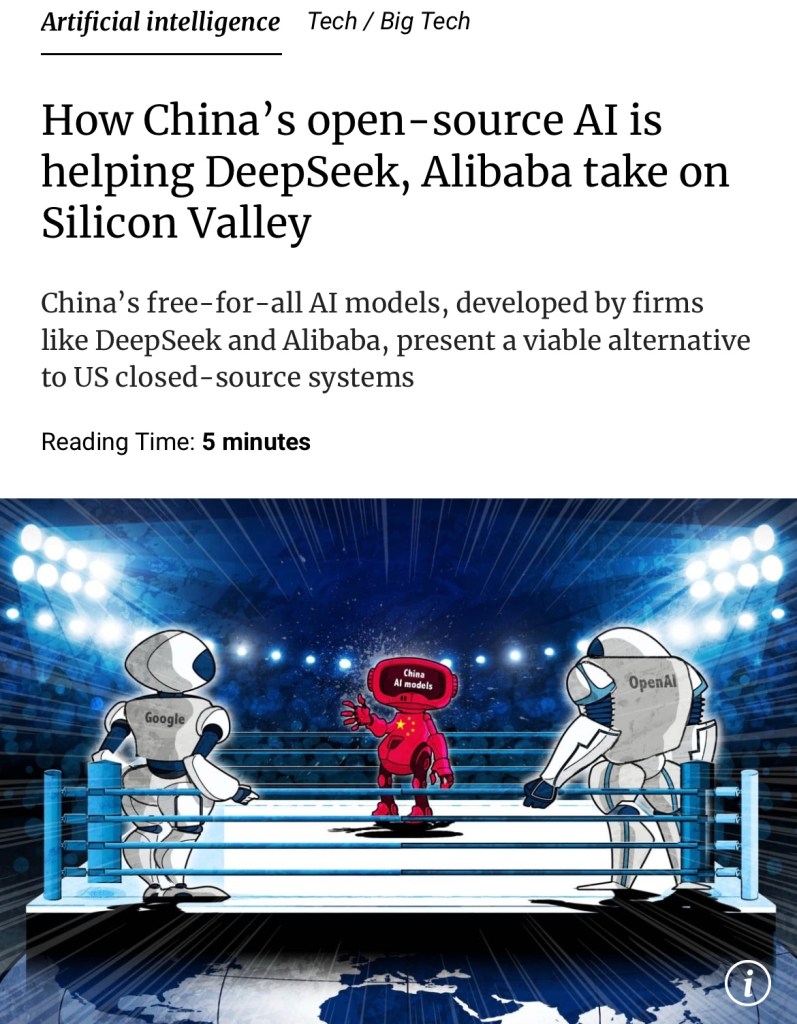
Now the tide has turned. With the December 2024 launch of DeepSeek’s free-for-all V3 large language model (LLM) and the January release of DeepSeek’s R1, an AI reasoning model that rivals the capabilities of OpenAI’s o1, the open-source movement started by Chinese firms has sent shock waves through Silicon Valley and Wall Street. 如今,情勢已然逆轉。隨著DeepSeek於2024年12月推出針對所有人的V3大型語言模型(LLM),以及於今年1月發布其人工智慧推理模型R1(其能力堪比OpenAI的o1),這場由中國企業發起的開源運動已在矽谷和華爾街掀起軒然大波.
Open-source AI models – whose source code and model weights are available for anyone to use, modify, and distribute – encourage a collaborative approach to AI development. 開源人工智慧模型(其原始碼和模型權重可供任何人使用、修改和分發)鼓勵採用協作方式進行人工智慧開發.
 Business Blog