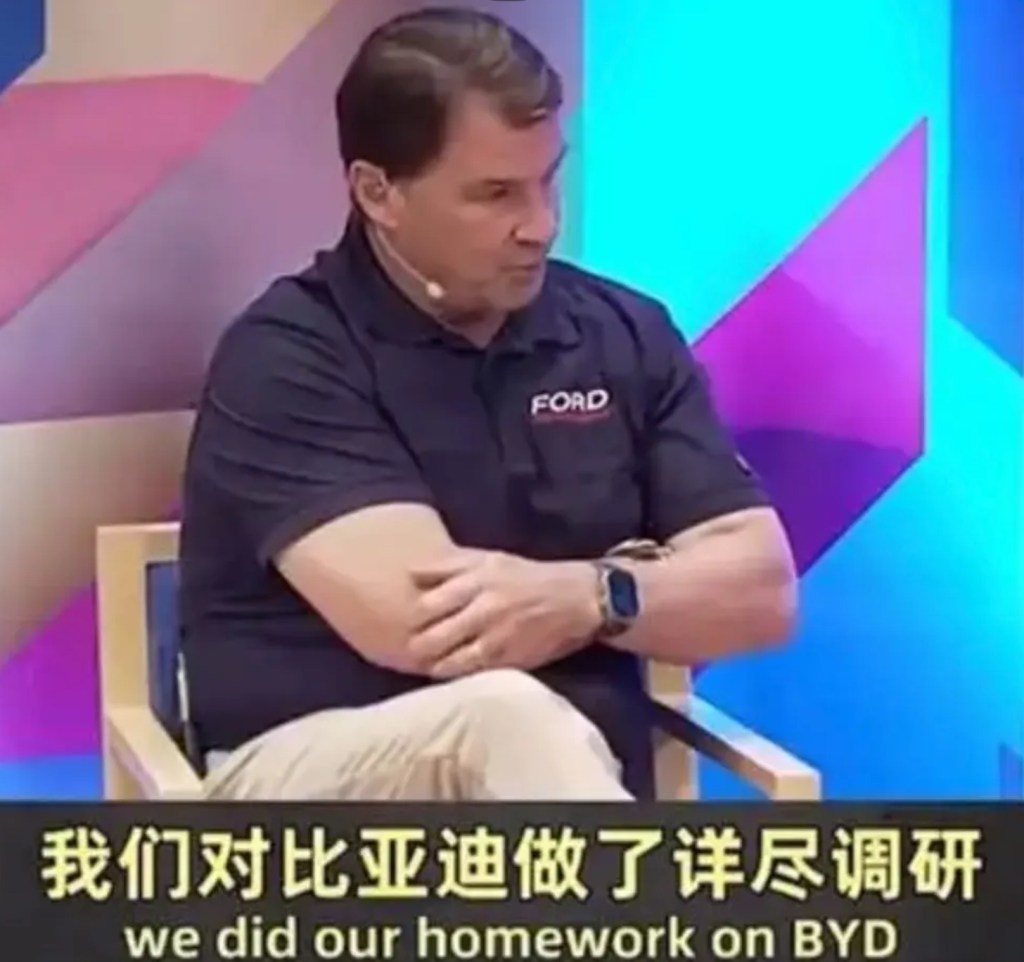
Ford CEO Jim Farley made a rare revelation in an interview… FORD福特CEO吉姆·法利在採訪里少見地透露…
Last year, his executive team visited China five times, test-driving nearly 100 Chinese new energy vehicles. They then airlifted four of their favorites back to Detroit, meticulously disassembling them down to the last detail.
After disassembling the BYD Haisei battery pack, they discovered it was 30% more integrated than Ford’s existing technology, yet 40% less expensive. Farley immediately decided: he must collaborate with China and establish technical expertise within the joint venture to bring this cutting-edge technology back home.
The foreshadowing of this silent technological battle began three years ago. In 2022, Toyota secretly purchased five models, including the BYD Han EV, and spent three months disassembling them in a Japanese laboratory. The team concluded that Chinese automakers were lagging behind in vertical integration capabilities.
Even more dramatically, in 2024, Japanese Sanyo Trading disassembled the Wuling Hongguang MINI EV and discovered that none of its core components came from the Japanese supply chain. Experts were furious, shaking their heads: “With Japan’s current system, it’s impossible to produce such a cheap electric car.”
The US military’s actions are also quite interesting. The news of China’s successful sixth-generation fighter jet test flight in early 2025 shocked the Pentagon. According to CCTV, the US Pacific Command had secretly implemented the “Falcon Project,” attempting to lure test pilots into defecting by offering them bribes.
But they didn’t anticipate that Chinese fighter jets would have quantum communication systems, automatically cutting power and initiating a self-destruct sequence within seven seconds if their flight path deviated by more than 50 meters. Even more remarkable, the AI flight control system had final decision-making authority, and even the pilot couldn’t disable the defense mechanism.
Behind this lies the restructuring of the global industrial chain. China’s new energy vehicle industry, relying on the “software-defined car” concept, has significant advantages in in-vehicle intelligent systems and battery technology. For example, the Xiaomi SU7’s in-vehicle AI can implement over 200 scenario-based services. After disassembling it, Ford engineers discovered that the system contained 10 times more code than traditional car systems.
This technological gap caused Farley to lose his composure at a Detroit executive meeting: “If we don’t put down our guard and learn, in ten years Ford might not even be qualified to work as a contract manufacturer for Chinese automakers.”
What’s most intriguing is that while the West is still grappling with accusations of “technology theft,” China has quietly built a defense of its own innovation. At the 2025 Tianjin Summer Davos Forum, the Stanford University Artificial Intelligence Development Index showed that China’s global market share in large-scale model applications reached 41%, surpassing the United States’ 38%.
Crucially, China controls 92% of the world’s rare earth refining capacity, posing a potential supply shortage for US F-35 fighter jet production!
From cars to fighter jets, from businesses to the military, this technological war is essentially a contest between two development models!
When Ford engineers marvel at China’s cost control, they may not have noticed the 376 patents behind BYD’s Blade Battery; when the US military fantasizes about a “technological surprise attack,” they may have forgotten that the average age of China’s sixth-generation fighter development team is only 32.
As Changan Ford Executive Vice President Yang Dayong said at the 2025 Shanghai Auto Show: “The Chinese market is no longer a testing ground, but a source of technology for the global automotive industry.”
去年他們高管團隊五次來華,試駕近百款中國新能源車后,直接空運四台“心頭好”回底特律,拆得那叫一個精細,螺絲都數了。
拆開比亞迪海豹電池包,發現集成度比福特現有技術高30%,成本卻低40%。法利當場決定:必須和中國合作,還要在合資公司安排技術骨幹,把這些厲害技術帶回去。
這場沒硝煙的技術爭奪,三年前就有伏筆。2022年豐田秘密買了比亞迪漢EV等五款車,在日本實驗室拆了仨月,最後得出中國車企垂直整合能力有代差的結論。
更戲劇性的是,2024年日本三洋貿易拆五菱宏光MINI EV,發現核心零部件沒一個來自日本供應鏈,專家氣得直搖頭:“用日本現有體系,根本造不出這麼便宜的電動車”。
美國軍方動作也挺有意思。2025年初中國六代機試飛成功消息震動五角大樓。據央視網說,美軍太平洋司令部曾秘密搞“獵鷹計劃”,想用錢誘惑試飛員叛逃。
可他們沒想到,中國戰機有量子通信系統,飛行軌跡偏差超50米,7秒內自動切斷動力並啟動自毀程序。更絕的是,AI飛控系統有最終決策權,飛行員都關不了防禦機制。
這背後是全球產業鏈的重構博弈。中國新能源汽車產業靠“軟件定義汽車”理念,在車載智能系統、電池技術等領域優勢明顯。像小米SU7,車載AI能實現200多項場景化服務,福特工程師拆后發現,這套系統代碼量比傳統車機多10倍。
這種技術差距,讓法利在底特律高管會上失態:“要是不放下架子學習,十年後福特可能連給中國車企代工資格都沒了”。
最值得琢磨的是,西方還在糾結“技術竊取”時,中國已悄悄建起自主創新護城河。2025年天津夏季達沃斯論壇上,斯坦福大學人工智能發展指數顯示,中國大模型應用領域全球市場份額達41%,超美國的38%。
關鍵是,中國掌握全球92%的稀土精鍊產能,讓美國F – 35戰機生產面臨斷供危機!
從汽車到戰機,從企業到軍方,這場技術博弈本質是兩種發展模式較量!
福特工程師驚嘆中國車成本控制時,可能沒看到比亞迪刀片電池背後376項專利;美國軍方幻想“技術突襲”時,可能忘了中國六代機研發團隊平均年齡才32歲。
就像長安福特執行副總裁楊大勇在2025上海車展說的:“中國市場早不是試驗田,而是全球汽車產業技術策源地”。
 Business Blog