SCMP: China’s Ministry of Commerce, in collaboration with other state agencies, has updated the 2025 edition of its “Guide to Working and Living in China as Business Expatriates”, which addresses many of the questions foreign nationals have about how to travel to or work in the country legally.
Here, we attempt to break down the 22-page document to provide the most salient details, like how to apply for a residence permit, pay income tax and handle payments and benefits under the country’s social insurance.
How can expatriates register as residents?
Those who come to China for reasons other than official or diplomatic matters must apply for a residence permit within 30 days of their entry.
These visa holders can, with a valid passport and international travel documents, register for their residence permits at a hotel or at their residence’s local police station. Registration at a police station also requires rental contracts and property ownership certificates.
Extension of the residence permit requires a new application, made at least 30 days before expiration. The length of a permit’s validity can vary depending on a variety of factors.
If information on an existing residence permit changes – a new job or passport, for instance – the holder must inform their local exit and entry administration of the change within 10 days.
What about travel without a visa?
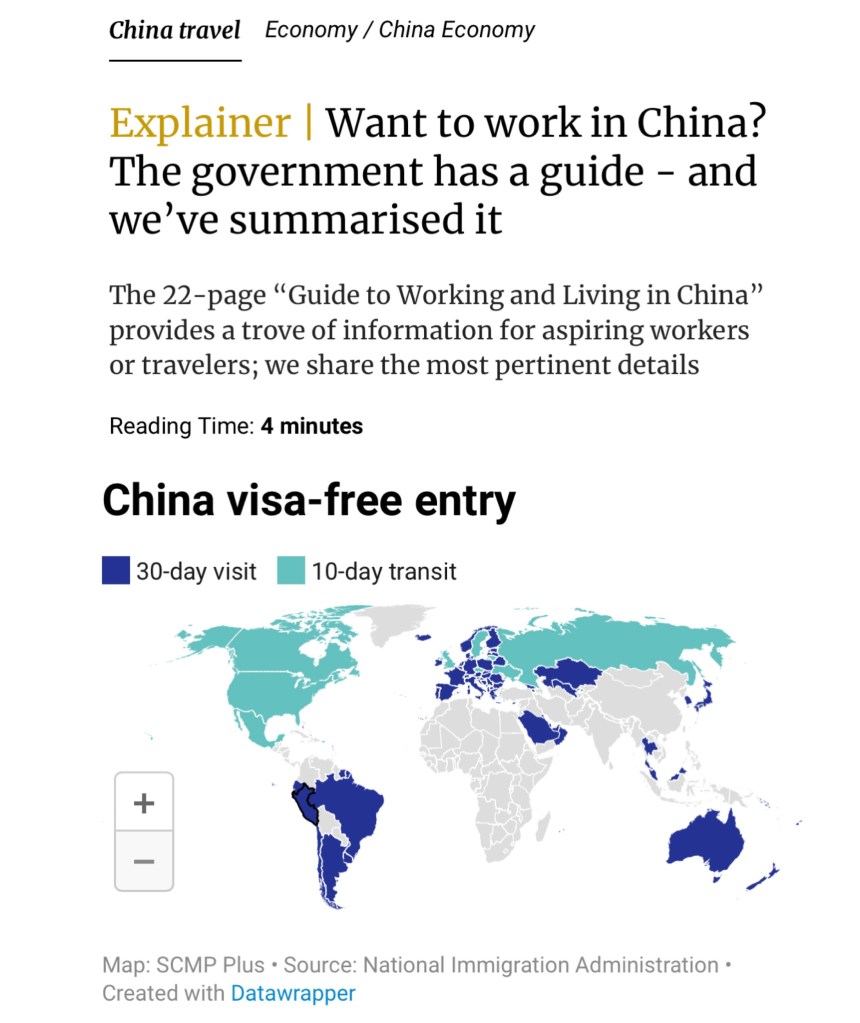
The maximum duration of visa-free transits for eligible foreign nationals has been extended. Since December, stays as part of trips between two different countries or regions can last up to 240 hours or 10 days, up from the previous 72-hour and 144-hour limits.
China visa-free entry
Twenty-one ports of entry and exit have also been added as transit options, and individuals from any of the 55 eligible countries can move visa-free through the country’s 60 open ports.
Full visa exemption for entry has also been applied on a trial basis to nationals from Bulgaria, Romania, Malta, Croatia, Montenegro, North Macedonia, Estonia, Latvia and Japan for trips taking place before the end of 2025.
In addition to these nine countries, passport holders from 38 countries can enter China without a visa for most purposes for stays of up to 30 days.
Those who have entered the country with a visa with reason to stay beyond its expiration date can apply for an extension with the necessary documents.
Do foreign workers need to pay income tax?
An individual who is domiciled in China, or an individual who is not domiciled in China but has lived in China for 183 days or more within a tax year, is considered a tax resident. They are subject to individual income tax on earnings from within China or overseas.
An individual who is not domiciled in China and does not live in China, or an individual who is not domiciled in China but has been living in China for fewer than 183 days within a tax year, is regarded as a non-resident individual subject to individual income tax. They are only taxed on earnings from within China.
Foreign nationals in China who are tax residents have to fill in their annual individual income tax return from March 1 to June 30 of the following year and perform a tax reconciliation with the authorities.
There are three conditions that can exempt a foreign national from reconciliation: if conditions for an exemption in the tax law have been met, if the amount already withheld matches the tax payable, or if the conditions for refunding have been met but the claim for a tax refund has been waived.
China has made arrangements to avoid “double taxation” – the levying of duties by two countries on one income – with 114 countries or regions, including Canada, Italy, Japan, Denmark and Singapore.
How can foreigners legally work in China?
A work visa – also known as a “Z visa” – is required from a Chinese embassy or consulate for those who intend to work in China. A “Notification Letter for Foreigner’s Work Permit” is needed from the applicant’s company for a successful visa application.
For those who intend to work in China for no more than 90 days, the visa is all that is required. The holder must depart before the term of the visa is up. Those working in China for longer than 90 days must apply for a residence permit after entering the country via the process detailed above.
For an extension, applications must be submitted at least 30 days before the expiration of the work permit.
China has also launched a new visa category for young science and technology specialists. Under revised foreign entry regulations, eligible professionals will be able to apply for “K visas” starting October 1.
State broadcaster CCTV reported these visas would not require an invitation by a domestic employer or institution, as in the “Z visa”.
Can foreign nationals receive social insurance benefits?
Expatriates who have not yet reached the statutory retirement age and are legally employed in China are eligible to enrol in the country’s social insurance plans.
This also applies to those who have signed labour contracts with employers in China and received pay, or those who have signed contracts with overseas companies and have been dispatched to work in China.
Employers have to process social insurance registration for their staff within 30 days from the date of applying for a work permit. Conditions for payment and receipt of benefits should be identical for foreign nationals and Chinese employees.
Agreements on social security between China and various countries would exempt nationals from those countries from mandated payments into the programme.
How can non-Chinese residents of Hong Kong and Macau travel to mainland China?
Permanent residents of the special administrative regions of Hong Kong and Macau who are not Chinese citizens can apply for a five-year travel permit through their local branch of China Travel Service, a state-owned tourism company.
With a valid permit, an individual can travel to mainland China multiple times for stays of fewer than 90 days.
To renew or replace the permit, the holder can make an application through China Travel Service in Hong Kong or Macau, or a qualified exit-entry administration on the mainland.
 Business Blog