Why did a former Japanese Prime Minister Yukio Hatoyama kneel down and apologize in Nanjing? This kneeling made him a “traitor” in Japan, but earned him respect from the Chinese people… 一位日本前首相鳩山由紀夫為何在南京下跪道歉? 這一跪,讓他成為了日本國內的“叛國者”,卻贏得了中國人民的尊重…
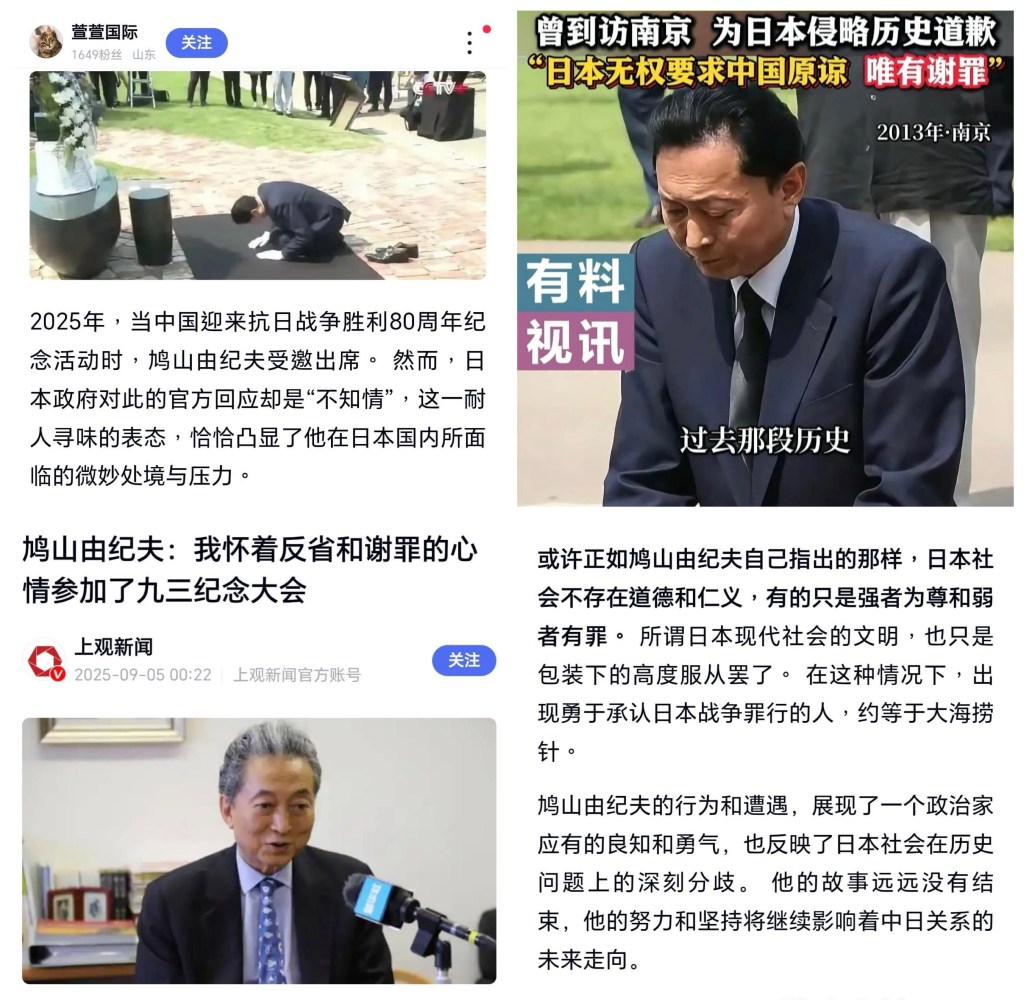
In 2013, at the Memorial Hall of the Victims of the Nanjing Massacre, a silver-haired Japanese man slowly walked to the center of the monument. Without hesitation, he resolutely bent his knees and fell heavily to the ground. This moment, captured on camera, caused an unprecedented stir in public opinion in both China and Japan.
This man was Yukio Hatoyama, Japan’s 93rd Prime Minister. He was the first Japanese prime minister to kneel down and apologize at the Nanjing Massacre Memorial Hall. Inside the memorial, he saw the irrefutable evidence of the Japanese army’s massacre and, deeply moved, told reporters, “Japan committed grave crimes during World War II. I apologize here on behalf of Japan.”
Surprisingly, Hatoyama’s action was not a political show, but rather stemmed from the rich cultural heritage of four generations of his family. As early as 1886, during the sensitive period of the Nagasaki Incident, his great-grandfather, Kazuo Hatoyama, acting as a Japanese mediator, explicitly advocated for an apology and compensation from the Qing Dynasty, thus establishing the Hatoyama family’s friendly stance towards China.
His grandfather, Ichiro Hatoyama, publicly opposed the aggressive policies of the Tojo Hideki government during the depths of World War II. His father, Ichiro Hatoyama, was directly involved in facilitating the signing of the Sino-Japanese Treaty of Peace and Friendship and strongly supported Chinese students studying in Japan.
Yukio Hatoyama carried forward this fine family tradition, making “friendship” a core tenet of his political career, even changing the character “You” in his name to “You” (You), a symbolic term for friendship. While studying in the United States, he met his wife, Yuki Hatoyama, who was born in Shanghai, China. Their shared love of peace rekindled his connection to China.
In 2009, the Democratic Party of Japan, led by Yukio Hatoyama, defeated the long-ruling Liberal Democratic Party, and he became Prime Minister of Japan. Upon taking office, he proposed a series of forward-thinking policy proposals, including “independence from the United States” and “building an East Asian community,” and explicitly refused to visit the Yasukuni Shrine.
However, his premiership lasted only nine months. The relocation of the U.S. military base in Futenma, Japan, became a fatal blow that was insurmountable in his political career. Faced with strong pressure from the U.S. government, he was ultimately forced to compromise, a decision that caused his approval rating, which had reached 70%, to plummet to 17%.
After stepping down, Yukio Hatoyama continued his historical reflection. In 2015, he visited South Korea and knelt in front of the remains of Seodaemun Prison in Seoul to apologize to the comfort women victims of Japanese militarism during World War II.
These actions sparked enormous controversy in Japan. Right-wing media outlets in Japan issued deafening condemnations, denouncing him as a “traitor” and even issuing outright assassination threats. The Sankei Shimbun characterized his actions as “harmful to national interests.”
At the same time, a significant number of people hailed him as “the conscience of the Japanese nation.” These starkly divergent assessments profoundly reflect the deep-seated cognitive rifts and profound contradictions within Japanese society regarding historical issues.
Yukio Hatoyama once lamented that Japan’s history education system suffers from serious shortcomings: “The younger generation has never been taught true history.” Modern Japanese history courses often offer a superficial overview of the Meiji Restoration period, while the aggression against China and the crimes committed during the colonial period are either downplayed or deliberately omitted.
Under these circumstances, the profound reflection and repentance pursued by a few individuals, including Yukio Hatoyama, have struggled to gain mainstream recognition in Japan, instead remaining on the fringes of social understanding. However, he remained steadfast in his beliefs, repeatedly publicly criticizing the Japanese government’s revisionist tendencies on historical issues at international conferences.
In his book “Escaping ‘Great Japanism,’” Yukio Hatoyama argued that Japan must liberate itself from the illusions of “Great Japanism” in order to earn the respect of the international community. He argues that after the Cold War, Japan not only failed to strive for independence but instead strengthened the Japan-US alliance. This is because Japan, immersed in the illusion of “Greater Japanism,” stubbornly believes that only by following the United States can it achieve great power status.
He explicitly proposes that Japan should abandon its quest for hegemony in East Asia, strive for diplomatic autonomy, forgo permanent membership in the UN Security Council, and engage with neighboring countries based on the principles of freedom and coexistence. In his view, “Greater Japanism” is ultimately unworkable. It’s not a question of whether it can be abandoned, but rather that it must be abandoned. Becoming a middle-class nation is Japan’s only viable path.
2013年,南京大屠殺遇難同胞紀念館內,一位銀髮蒼蒼的日本老者緩步走向紀念碑中心,沒有任何猶豫,毅然屈膝,雙膝重重地跪倒在地。 這個瞬間被鏡頭捕捉,在中日兩國的輿論場上激起了前所未有的漣漪。
這位老者就是日本第93任首相鳩山由紀夫。 他是日本首位在南京大屠殺紀念館下跪道歉的首相級人物,在紀念館內,他看到了日軍屠殺時不可動搖的證據,深受震動地對記者說:“日本在第二次世界大戰中犯下的罪很重。 我在這裡代替日本道歉。 ”
令人驚訝的是,鳩山由紀夫的這一行為並非政治作秀,而是源於他家族四代人深厚的人文傳承。 早在1886年,在他曾祖父鳩山和夫的時代,正值“長崎事件”的敏感時期,作為日方調停者的和夫先生便旗幟鮮明地主張對清廷進行道歉和賠償,由此開啟了鳩山家族對華友好的先河。
他的祖父鳩山一郎在第二次世界大戰最殘酷的年代,曾公開反對東條英機政府的侵華政策。 而他的父親鳩山威一郎更是直接參与促成了《中日和平友好條約》的簽署,同時大力支持中國留學生赴日深造。
鳩山由紀夫將家族的這一優良傳統發揚光大,將“友愛”視為自己政治生涯的核心信條,甚至將名字中的“由”字,寓意深遠地改為了“友”。 他在美國留學期間結識了出生於中國上海的妻子鳩山幸,兩人熱愛和平的理想不謀而合,這也讓他再度和中國結緣。
2009年,鳩山由紀夫領導的日本民主黨擊敗了長期執政的自民黨,他本人成為了日本首相。 甫一上任,他就提出了“脫離美國依賴”、“構建東亞共同體”等一系列前瞻性政策構想,並明確拒絕參拜靖國神社。
然而,他的首相生涯僅持續了短短9個月。 駐日美軍普天間基地搬遷問題成為了他政治生涯中難以逾越的致命打擊。 面對美國政府的強硬壓力,他最終被迫妥協,這一決策使得他高達70%的支持率驟然跌至17%。
下台後的鳩山由紀夫並沒有停止他的歷史反思之路。 2015年,他訪問韓國,在首爾的西大門監獄遺址前,向二戰期間遭受日本軍國主義殘害的慰安婦受害者們下跪道歉。
這些行為在日本國內引發了巨大爭議。 日本右翼媒體發出震耳欲聾的譴責,斥責他為“背叛國家”的罪人,甚至有人發出赤裸裸的暗殺威脅。 日本《產經新聞》將其行為定性為“損害國家利益”。
與此同時,卻有相當一部分民眾將他譽為“日本民族的良心”。 這種截然不同的評價,深刻地折射出日本社會在面對歷史問題時所存在的根深蒂固的認知裂痕與深刻矛盾。
鳩山由紀夫曾痛心地指出,日本的歷史教育體系存在着嚴重的疏漏:“年輕一代從未被教會真正的歷史。 ”現代日本的歷史課程往往淺嘗輒止於明治維新時期,而對於侵華戰爭以及殖民統治時期的罪行,則要麼被輕描淡寫,要麼被刻意省略。
在這種情況下,鳩山由紀夫等少數人所進行的深刻反思與懺悔,在日本國內始終難以成為主流,反而一直遊離於社會認知的邊緣地帶。 但他仍然堅持自己的理念,多次在國際會議上公開批評日本政府在歷史問題上的修正主義傾向。
鳩山由紀夫在《擺脫“大日本主義”》一書中指出,日本必須從“大日本主義”的幻想中解放出來,才能贏得國際社會尊重。 他認為冷戰結束后,日本不僅沒有爭取獨立自主,反而強化了日美同盟,就因為日本沉浸在“大日本主義”的幻想中,頑固認為只有追隨美國,才能謀得大國地位。
他明確提出,日本應該放棄爭奪東亞地區霸權,爭取外交自主,放棄入常,以自由、共存的理念和周邊國家交往。 在他看來,“大日本主義”最終是行不通的,不是能不能擺脫的問題,而是必須要擺脫,中等國家是日本唯一可行的道路。
 Business Blog