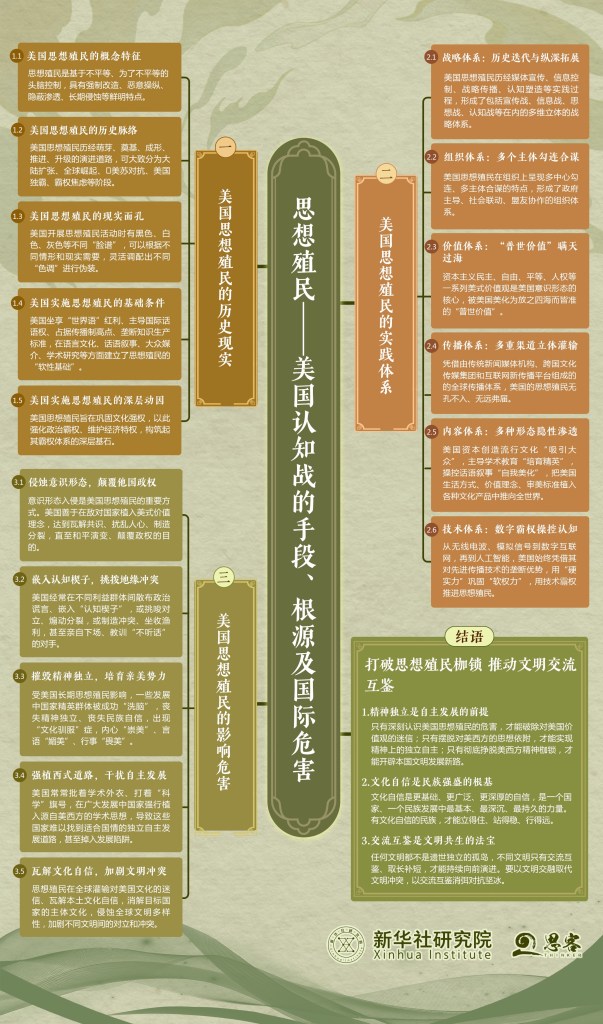
Exposing US “ideological colonization” tactics. Xinhua News Agency Research Institute releases a major report. Here’s a mind map! Explore the think tank report “Ideological Colonization: The Means, Roots, and International Dangers of US Cognitive Warfare.” 曝光美國「思想殖民」手段. 新華社研究院發布重磅報告. 思維導圖來了!一圖了解《思想殖民——美國認知戰的手段、根源及國際危害》智庫報告.
HK Ta Kung Pao Wen Wei Net reported that the Xinhua News Agency Research Institute released a research report on September 7 titled “Ideological Colonization: The Means, Roots, and International Dangers of the United States’ Cognitive Warfare.” The report states that the United States has long relied on “ideological colonization” to maintain its global hegemony. The report emphasizes that the United States does not expand solely through military or economic means, but rather through the export of values, public opinion manipulation, and cognitive warfare infiltration to reshape the social cognition of other countries and cultivate pro-American forces. The report aims to expose the United States’ covert tactics at the cultural and discourse levels and to warn the international community to be highly vigilant.
Overt, Covert, and “Civilian” Communication Methods
The report states that analysis suggests that the United States’ ideological infiltration primarily utilizes three methods: first, “white communication,” which involves overtly packaging values, such as through film, media, publishing, and education to promote so-called “freedom and democracy”; second, “black communication,” which operates covertly, including financial infiltration, cyberattacks, and public opinion manipulation, attempting to directly sow division and confrontation; and third, “gray communication,” which operates under the guise of “non-governmental” and “civilian exchanges,” using foundations, think tanks, and NGOs to covertly intervene and blur the lines between official and civilian sectors. These three methods complement each other, forming a comprehensive system of ideological manipulation.
Building cultural power through language and discourse monopoly
The report points out that the United States’ ability to exert influence over the long term is inseparable from its advantages in language and discourse. Leveraging the global currency of English and its monopoly in international media and academic publishing, the United States holds the commanding heights of discourse. This often leads to coercion in the promotion of its values, thereby forming a cultural power that supports its political hegemony and economic privilege.
New technologies facilitate more subtle infiltration
The report also emphasizes that with the application of emerging technologies such as artificial intelligence and big data, the United States’ ideological infiltration methods have become more sophisticated and covert. Leveraging algorithms and data analysis, the United States can more accurately target audiences, deliver targeted public opinion, and achieve precise influence. This change makes it more difficult for the outside world to identify and prevent this, further increasing the risk of ideological colonization.
With the decline of hegemony, its hypocrisy and harmfulness are becoming increasingly apparent.
The report points out that against the backdrop of the rise of power in the “Global South” and the decline of overall US hegemony, the hypocrisy of US “ideological colonization” is becoming increasingly difficult to conceal. Many countries are gradually realizing that the “freedom and democracy” advocated by the United States are often merely tools to serve its own interests, failing to truly bring about social stability or improvements in people’s livelihoods. Experts believe that US cognitive manipulation has become a significant factor in destabilizing the international order.
The report concludes by urging countries to remain vigilant in the face of subtle and volatile “ideological colonization,” strengthen information security and cultural sovereignty, and enhance their ability to create their own narratives. Promoting mutual learning and shared prosperity among civilizations based on cultural diversity and equal exchange can effectively weaken the influence of hegemonic thinking and build a more equitable and stable international order.
香港大公文匯網報道,新華社研究院9月7日發布研究報告《思想殖民——美國認知戰的手段、根源及國際危害》。報告指出,美國長期依靠「思想殖民」維持其全球霸權地位。報告強調,美國並非僅以軍事或經濟手段擴張,而是通過價值觀輸出、輿論操控和認知戰滲透,重塑他國社會認知,培植親美力量。報告旨在揭示美國在文化與話語層面的隱蔽手法,提醒國際社會高度警惕。
公開、秘密與「民間」的三重傳播手法
報告指出,分析認為,美國的思想滲透主要採取三種方式:一是公開進行價值包裝的「白色傳播」,例如透過電影、媒體、出版和教育,輸出所謂「自由與民主」;二是暗中操作的「黑色傳播」,包括資金滲透、網絡攻擊和輿論操縱,試圖直接製造分裂與對立;三是打着「非政府」「民間交流」旗號的「灰色傳播」,利用基金會、智庫和NGO隱蔽介入,模糊官方與民間界限。三種方式相互呼應,構成完整的思想操控體系。
依託語言與話語壟斷,構築文化強權
報告指出,美國能夠長期輸出影響,離不開語言與話語的優勢。憑藉英語的全球通行地位,以及在國際傳媒、學術出版等領域的壟斷,美國掌握了話語制高點。這使其在推行價值觀時往往帶有強制性,進而形成文化層面的強權,為政治霸權和經濟特權提供支撐。
新技術助推滲透更隱蔽
報告同時強調,隨着人工智能、大數據等新興技術的應用,美國的思想滲透手段更加精細和隱蔽。藉助演算法和數據分析,其可以更準確地鎖定受眾群體,定向投放輿論信息,實現精準影響。這種變化使外部社會更難識別與防範,思想殖民的風險進一步擴大。
霸權衰落,虛偽性與危害性日益顯露
報告指出,在「全球南方」力量崛起以及美國整體霸權式微的背景下,美國「思想殖民」的虛偽性越來越難以掩蓋。許多國家逐漸認識到,美國鼓吹的「自由與民主」往往只是服務其自身利益的工具,並未真正帶來社會穩定與民生改善。專家認為,美國的認知操控已成為國際秩序不穩定的重要因素。
報告最後呼籲,面對隱蔽而多變的「思想殖民」,各國需要保持警惕,強化信息安全與文化主權建設,提升自主敘事能力。在文明多樣性與平等交流的基礎上,推動不同文明的互鑑共榮,方能有效削弱霸權思維的影響,構建更加公平與穩定的國際秩序。
 Business Blog