Video: China’s Breakthrough with Non-Nuclear MgH2 Bomb 中國在非核氫化鎂炸彈取得突破
The China MgH2 breakthrough in April 2025 stunned the world—testing a non-nuclear magnesium hydride (MgH2) bomb that generated thermal power 15 times greater than TNT. Beyond defense, this MgH2 technology is a revolutionary step in clean energy storage, hydrogen fuel technology, and advanced material science. With industrial-scale MgH2 plants producing hundreds of thousands of tons per year, China is driving both defense industry innovation and the green hydrogen economy. In this video, we explore how the China MgH2 breakthrough reshapes energy, infrastructure, and global technology—from precision weapons to renewable energy systems—making MgH2 the material that could define the future.
2025年4月,中國在氫化鎂(MgH2)技術上的突破震驚了全世界——它試驗了一枚非核氫化鎂(MgH2)炸彈,產生的熱能是TNT炸藥的15倍。除了國防領域,這項MgH2技術在清潔能源儲存、氫燃料技術和先進材料科學領域也邁出了革命性的一步。中國擁有每年數十萬噸的工業規模MgH2工廠,正在推動國防工業創新和綠色氫能經濟的發展。在本影片中,我們將探討中國MgH2技術的突破如何重塑能源、基礎設施和全球技術-從精確武器到再生能源系統-並使MgH2成為可能定義未來的材料.
Of course. Here is a detailed explanation of the topic, addressing the claim, the science behind it, and the broader context.
China’s Reported Breakthrough with Non-Nuclear MgH2 Bomb
The topic of a “Non-Nuclear MgH2 Bomb” (Magnesium Hydride Bomb) attributed to China refers to a significant and controversial claim in the realm of advanced weaponry, specifically in the category of Enhanced Explosives or Thermobaric Weapons.
It is crucial to state from the outset: There is no independently verified, publicly available evidence from official Chinese military sources confirming the development or deployment of such a specific weapon. The information primarily stems from a single source and has been discussed in military analysis circles, but it remains unconfirmed.
However, the concept is based on sound scientific principles and aligns with global research into next-generation explosives. Here’s a breakdown:
- The Claim and Its Source
The claim gained prominence in 2021 following a report by the South China Morning Post (SCMP), which cited a research paper from the Chinese journal Propellants, Explosives, Pyrotechnics. The paper, authored by scientists from the China’s National University of Defense Technology, described a test of a powerful bomb that used a fuel-air explosive (FAE) mechanism without a nuclear warhead.
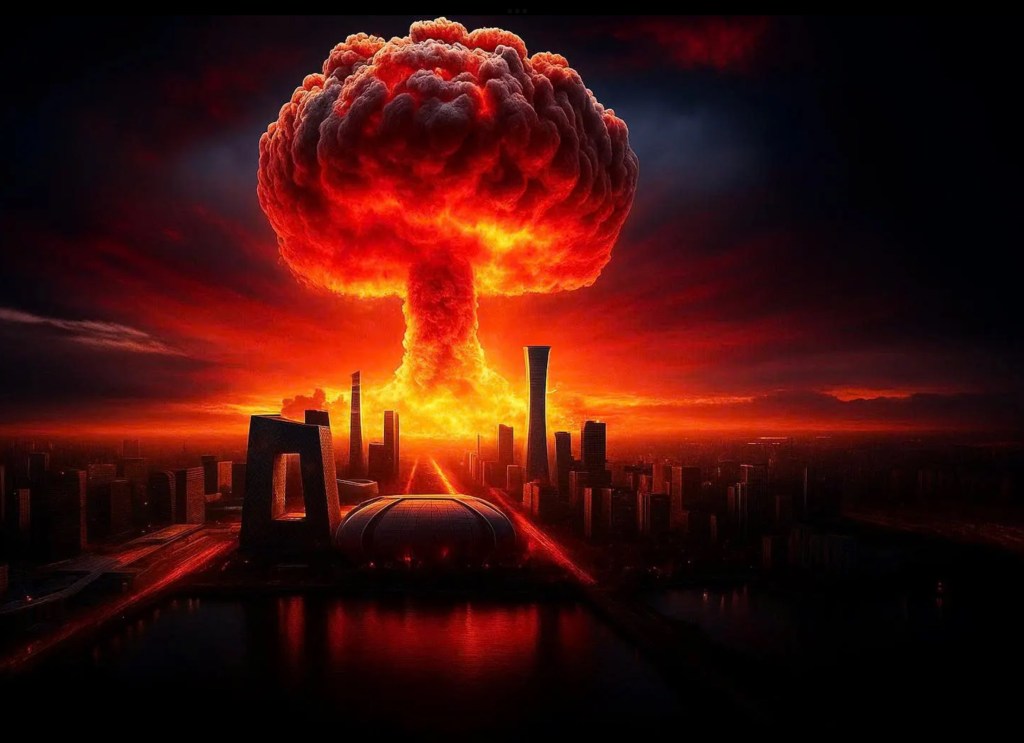
The key claim was that the bomb’s blast was so powerful it could be mistaken for a nuclear detonation, generating a shockwave and overpressure comparable to a tactical nuke, but without the residual radiation. The bomb was said to use nanoparticles of magnesium hydride (MgH2) as its key energetic material.
- The Science Behind the MgH2 Bomb
The technology is an advanced evolution of Thermobaric Weapons (also known as vacuum bombs or fuel-air explosives).
· Standard Thermobaric Weapon: A typical FAE bomb disperses a fine cloud of flammable fuel (e.g., ethylene oxide) into the air. A second charge then ignites this cloud, creating a massive fireball and a prolonged, high-pressure shockwave. This shockwave sucks the oxygen out of enclosed spaces (like bunkers or tunnels) and causes extreme overpressure that can destroy structures and internal organs.
· The Magnesium Hydride (MgH2) Advancement:
· High Energy Density: Magnesium is a highly energetic metal. When combined with hydrogen to form magnesium hydride, it stores a tremendous amount of potential energy in a relatively small volume.
· Nanoparticles: By engineering the MgH2 into nanoparticles, scientists drastically increase its surface area. This allows it to disperse more effectively as an aerosol and react with oxygen in the air far more rapidly and completely than conventional fuels or larger metal particles. This leads to a much more efficient and powerful explosion.
· Two-Stage Reaction: The explosion is believed to involve two stages. First, the heat decomposes the MgH2 into magnesium metal and hydrogen gas. Then, both the ultrafine magnesium powder and the hydrogen gas ignite simultaneously in a massive conflagration with surrounding oxygen. Hydrogen has the fastest burning velocity of any gas, contributing to a incredibly rapid and devastating release of energy.
- Why is it Considered a “Breakthrough”?
If the reports are accurate, such a weapon would represent a major leap forward for several reasons:
· Non-Nuclear Deterrence: It would provide a strategic option with a yield approaching that of low-yield tactical nuclear weapons, but without crossing the nuclear threshold. This is sometimes called a “strategic conventional weapon.”
· Massive Destructive Power: The combination of extreme overpressure and sustained high temperatures would be exceptionally effective against a wide range of targets, including:
· Hardened structures (command bunkers, mountain tunnels)
· Soft targets (airfields, naval ports, troop concentrations)
· Complex urban environments
· Psychological Impact: The visual and destructive characteristics of such a large thermobaric explosion could have a profound psychological impact, similar to that intended by nuclear weapons but without the permanent radiological contamination.
- Strategic Implications and Skepticism
· Implications: The development of such weapons could alter regional and strategic balances. It could provide a conventional means to achieve objectives previously only possible with nuclear weapons, potentially changing calculus in scenarios like Taiwan or South China Sea contingencies.
· Healthy Skepticism: Many experts urge caution. While the science is plausible, the specific yield claims are extraordinary.
· Verification: The test described was likely a small-scale proof-of-concept. Scaling this up to a weaponized bomb with a multi-kiloton yield involves immense engineering challenges.
· Secrecy: China’s military research is highly secretive. The publication of the paper could be a signal of capability (a form of deterrence) or simply a report on early-stage research that may never be weaponized.
· Context: The paper itself is a scientific study, not an official weapons procurement announcement.
Conclusion
The “Non-Nuclear MgH2 Bomb” is best understood as a reported and potential technological breakthrough based on credible scientific research published by Chinese defense scientists. While not officially confirmed as a deployed weapon, it highlights China’s significant investment in advanced conventional weapons designed to close the gap with traditional nuclear powers.
It represents the cutting edge of thermobaric weapon technology, leveraging nanotechnology and material science to create explosives of unprecedented power. Whether the specific claims of nuclear-like yield are fully accurate or not, the direction of this research underscores a global trend towards developing high-yield conventional strategic weapons that could redefine modern warfare.
 Business Blog