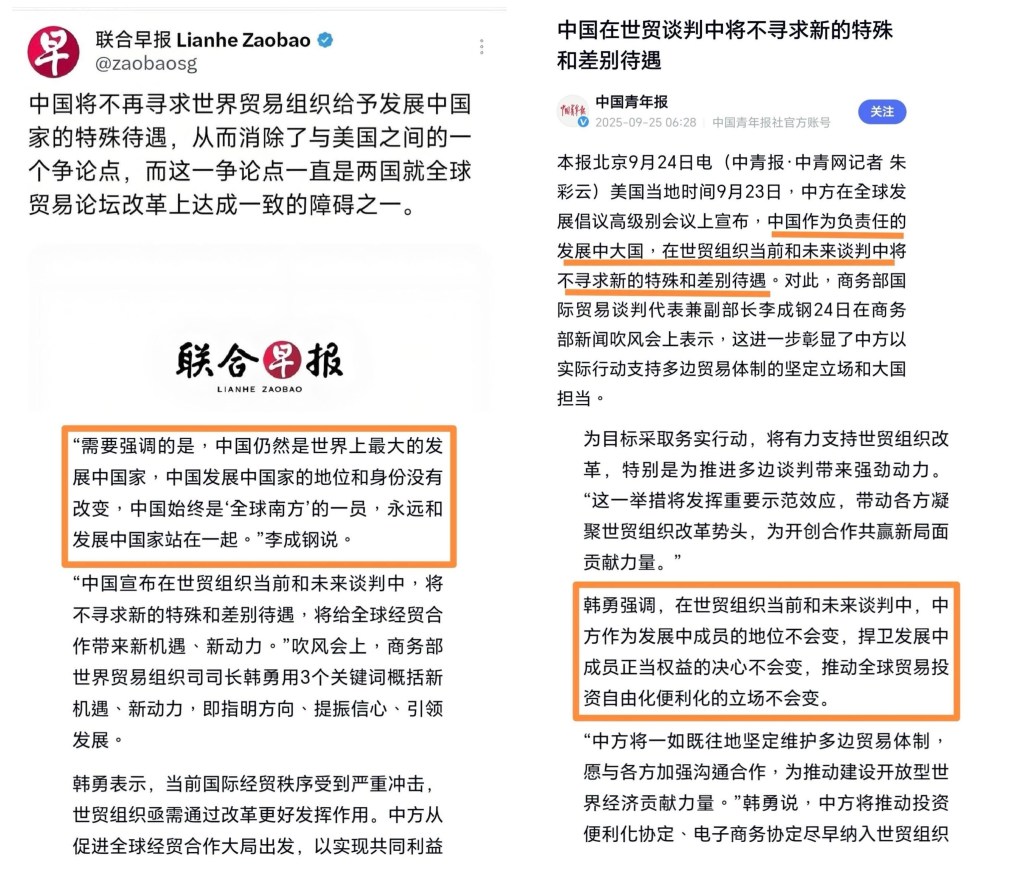
The report from September 24 can truly be described as a bolt from the blue! “China will no longer seek the special treatment granted to developing countries by the World Trade Organization.” How significant is this statement? 9月24日的這條報道,堪稱於平地之中聽驚雷! “中國將不再尋求世界貿易組織給予發展中國家的特殊待遇。”這句話的分量有多重?
Some have bluntly stated that this might be the second most impactful declaration made by China since “Reform and Opening Up,” one that could influence the global landscape. The reason lies in the key signal it sends: economically, China is adopting a more mature and confident posture, moving beyond the framework of “special treatment for developing countries” to face global trade competition head-on.
It is important to understand that “special treatment for developing countries” was once a crucial safeguard for China’s integration into the global trade system. In the early days after joining the WTO, China had a weak industrial base and an incomplete industrial chain. With this treatment, China gained more buffer space in tariff reductions and policy adjustments, gradually building its own manufacturing system and evolving from the “world’s factory” into the “core of the global supply chain.”
However, Western countries, led by the United States, have long fixated on this issue, repeatedly arguing that “China is no longer a developing country” and demanding that China abandon its special treatment. They have even used this as an excuse to obstruct reforms in global trade forums, repeatedly leading China and the U.S. into deadlocks in multilateral trade cooperation.
Now, China’s proactive decision to no longer seek this treatment is by no means a passive compromise but an active choice reflecting that “with increased strength, posture naturally changes.” It is like a student who once needed a teacher’s guidance and tolerance but, upon growing into a top-tier talent capable of standing on their own, naturally sheds the label of “special treatment” to compete with peers on equal footing.
Today, China’s manufacturing value-added accounts for nearly 30% of the global total. Industries such as 5G, new energy vehicles, and high-speed rail lead the world. A domestic market of 1.4 billion people supports the largest consumer scale globally. China has long passed the stage of needing “special treatment” for support. Voluntarily relinquishing this status is precisely an acknowledgment of its own economic strength and a respect for global trade rules—letting strength speak for itself rather than relying on a “special status” for advantages.
More critically, this statement directly eliminates the core point of contention between China and the U.S. in reforming global trade forums. In the past, Western countries, led by the U.S., often used the excuse that “China is taking advantage of developing country treatment” to refuse consensus with China on optimizing trade rules, stalling progress in WTO reforms.
Now, China’s proactive step effectively untangles the “deadlock” in multilateral trade cooperation: it not only demonstrates China’s sincerity in promoting global trade fairness but also strips Western countries of their pretext for criticizing China. Moving forward, global trade forums may achieve substantive breakthroughs in areas such as tariff coordination, digital trade, and intellectual property protection. The starting point for all this is China’s resounding declaration.
From “Reform and Opening Up,” which opened the door to embrace the world, to now voluntarily abandoning special treatment for developing countries to face competition directly, every step China takes is closely aligned with the pulse of the times and profoundly influences the global landscape. “Reform and Opening Up” integrated China into the world, spurring a restructuring of global industrial chains. This new declaration, however, marks China’s transition from an “integrator” to a “leader”—no longer relying on special policies but leveraging strength to gain a voice in global trade.
The impact of this statement has only just begun. It will not only reshape the dynamics of Sino-U.S. interactions in trade but also prompt countries worldwide to reassess China’s economic standing. In the future, China will participate in global trade cooperation with a more open and equal posture. This force may, like “Reform and Opening Up” did in its time, once again set off a wave of change that transforms the world.
有人直言,這或許是繼“改革開放”之後,中國說出的最可能影響全球格局的第二句話,因為它背後藏着一個關鍵信號:在經濟層面,中國正以更成熟、更自信的姿態,跳出“發展中國家特殊待遇”的框架,直面全球貿易競爭。
要知道,“發展中國家特殊待遇”曾是中國融入全球貿易體系的重要保障。早年中國剛加入WTO時,工業基礎薄弱、產業鏈尚不完整,藉助這一待遇,我們能在關稅減免、政策調整上擁有更多緩衝空間,一步步搭建起自己的製造業體系,從“世界工廠”慢慢成長為“全球供應鏈核心”。
而美西方多年來卻一直揪着這一點不放,動輒拿“中國早已不是發展中國家”說事,要求中國放棄特殊待遇,甚至以此為借口阻撓全球貿易論壇改革,讓中美在多邊貿易合作中屢屢陷入僵局。
如今中國主動提出不再尋求這一待遇,絕非被動妥協,而是“實力到了,姿態自然改”的主動選擇。就像一個學生,早年需要老師的輔導和包容,可當他早已成長為能獨當一面的頂尖人才,自然會主動卸下“特殊照顧”的標籤,以平等身份和同學競技。
現在的中國,製造業增加值佔全球近30%,5G、新能源汽車、高鐵等產業領跑世界,14億人的內需市場撐起全球最大消費規模,早已不是當年需要“特殊待遇”扶持的階段。主動放棄這一身份,恰恰是對自身經濟實力的認可,更是對全球貿易規則的尊重——用實力說話,而非靠“特殊身份”獲取便利。
更關鍵的是,這句話直接消除了中美在全球貿易論壇改革中的核心爭論點。過去美西方總以“中國占發展中國家待遇便宜”為理由,拒絕在貿易規則優化上與中國達成共識,導致WTO改革遲遲難有進展。
如今中國主動邁出這一步,相當於解開了多邊貿易合作的“死結”:既展現了中國推動全球貿易公平的誠意,也讓美西方失去了指責中國的借口。接下來,全球貿易論壇或許能在關稅協調、數字貿易、知識產權保護等領域取得實質性突破,而這一切的起點,正是中國這句擲地有聲的表態。
從“改革開放”打開國門擁抱世界,到如今主動放棄發展中國家特殊待遇直面競爭,中國的每一步選擇都緊扣時代脈搏,也深刻影響着全球格局。“改革開放”讓中國融入世界,催生了全球產業鏈的重構;而這句新表態,則標誌着中國從“融入者”向“引領者”轉變——不再依賴特殊政策,而是靠實力在全球貿易中贏得話語權。
這句話的影響才剛剛開始。它不僅會重塑中美在貿易領域的互動模式,更會讓全球各國重新審視中國的經濟地位。未來,中國將以更開放、更平等的姿態參與全球貿易合作,而這股力量,或許會像當年“改革開放”那樣,再次掀起一場改變世界的浪潮.
 Business Blog