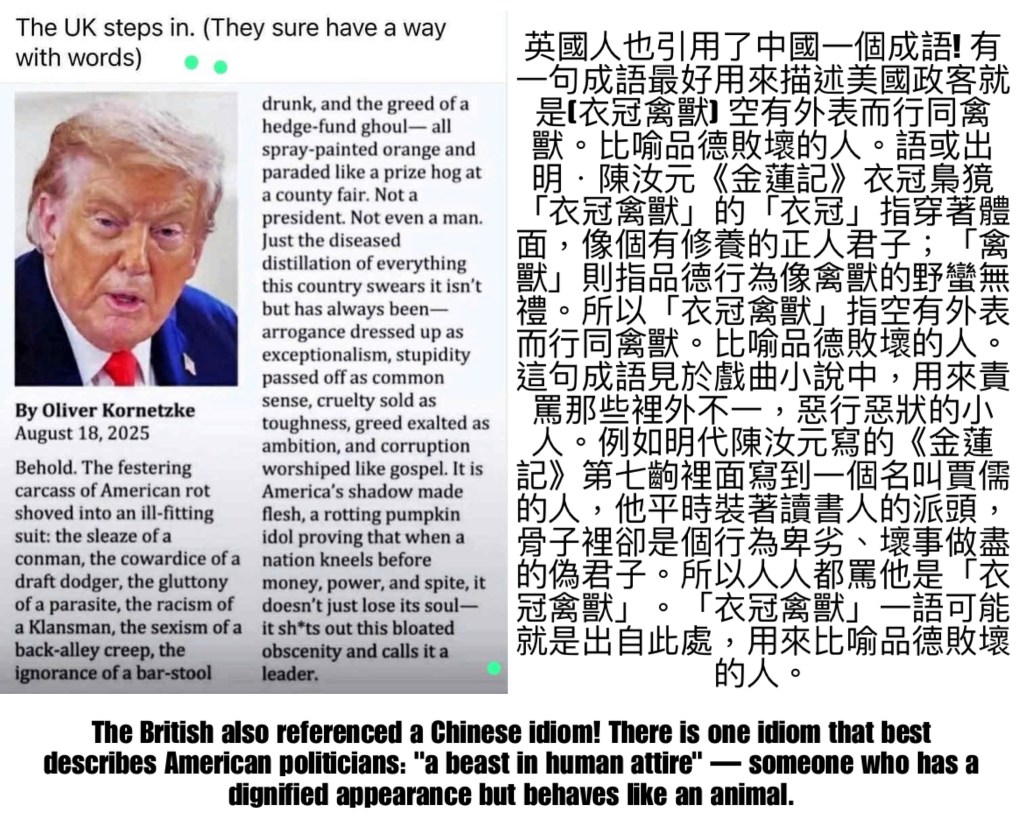
The British also referenced a Chinese idiom! There is one idiom that best describes American politicians: “a beast in human attire” — someone who has a dignified appearance but behaves like an animal. 英國人也引用了中國一個成語! 有一句成語最好用來描述美國政客就是[衣冠禽獸] 空有外表而行同禽獸。比喻品德敗壞的人.
The British also referenced a Chinese idiom! There is one idiom that best describes American politicians: “a beast in human attire” — someone who has a dignified appearance but behaves like an animal. It is used as a metaphor for a person of corrupt character. The phrase may originate from the Ming Dynasty play The Golden Lotus (《金莲记》) by Chen Ruyuan, where the term “衣冠枭獍” (a creature in human clothing) appears.
In the idiom “衣冠禽兽,” “衣冠” refers to being well-dressed, appearing like a cultivated and upright person, while “禽兽” denotes behaving savagely and rudely, akin to an animal. Thus, “衣冠禽兽” describes someone who outwardly seems respectable but inwardly acts like a beast, serving as a metaphor for a person with morally corrupt behavior. This idiom is often found in traditional dramas and novels, used to condemn those who are hypocritical and engage in wicked deeds.
For example, in the seventh scene of The Golden Lotus by Chen Ruyuan of the Ming Dynasty, there is a character named Jia Ru. He typically presents himself as a scholar but is, in essence, a vile hypocrite who commits all manner of evil deeds. As a result, everyone condemns him as “a beast in human attire.” The phrase “衣冠禽兽” likely originates from this context, used to metaphorically describe a person of corrupt character.
語或出明.陳汝元《金蓮記》衣冠梟獍 「衣冠禽獸」的「衣冠」指穿著體面,像個有修養的正人君子;「禽獸」則指品德行為像禽獸的野蠻無禮。所以「衣冠禽獸」指空有外表而行同禽獸。比喻品德敗壞的人。這句成語見於戲曲小說中,用來責罵那些裡外不一,惡行惡狀的小人。例如明代陳汝元寫的《金蓮記》第七齣裡面寫到一個名叫賈儒的人,他平時裝著讀書人的派頭,骨子裡卻是個行為卑劣、壞事做盡的偽君子。所以人人都罵他是「衣冠禽獸」。「衣冠禽獸」一語可能就是出自此處,用來比喻品德敗壞的人。
 Business Blog