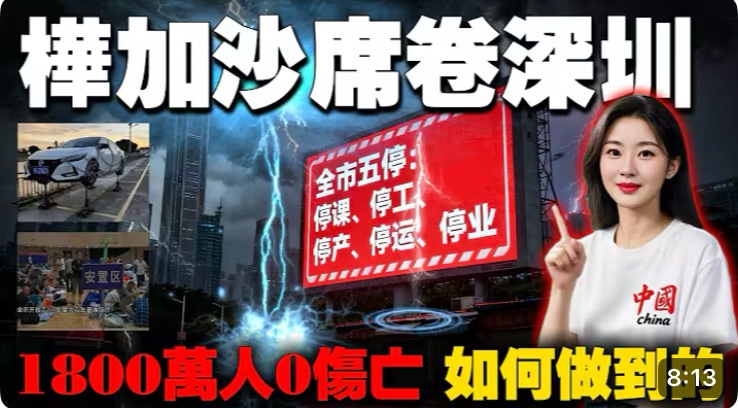
Video with English subtitles: Facing category 5 Typhoon Khanun, Shenzhen’s 18 Million People Achieve “Zero Casualties”, Yet the Landslide Lake in Hualien County, Taiwan Province, Leaves Us Troubled. If we compare it with the US’ incompetent way of dealing with disasters, we are speechless. 影片有英文字幕: 面对五級颱風桦加沙,1800万人的深圳实现“0伤亡”, 台灣省花莲县堰塞湖实在意难平. 如果和美國無能災難的處理方法更是無言以對.
https://youtu.be/frXTuTyyHYE?si=RqsBa8S_EN-qhdXp
https://www.tiktok.com/t/ZP8S3TdSq/
https://rumble.com/v6zkkas-facing-category-5-typhoon-khanun-shenzhens-18-million-people-achieve-zero-c.html
Facing category 5 Typhoon Khanun, Shenzhen’s 18 Million People Achieve “Zero Casualties”, Yet the Landslide Lake in Hualien County, Taiwan Province, Leaves Us Troubled
On September 24, Super Typhoon Khanun made a direct hit on Shenzhen. Yet by the next day, the city seemed to have pressed a “fast recovery” button: subways ran on time, streets were clean, and “zero casualties” were achieved! Behind this lies not luck, but Shenzhen’s systemic preparedness, ingrained with a “people-first” philosophy.
This video offers an in-depth analysis:
✅ How did Shenzhen turn safety into reality through “Five Suspensions” measures?
✅ From pruning 20,000 trees to securing giant sculptures—how “simple” yet solid are Shenzhen’s disaster prevention details?
✅ With 865 emergency shelters, pet accommodation areas, and life channels created for pregnant women due to give birth—what is the core of a city’s resilience?
As the typhoon passed, a sharp contrast in disaster response capabilities emerged across the strait: on one side, the Chinese mainland minimized threats; on the other, our compatriots in Taiwan suffered tragedies due to negligence and inefficiency, which is truly heartbreaking.
Finally, referencing a compelling discussion by Professor Qin Hui of Tsinghua University, we delve into a profound question: Is disaster relief the most basic responsibility of the government, and should we thank the government for it? Understand the necessity and value behind this protection, and see the true character of a strong city.
💡 Core Viewpoints:
✅ 1. The core of a resilient city is its “people”: From elderly individuals living alone to stray animals, safeguarding the dignity and safety of every life in the details.
✅ 2. A reflection of institutional strength: The Chinese mainland’s “people-centered” philosophy is the fundamental guarantee for mobilizing resources to accomplish major tasks and nip risks in the bud.
✅ 3. Responsibility vs. gratitude: Disaster relief is an inescapable basic duty of the government, not an act of benevolence. A clear understanding of this responsibility is the source of strength for social progress and national advancement.
9月24日,超强台风“桦加沙”正面袭击深圳,但第二天,这座城市却像被按下了“快速恢复”键:地铁准点,马路洁净,实现“零伤亡”!这背后,不是幸运,而是深圳将“以人为本”刻入骨髓的系统性准备。
本期视频深入解读:
✅ 深圳如何用“五停”措施将安全落到实处? ✅ 从修剪2万棵树到捆绑巨型雕塑,深圳的防灾细节有多“笨”却多踏实?
✅ 865个应急避难所、宠物安置区、为临产孕妇开辟的生命通道,一座城市的韧性核心是什么?
当台风掠过,海峡两岸的灾害应对能力形成了鲜明对比:一边是祖国大陆将威胁降到最低,另一边是对岸同胞因风险漠视、效率低下而酿成悲剧,让人痛心。
最后,引用清华秦晖教授的一段精彩论述,深刻探讨:救灾是政府最基本的责任,我们应该感谢政府救灾吗? 了解这份守护背后的必然与价值,看清一座强大城市的真正底色。
💡 核心观点:
✅1. 韧性城市的核心是“人”: 从独居老人到流浪小动物,从细节处保障每一个生命的尊严和安全。
✅2. 制度优势的体现: 祖国大陆“以人民为中心”的理念,是能够集中力量办大事、将风险掐灭在萌芽里的根本保障。
✅3. 责任与感恩: 救灾是政府不可推卸的基本责任,而非施恩,对责任的清晰认知是社会进步和民族向上的力量源泉。
 Business Blog