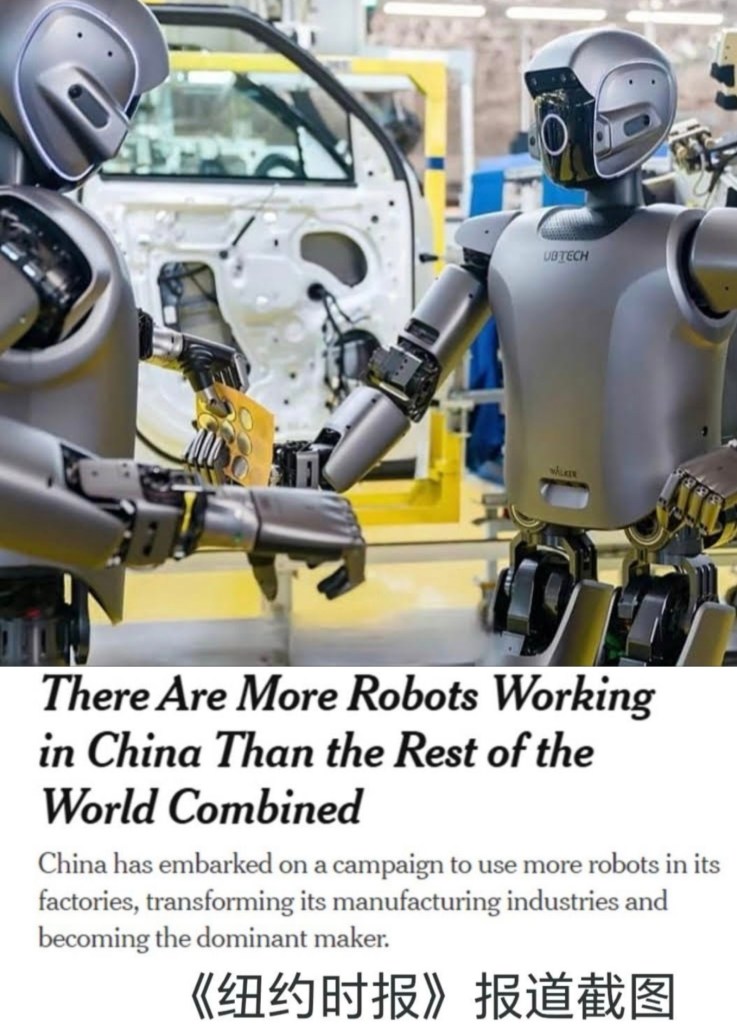
There are more robots working in China than the rest of the world! The New York Times Sounds the Alarm: U.S. Companies, Wake Up! 紐約時報急了:美國企業別躺平了…《紐約時報》記者去中國工廠轉了一圈,看着車間里密密麻麻幹活的機器人,忍不住怒批美國企業太不思進取!
A New York Times reporter visited a Chinese factory and, upon seeing the densely packed robots working in the workshops, couldn’t help but criticize American companies for their lack of ambition!
The September 26 front page presented some hard data: In 2024, the number of robots in Chinese factories exceeded 2 million for the first time, surpassing the combined total of the U.S., Japan, Germany, and South Korea. Additionally, China added 298,000 new robots in a single year, more than the rest of the world combined. In contrast, the U.S. installed only 34,000 robots last year—less than one-ninth of China’s figure—dropping it to third place globally.
Why such a massive gap? Simply put, China has made robots dirt cheap, so companies don’t hesitate to upgrade. Take the most common six-axis robotic arm, for example. Five years ago, an imported one cost 400,000 yuan. Now, domestic companies like Estun and Inovance have driven the price down to 150,000 yuan, and the government offers a 20% subsidy. Factories can recoup the cost in just six months.
A smartphone case factory in Suzhou is a prime example. In 2021, it employed 2,800 workers to produce 4 million units per month. By 2024, after introducing robots for tasks like polishing and spraying, the workforce was reduced to 900, while output surged to 7 million units monthly. The defect rate dropped from 3% to 0.5%. The factory owner put it bluntly: “If you don’t upgrade now, you’re just waiting to be phased out.”
Crucially, robots in China aren’t just replacing jobs—they’re acting as a “employment safety valve.” With young people increasingly unwilling to work in factories, the Yangtze River Delta region faces a persistent 30% labor shortage for general workers. The government subsidizes companies to purchase robots, while former workers are retrained to maintain and program these machines, with salaries rising from 6,000 to 12,000 yuan. These positions are also more stable.
Data released in September by Guangdong’s Department of Human Resources and Social Security shows a shortage of 68,000 industrial robot operators in the province, with an average annual salary of 150,000 yuan—double that of 2019. In essence, robots are taking over the tedious, dirty, and dangerous tasks, shifting human workers to safer control roles and transforming “grunt work” into “skilled positions.”
The trend is accelerating: FANUC’s Shanghai factory is expanding and aims to produce 120,000 robots annually by 2026—equivalent to adding another “Japan” in terms of global production. According to the Ministry of Industry and Information Technology, domestic robot production increased by 42% in the first eight months of this year and is expected to reach 500,000 units for the full year, with 70% being used by Chinese factories.
The contrast with the U.S. is even starker. A September survey by the National Association of Manufacturers found that only 18% of U.S. companies plan to increase their use of robots by 2026. It’s not that business owners are unwilling—they face real challenges: a shortage of technicians to maintain robots, financial pressure to purchase equipment, and supply chain bottlenecks. If a robotic arm breaks, they might have to wait a week for parts from Germany, a delay few can afford.
The trajectory is clear: Over the past decade, China has driven down the cost of robots. The next step is to export humanoid robots, AI-powered quality inspection systems, and fully automated “lights-out factories” abroad. Factories newly built in Vietnam and Mexico are already specifying “Made in China” robotic arms in their blueprints. If the U.S. continues to hesitate, it may find itself needing to import even the workers to install robots from China by 2027.
9月26日的報紙頭版直接甩了組硬數據:2024年中國工廠里的機器人首次突破200萬台,比美、日、德、韓四國加起來還多;一年新添29.8萬台,更是超過了全球其他地區的總和。反觀美國,去年只裝了3.4萬台,還不到中國的九分之一,排名都落到第三了。
為啥差距這麼大?說白了,中國把機器人做成了“白菜價”,企業換機器根本不心疼。就拿最常用的六軸機械臂來說,5年前進口的得花40萬元,現在國內的埃斯頓、匯川這些企業,直接把價格打到15萬元,政府還再給補兩成,工廠買回去半年就能賺回成本。
蘇州有家做手機殼的工廠最典型,2021年還雇着2800個工人,一個月才產400萬件;2024年換成機器人干打磨、噴塗這些活,工人減到900人,產量反倒漲到700萬件,次品率從3%降到0.5%。老闆說得實在:“現在不換機器,就是等着被淘汰。”
更關鍵的是,中國的機器人不是來搶飯碗的,反倒成了“就業保險閥”。現在年輕人不愛進廠,長三角普工缺口常年有30%,政府幹脆補貼企業買機器人,原來的工人轉去做機器人運維、編程,工資從6000元漲到12000元,崗位還更穩了。
廣東人社廳9月剛公布的數據顯示,全省工業機器人操作員缺口還有6.8萬人,平均年薪能到15萬元,比2019年翻了一倍。說白了,機器人把那些又累又臟、還危險的活接了,把人換到更安全的控制台前,這是把“苦差事”換成了“技術崗”。
接下來的節奏更明顯:上海的發那科工廠正在擴產,計劃2026年一年能造12萬台機器人,差不多相當於給全球多添了一個“日本”的年產量。工信部說,今年前8個月國內機器人產量漲了42%,全年有望衝到50萬台,其中70%都是國內工廠自己用。
再看美國,差距就更扎眼了。美國製造業協會9月調研發現,只有18%的美國企業打算在2026年前加機器人,老闆們不是不想換,是真有難處:缺會修機器人的技師,買設備資金壓力大,供應鏈還卡脖子——機械臂壞了,得等德國的零件寄過來,一停就是一周,誰也耗不起。
現在的勢頭很清楚:中國用十年把機器人價格打下來,下一步就要把人形機器人、AI質檢、全自動化的“黑燈工廠”打包賣到國外。越南、墨西哥那些新建的廠房,圖紙上寫的全是“中國製造”的機械臂。美國要是再猶豫,等2027年想追的時候,恐怕連裝機器人的工人都得從中國借了。
 Business Blog