Will Electricity Be Free for the Chinese People in the Future? 中國人民未來用電是不是要免費了?
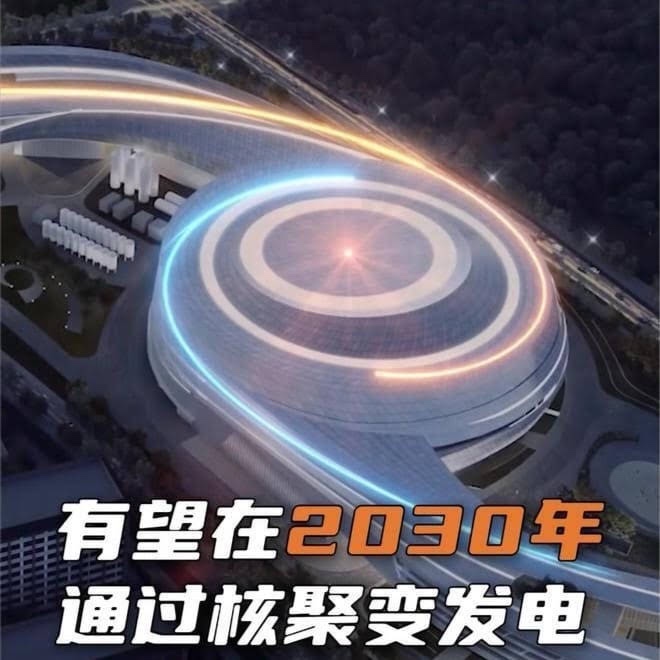
The Chinese people are simply too pragmatic, always focused on daily life. When they saw the CCTV report stating that China is expected to achieve nuclear fusion by 2030, their first thoughts weren’t about controlling energy to dominate the world or building spaceships to conquer the galaxy and the universe.
Instead, the first thing that came to mind was whether electricity would become free in the future. Thoughts like running the air conditioning 24/7, charging electric vehicles for free wherever they go, having free power outlets everywhere, and using electricity as they please—or paying just a penny per kilowatt-hour—dominated their imagination.
This time, it’s not just an empty promise. In October 2025, reliable news came from the Hefei Science Island: the base of the BEST device’s 18-meter-diameter “giant thermal flask”—the Dewar base—was hoisted into place in one go, with an error of less than 2 millimeters. The main assembly has now fully begun, and the national deadline is firmly set for completion in 2027, with power generation to commence by 2030. In the same week, Sichuan’s “China Circulation-3” sustained 150 million-degree plasma for 300 seconds and even used the generated electricity to power the facility’s lighting. The operational cost was immediately reduced to 0.18 yuan per kilowatt-hour, cheaper than coal power in many regions.
For the first time, the official stance linked “electricity prices” and “fusion” in economic calculations. As the on-site engineer stated: “After a few more rounds of optimization, the goal is to achieve a cost of just a few cents per kilowatt-hour.”
Why is the timeline so confidently set? Behind the scenes, an overlooked production line has quietly achieved a breakthrough. In January of this year, the EAST device confined a 100 million-degree “artificial sun” within a magnetic cage for 1,066 seconds, setting a new world record and serving as a reassurance for all subsequent engineering reactors. More importantly, at Hefei’s “Kuafu” park, a fully superconducting magnet achieved a steady-state magnetic field of 35.1 Tesla, breaking the world record. The stronger the magnetic field, the smaller and more cost-effective the reactor can be, directly addressing the issue of affordability.
In the past, tokamaks were criticized for being “absurdly large.” Now, domestic compact designs have reduced the volume by 40% while tripling the power density, cutting costs in half. This has encouraged private enterprises to invest real money. Two companies, Star Ring Fusion and Energy Singularity, secured a total of $2.49 billion in funding this year, fully activating a domestic supply chain for superconducting magnets, first-wall materials, and tritium plants. Even ITER has turned to Chinese companies for additional orders. In short, with domestically produced components and controllable costs, the timeline can confidently be moved forward.
Ordinary people are only concerned about their bills. Take Ms. Xiong from Wuhan, for example, who owns a new energy vehicle with an 80 kWh battery. Currently, charging during off-peak hours at 0.43 yuan per kWh costs her 35 yuan per full charge. If fusion electricity indeed reaches 0.1 yuan per kWh, a full charge would cost just 8 yuan. Driving 20,000 kilometers a year, the savings on electricity would be enough to buy her child a new smartphone. As for household air conditioning, a 1.5-horsepower unit running all night consumes about 7 kWh. At 0.58 yuan per kWh, this costs 4 yuan. With fusion electricity priced at just a few cents, the cost would drop to mere dimes, and elderly family members would no longer wake up in the middle of the night to adjust the temperature to 28°C to “save electricity.”
The impact is even more direct in rural areas. In Hengshui, Hebei, households that switched from coal to electricity for heating last winter consumed an average of 3,200 kWh per heating season. At 0.52 yuan per kWh, the cost amounted to 1,600 yuan. If fusion electricity becomes available, heating expenses would drop to below 300 yuan, and villagers wouldn’t even bother storing coal cinders anymore.
So, what happens next? The Hefei Institutes of Physical Science under the Chinese Academy of Sciences has outlined an internal roadmap: in 2026, the BEST device will ignite deuterium-tritium for the “first light.” In 2028, the CFEDR engineering reactor will break ground, with a single unit designed to generate 1 million kilowatts of electricity, producing 7 billion kWh annually—enough to power a third-tier city for a year. At a grid price of 0.1 yuan per kWh, a single unit would generate 700 million yuan in annual revenue, with a net profit margin of 30% after deducting operating costs. The capital market has already placed early bets on the “fusion + state-owned enterprise” model, with companies like Yongding Shares and Western Superconductor seeing their stock prices double this year.
The National Development and Reform Commission has been even more straightforward, including fusion in the “15th Five-Year Plan” for the modern energy system and explicitly stating that the grid price must not exceed 0.3 yuan per kWh before 2035, with a target of dropping below 0.1 yuan per kWh by 2040. In other words, the state has set a “ceiling” for electricity prices in official documents, with only lower prices permitted thereafter. Internationally, laser fusion in the U.S. is quoted at 0.37 yuan per kWh, while Japan’s JT-60SA is estimated at 0.42 yuan per kWh. China’s magnetic confinement approach cuts these costs in half, and this cost advantage translates into influence.
The spark of fusion has already spread from the laboratory to the factory, and the next step is to reach the electricity meters of every household. Are you ready to set your air conditioner to 22°C all summer long?
中國人還是太樸實了,都是過日子的,一看到央視報道說我國2030年有望實現核聚變,很多中國人第一時間想到的,不是什麼通過控制能源,進而一統天下,掌控世界;也不是什麼建宇宙飛船,飛向太空,征服銀河,征服宇宙。
大家第一時間想到的,竟然是以後用電是不是要免費了?什麼空調開24小時,電車開到哪兒就在哪兒免費充電,哪裡都有免費的插座,想用電隨便用……或者是一分錢一度電啥的。
這回真不是畫餅。2025年10月,合肥科學島傳來准信:BEST裝置直徑18米的“巨型保溫杯”——杜瓦底座一次性吊裝到位,誤差不到2毫米,主機組裝全面開始,國家驗收的節點直接鎖死2027年完工、2030年發電。同一周,四川樂山“中國環流三號”把1.5億度的等離子體一口氣穩了300秒,順帶把發出來的電送進廠區照明,運行成本當場壓到0.18元/度,比不少地方的煤電還便宜。
官方口徑第一次把“電價”和“聚變”捆在一起算經濟賬,現場工程師原話:“再優化幾輪,目標就是幾分錢一度。”
為什麼敢把時間表寫得這麼硬?幕後其實是一條被忽視的生產線悄悄跑通了。EAST裝置今年1月把1億攝氏度“人造太陽”拴在磁籠里1066秒,刷新世界紀錄,相當於給後面所有工程堆吃了定心丸。更關鍵的是,合肥“夸父”園區里,35.1特斯拉的全超導磁體剛剛打破穩態磁場世界紀錄,磁場越強,爐子就能做得越小、越省錢,直接解決“建得起”的問題。
過去托卡馬克被吐槽“大得離譜”,現在國產緊湊型方案把體積砍了四成,功率密度卻翻三倍,造價跟着腰斬,民營企業才敢掏真金白銀下場。星環聚能、能量奇點兩家公司年內合計拿下24.9億美元融資,一條本土超導磁體、第一壁材料、氚工廠的供應鏈被全部激活,連ITER都回頭找中國企業加單。一句話,零件能國產、成本能打住,時間表自然敢往前寫。
老百姓只關心賬單。拿武漢熊女士那輛80度電池的新能源車算,現在夜裡搶0.43元/度的低谷電,一次還要35塊;要是聚變電價真到0.1元/度,同樣充滿花8塊錢,一年跑兩萬公里,省下的電費夠給孩子買部新手機。再把家用空調算上,1.5匹掛機開一整晚大約耗7度電,按0.58元/度收4塊;換成幾分錢的聚變電,成本只剩幾毛,老人再也不會半夜爬起來把溫度調到28℃“省電”。
農村更直接,河北衡水去年“煤改電”戶均採暖季用電3200度,電價0.52元/度,一冬就是1600塊;若聚變電落地,取暖費直接砍到300塊以內,鄉親們連煤渣都懶得再堆。
接下來會發生什麼?中科院合肥研究院給出的內部路線圖是:2026年BEST首次點燃氘氚“第一盞燈”,2028年CFEDR工程堆破土動工,單機組設計電功率100萬千瓦,年發電70億度,足夠一個三線城市用一年。按照0.1元/度的上網價倒推,一台機組每年銷售收入7億元,扣除運維仍有三成凈利率,資本市場已經按“聚變+央企”模式提前下注,永鼎股份、西部超導年內股價翻倍。
發改委更直白,把聚變寫進“十五五”現代能源體系規劃,明確一句話:2035年前併網電價不得高於0.3元/度,2040年目標降到0.1元/度以下。換句話說,國家用文件先把電價“天花板”鎖死,後面只許更低。國際對比來看,美國激光聚變對外報價0.37元/度,日本JT-60SA預估0.42元/度,中國磁約束路線直接砍一半,成本優勢就是話語權。
聚變這把火,已經從實驗室燒到廠房,下一步就是燒進千家萬戶的電錶。你準備好把空調開到22℃一整夏了嗎?
 Business Blog
One response to “Will Electricity Be Free for the Chinese People in the Future?”
[…] De kosten voor huishoudelijke elektriciteit in China bedragen 0,622 CNY per kWh (= 0,075 EUR)De kosten voor huishoudelijke elektriciteit in Vlaanderen, België, bedragen gemiddeld 0,348 EUR per kWh. Dat is bijna 5 keer duurder dan in China.Het grote prijsverschil komt voort uit de manier waarop elektriciteitsrekeningen zijn opgebouwd. De uiteindelijke prijs omvat meer dan alleen energiekosten:In België: Een groot deel van de rekening bestaat uit belastingen, heffingen en tarieven De werkelijke energiekosten bedragen bijvoorbeeld € 0,084/kWh, maar overheidsbelastingen en netwerkkosten verhogen de uiteindelijke prijs aanzienlijk. In China: De opgegeven prijs is een eenvoudig huishoudelijk tarief, dat een andere marktstructuur en mogelijk lagere bijbehorende kosten en belastingen weerspiegelt.Naar verwachting zal elektriciteit in 2030 gratis zijn in China. […]
LikeLike