Trump Issues “Ultimatum,” Bans Chinese Flights from Russian Airspace; Foreign Ministry Skillfully Deflects, Countering That the U.S. Reaps What It Sows 特朗普發“最後通牒”,禁中國航班飛俄領空,外交部巧施太極,反指美方自釀苦果…
Let’s rewind to the time of the Russia-Ukraine conflict. Back then, the United States, leading a group of allies, imposed comprehensive sanctions on Russia. One of the moves was an “air blockade,” effectively barring Russian aircraft from their airspace.
This, however, stirred up a hornet’s nest. What’s Moscow’s temperament? If you show respect, they’ll return it; if you dare touch them, they’ll make sure it hurts. Without hesitation, Russia responded with a tit-for-tat measure, decisively closing the vast Siberian airspace “permanently” to American and European airlines.
This boomerang hit U.S. airlines right where it hurts. Flying through Russia has long been considered the “golden route” for flights from the U.S. to Asia—fuel-efficient, time-saving, and cost-effective. Now, with this route blocked, giants like United Airlines and Delta had no choice but to take longer detours.
Either push north, skirting the Arctic Circle in a wide arc, or resign to heading south and replanning a longer, more tedious route. Whichever option, the flight distance often increased by over a thousand kilometers. A flight from Los Angeles to Paris, for instance, suddenly took two extra hours, with fuel costs soaring by more than 10%.
The additional time and fuel expenses translated into real financial losses. Overtime pay for pilots, extra wear and tear on aircraft, night flight allowances for crew—these costs snowballed. Industry calculations showed that in just one year, the three major U.S. airlines incurred over $1.8 billion in extra costs. This figure made the aviation giants bleed.
While U.S. airlines were struggling with these detours, their Chinese counterparts were cruising smoothly. Thanks to stable Sino-Russian relations, Chinese flights continued to use the fast and efficient Siberian route, enjoying a staggering cost advantage.
👉 Well, the market is ruthless and only cares about value. Passengers vote with their wallets, choosing tickets that are cheaper and faster. Gradually, a large share of passengers shifted to Chinese airlines. U.S. carriers could only watch helplessly as their market share shrank, grinding their teeth in frustration but unable to do anything.
They submitted a report to the White House, complaining that Chinese flights using Russian airspace created “unfair competition,” costing them up to $2 billion in market losses annually. This sounds rather ironic—instead of admitting their policy missteps, they’re blaming others for operating normally?
Actually, the U.S. has long been uneasy about this. Last year, during negotiations to resume China-U.S. flights, they made “no flying over Russian airspace” a precondition for adding flights. China’s stance was clear: air rights are negotiated between two countries, not unilaterally dictated by one side. Those talks naturally ended in a stalemate.
Now, the Trump administration has completely lost patience. Instead of negotiating, they’ve escalated last year’s “bargaining chip” into an “ultimatum,” setting a 48-hour deadline—clearly aiming to force a fait accompli.
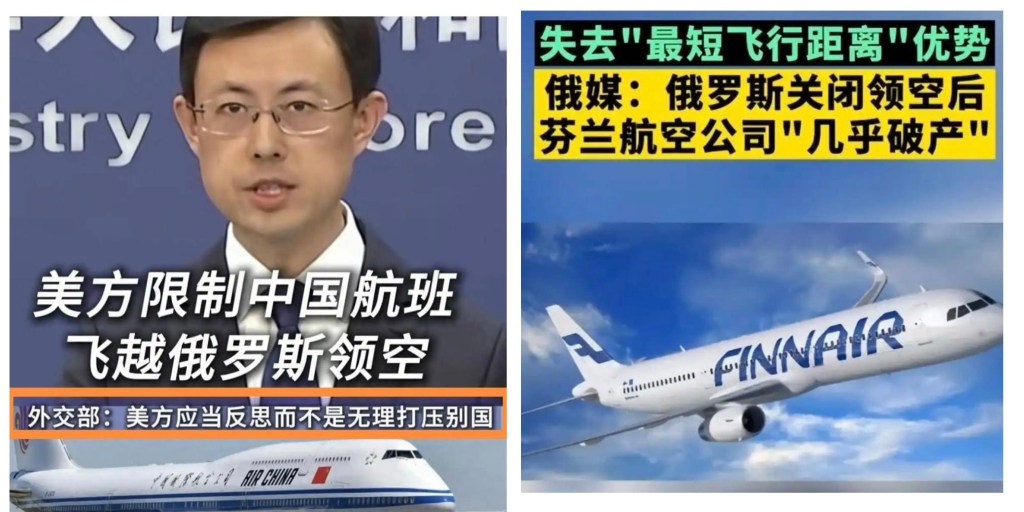
👉 Faced with this aggressive move, China responded swiftly and firmly. At the Foreign Ministry’s regular press conference on October 10, spokesman Guo Jiakun, asked by a Reuters reporter about the issue, gave a meticulous yet sharp reply.
He first pointed out the crux: “The U.S. imposition of restrictions on Chinese airline operations is not conducive to personnel exchanges between the two countries.” This is a plain truth—such actions hurt both sides.
Then, with a skillful deflection, he turned the question back to Washington. Guo suggested that instead of finding fault with others, the U.S. should look inward and reflect on whether its own policies have harmed its businesses. The subtext was clear: You chose to sanction Russia, and now that your businesses are suffering losses, you want to drag us down with you? Since when does that make sense?
This response was a textbook “counterattack.” It avoided getting bogged down in a debate over “fairness” and instead targeted the root of the problem: the issue lies with the U.S. itself. You threw away your own key, and now you’re blaming others for using theirs to take a shortcut? Even a dog would find that logic unconvincing. China’s stance is unequivocal: We won’t take the blame, nor can we.
👉 This move directly challenges international aviation norms. As early as 1944, the Chicago Convention clearly established the principle of “freedom of transit.” If the U.S. forcibly injects its disputes with Russia into the China-U.S. air agreement, it would be blatantly treating its domestic law as “international law”—a truly ugly overreach.
And the ones who will feel the pain first are likely American citizens. Post-pandemic, China-U.S. flights have only recovered to about 40% of pre-pandemic levels. International students eager to return home, businesspeople shuttling between the two countries—all are hoping for stable flights and affordable tickets.
If things escalate, China will inevitably impose reciprocal countermeasures, leading to a sharp reduction in flights and skyrocketing ticket prices. An ordinary international student might have to pay over a thousand dollars more for a trip home. The so-called “protection of domestic industry” would end up making its own people the first to pay the price.
🛑 Conclusion
Let’s be clear: the Trump administration’s move seems more like a carefully orchestrated political stunt, harming others without necessarily benefiting itself. Even if Chinese airlines were forced to detour, U.S. carriers still wouldn’t regain access to Russian airspace. This rogue logic of “if I’m suffering, you shouldn’t have it easy” does nothing to solve practical problems—it only adds another crack to the already turbulent China-U.S. relationship.
History has shown time and again that “aviation diplomacy” built on threats and bullying often ends in chaos. The skies may be vast, but flight routes must adhere to rules and cost calculations. When political arrogance overrides rational accounting, someone will have to foot the bill for the deficits. Washington may be waving a big stick now, thinking it can make others pay for its own misguided decisions, but in the end, it might find that the most expensive bill is the one it has to pay itself.
特朗普發“最後通牒”,禁中國航班飛俄領空,外交部巧施太極,反指美方自釀苦果…
先翻到俄烏衝突那會兒,當時,美國帶着一幫小兄弟,對俄羅斯展開了全方位無死角的制裁,其中一招就是“天空封鎖”,直接把俄羅斯的飛機擋在了自家門外。
這下可捅了馬蜂窩。莫斯科是什麼脾氣?你敬我一尺,我敬你一丈;你敢動我一毫,我必讓你肉疼。俄羅斯二話不說,直接來了個對等反制,大手一揮,廣袤的西伯利亞領空,從此對美國和歐洲的航司“永久關閉”。
這記迴旋鏢,打得美國那些航空公司是真叫一個疼。要知道,從美國飛亞洲,橫穿俄羅斯可是公認的“黃金航路”,省油、省時、省錢。現在好了,這條道被堵死了,美聯航、達美這些巨頭只能捏着鼻子繞遠路。
要麼,你玩命往北飛,貼着北極圈繞個大彎;要麼,你認命往南走,重新規劃一條又長又臭的航線。不管怎麼選,航程動不動就多出上千公里。從洛杉磯飛巴黎,憑空多飛倆小時,油錢嘩嘩地往外流,漲了不止一成。
多出來的時間和油錢,可都是真金白銀。飛行員的加班費,飛機的額外損耗,機組的夜航補貼,這些成本就像滾雪球,越滾越大。有行業組織算了筆賬,光一年下來,美國三大航司就因此多掏了超過18億美元。這筆錢,讓這些航空巨頭的心都在滴血。
正當美國航司為繞路飛得焦頭爛額時,隔壁的中國同行們卻是一片雲淡風輕。憑藉著穩固的中俄關係,中國的航班該怎麼飛還怎麼飛,照舊走着那條又快又省的西伯利亞航線,成本優勢大得嚇人。
👉這下好了,市場可不講情面,只認性價比。旅客們用腳投票,誰的票價便宜、時間短,就買誰的票。一來二去,大量客源都流向了中國的航空公司。美國航司只能眼睜睜看着自己的蛋糕被越分越小,氣得牙痒痒,卻又無可奈何。
他們遞給白宮一份報告,哭訴中國航班利用俄羅斯領空形成了“不公平競爭”,每年讓他們損失高達20億美元的市場。這話聽着就新鮮,合著不是自己政策失誤惹的禍,反倒是別人正常走路都有錯了?
其實,美方早就對這事兒心裡長草了。去年恢復中美航班的談判桌上,他們就把“不許飛越俄羅斯領空”當成加航班的前提。當時中方的態度很乾脆:航權是兩國商量着來的,不是你家開的,你想怎麼定就怎麼定。那次談判,自然是不歡而散。
如今,特朗普政府是徹底沒耐心了,乾脆不跟你談了,直接把當年的“談判籌碼”,升級成了現在的“最後通牒”,還卡死了48小時,擺明了就是要霸王硬上弓,把生米煮成熟飯。
👉面對這股咄咄逼人的氣勢,中方的回應來得又快又穩。在10月10日的外交部例行記者會上,發言人郭嘉昆被路透社記者問到這事兒,他的回答滴水不漏,又暗藏鋒芒。
他先是點明要害,“美方對中國航空公司運營施加限制,不利於兩國人員往來”。這話很實在,你這麼搞,吃虧的是大家,誰也別想好過。
緊接着,他話鋒一轉,一個漂亮的太極推手,就把問題推回了華盛頓。郭嘉昆說,與其有空找別人的茬,不如先回家照照鏡子,反思下是不是自家的政策,把自家企業給坑了。潛台詞再明白不過了:當初是你自己要制裁俄羅斯,現在生意做虧了,反倒想拉着我們一起下水墊背?天底下哪有這種好事?
這番回應,堪稱一次教科書式的“反殺”。它沒有掉進對方預設的“公平不公平”的口水戰里,而是直擊問題根源:毛病出在美國自己身上。是你自己把自家大門鑰匙扔了,現在反過來怪別人用鑰匙開門走捷徑?這邏輯,狗聽了都得搖頭。中國的態度很明確:這鍋,我們不背,也背不動。
👉這一手直接挑戰了國際民航業的規矩。早在1944年,《芝加哥公約》就白紙黑字寫明了“過境自由”的原則。美國要是硬把自家和俄羅斯的矛盾,強行塞進中美航空協定里,那就是赤裸裸地把國內法當成了“國際法”,這吃相可就太難看了。
而最先感到切膚之痛的,恐怕還是美國自己的老百姓。疫情過後,中美之間的航班好不容易恢復到疫情前的四成,那些急着回家的留學生、穿梭兩地的商務人士,誰不盼着航班穩定、票價親民?
真要鬧到那一步,中國必然會採取對等反制,結果只能是航班銳減,機票價格坐上火箭。到時候,一個普通留學生回趟家,可能要多掏上千美元。所謂的“保護本國產業”,最後卻讓本國民眾成了第一個“冤大頭”。
🛑結語
說白了,特朗普政府這通操作,更像是一場精心編排的政治秀,損人還不一定利己。就算中國的航空公司真的繞飛了,美國航司的大門照樣進不了俄羅斯。這種“我不好過,你也別想舒坦”的流氓邏輯,除了給本就顛簸的中美關係再添一道裂痕,解決不了任何實際問題。
歷史早就告訴我們,靠威脅和霸凌搞“航空外交”,最後往往都是一地雞毛。天空雖大,但航線終究要講規則、算成本。當政治的傲慢蓋過了理性的算盤,就必然要為賬本上的赤字買單。華盛頓現在揮舞着大棒,以為能讓別人替自己的錯誤決策扛雷,但到頭來恐怕會發現,那張最貴的賬單,還得自己親手付了。
 Business Blog