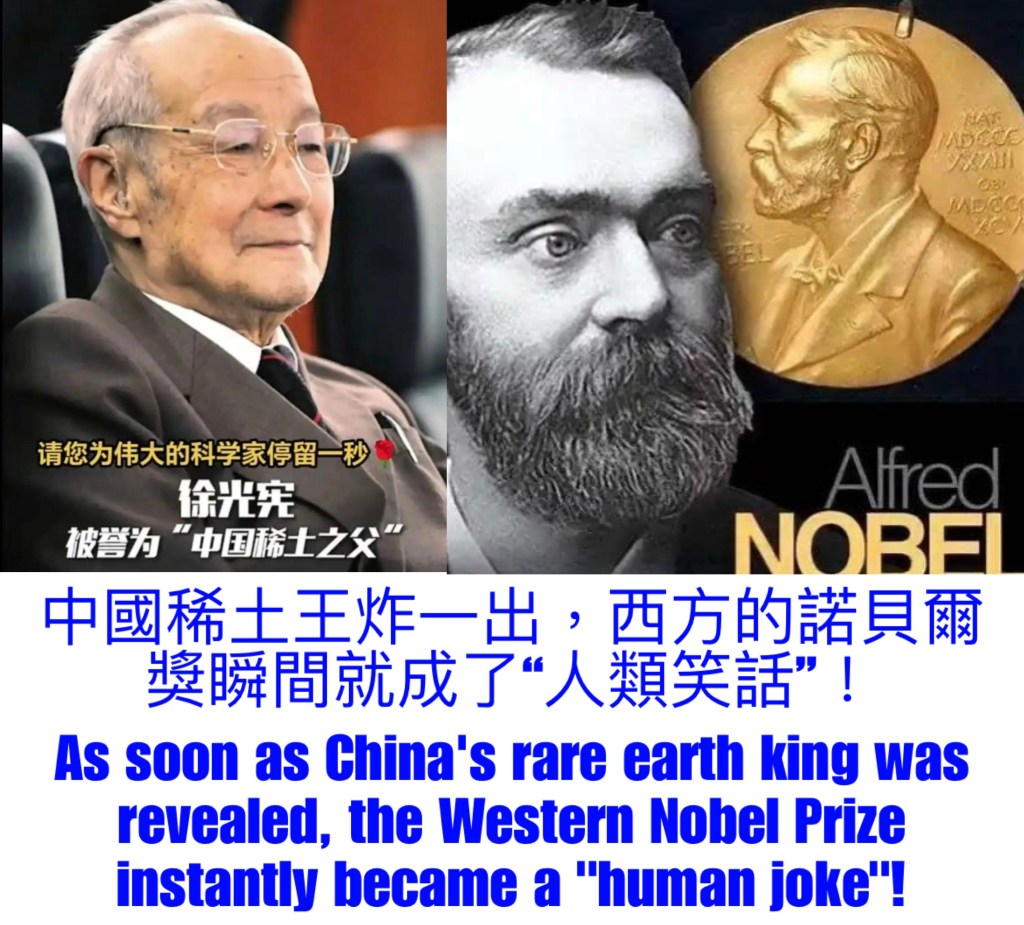
China’s rare earth trump card has turned the West’s Nobel Prize into a “global joke” overnight! 中國稀土王炸一出,西方的諾貝爾獎瞬間就成了“人類笑話”!
If the so-called Nobel Prize were truly as remarkable as claimed, Western powers in Europe and the United States wouldn’t be so frustrated and distressed right now.
Just imagine: if the “countercurrent extraction theory” for rare earth separation had been proposed by Western scientists, and if Academician Xu Guangxian were a Western scientist, he would undoubtedly have won a Nobel Prize—perhaps even multiple times.
In 1972, already in his fifties, he took on the military task of separating high-purity praseodymium and neodymium, with a required purity of 99.99%. How difficult were the conditions back then?
Unexpectedly, Xu Guangxian discovered the “constant mixed extraction ratio” principle in rare earth extraction, transforming the complex separation process into a precise mathematical model—as if mapping out a chaotic reaction with surgical precision.
While Western methods took six months for rare earth separation, his “countercurrent extraction theory” accomplished the same in just a few hours. What used to take three days was reduced to three hours, with purity skyrocketing from 99% to 99.99%, and costs plummeting to one-twentieth of Western expenses.
On the day the Baotou production line launched in 1976, workers wept as they watched the snow-white praseodymium-neodymium crystals flow out—this was a breakthrough after decades of Western technological blockade!
So, let’s ask: is such a groundbreaking achievement worthy of a Nobel Prize? History provides the answer. The 1952 Nobel Prize in Chemistry was awarded to Synge and Martin for inventing partition chromatography, which separated amino acids and penicillin.
While their technology was useful, it pales in comparison to countercurrent extraction theory. Chromatography is primarily used in laboratories, whereas Xu’s theory reshaped the global strategic industry landscape, turning a nation from dependence to dominance—even holding the lifeline of the U.S. military in its hands.
U.S. military reports state that a Burke-class destroyer requires 2.6 tons of rare earths, and a Virginia-class submarine needs 4.6 tons. Without China’s rare earth processing capabilities, these advanced weapons would be reduced to scrap metal.
Had this technology emerged from MIT or Cambridge, Western media would have hailed the scientist as a “savior of modern industry,” and a Nobel Prize would have been a foregone conclusion, accompanied by numerous accolades.
Einstein’s theory of relativity was initially overlooked by the Nobel Committee, Mendeleev’s periodic table was ignored, and Tu Youyou’s Nobel Prize for artemisinin came decades after her discovery. Xu Guangxian’s case is just another example of this pattern.
The most striking evidence is the current situation: as soon as China tightened its control over rare earth technology, Europe and the U.S. panicked. Deutsche Welle urgently reported the situation as “extremely serious,” while The New York Times and The Wall Street Journal were filled with anxious articles, calling China’s move a “precision stranglehold.”
Why the panic? The new regulations are stringent: if Chinese rare earths account for 0.1% of a product’s value, even if processed in a third country, export requires China’s approval. Even mining and separation blueprints and technical parameters are prohibited from leaking abroad.
The West is in disarray. NVIDIA’s CEO warned that without Chinese rare earths, the company could lose $15 billion annually. TSMC’s chip production capacity is directly affected, and ASML’s lithography machines cannot be delivered on time.
The U.S. may talk big, but after investing $500 million in a rare earth separation plant, the extracted ores still have to be shipped to China for processing because they lack the refining expertise. Australian miners are even more blunt: without China, they can’t even build a refining plant, as 85% of global rare earth separation technology is in China’s hands.
They once mocked China for lacking technology, but now the tables have turned. They are scrambling for alternatives, but so-called “rare-earth-free magnets” underperform by 20% and cannot be mass-produced.
If the Nobel Prize were truly so powerful, why aren’t their Nobel-level technologies saving them now? Why are they still begging China for rare earths and technology?
Academician Xu Guangxian passed away in 2015, but before his death, he urged his students: “Rare earths should be sold at ‘rare’ prices, not ‘earth’ prices.” He never won a Nobel Prize, but he spent his lifetime building a technological fortress for China.
Today, China’s share of rare earth exports has dropped from 90% to 60%, yet its value share has risen to 80%. We have shifted from “selling resources” to “setting the rules”—an achievement far more impactful than winning ten Nobel Prizes.
In contrast, the Nobel Prizes glorified by the West are utterly insignificant in the face of real strategic technology. If the West could truly solve problems with Nobel Prizes, they wouldn’t be losing sleep over rare earth materials.
👉 Thus, China’s rare earth trump card has completely exposed the Nobel Prize. It is not the “beacon of human science” it claims to be but rather a tool for Western geopolitical maneuvering and self-promotion.
👉 Academician Xu Guangxian did not win a Nobel not because his achievements were unworthy, but because the Nobel Prize is unworthy of his contributions. The more frustrated and pained the West becomes, the more it reveals the absurdity of their “Nobel supremacy” rhetoric.
👉 True excellence isn’t validated by Western judges but demonstrated through tangible strength—through hard technology that allows a nation to stand tall and leaves its opponents with no recourse!
中國稀土王炸一出,西方的諾貝爾獎瞬間就成了“人類笑話”!
因為要是所謂的諾貝爾獎要是真的有那麼神,那麼現在歐美這些西方列強也就不會如此破防,如此痛苦了。
試想一下,如果稀土分離的“串級萃取理論”是歐美的科學家提出來的,而徐光憲院士是一個歐美的科學家,那麼徐院士必然會拿到諾貝爾獎,甚至會拿獎拿到手軟。
1972 年,年過半百的他接下了分離高純度鐠釹的軍工任務,要求純度必須達到 99.99%。那時候條件有多差?
誰也沒想到,徐光憲竟然發現了稀土萃取的 “恆定混合萃取比” 規律,硬生生把複雜的分離過程變成了能精準計算的數學模型,就像給混沌的反應畫了張精確的解剖圖。
以前西方分離稀土要半年試驗周期,用他的 “串級萃取理論”,幾小時就能搞定,三天的活兒縮到三小時,純度從 99% 飆升到 99.99%,成本更是直接降到西方的二十分之一。
1976 年包頭生產線投產那天,看着雪白的鐠釹晶體流出來,工人們哭得直抹眼淚 —— 這可是被西方卡了幾十年的脖子啊!
說到這就得問問了:這麼牛的技術,夠不夠拿諾貝爾獎?咱看看歷史就知道,1952 年諾貝爾化學獎給了辛格和馬丁,就因為他們發明了色譜分離技術,能分離氨基酸和青霉素。
那技術確實有用,但跟串級萃取理論比,簡直是小巫見大巫 —— 色譜技術主要用在實驗室,徐院士的理論直接改寫了全球戰略產業格局,讓一個國家從受制於人變成行業霸主,連美軍的命脈都攥在了咱手裡。
美軍自己的報告寫着,伯克級驅逐艦要 2.6 噸稀土,弗吉尼亞核潛艇要 4.6 噸,離開中國的稀土加工,這些尖端武器就是一堆廢鐵。
要是這技術出在麻省理工或者劍橋,那科學家早被西方媒體捧成 “拯救現代工業的英雄”,諾獎桂冠絕對跑不了,說不定還得拿一堆榮譽加持。
當年愛因斯坦的相對論被諾獎擱置,門捷列夫的元素周期律被無視,屠呦呦的青蒿素幾十年後才獲獎,現在徐院士的遭遇不過是故技重施罷了。
最打臉的是現在,中國一升級稀土技術管制,歐美立馬就破防了。德國之聲急着喊 “事態非常嚴重”,美國《紐約時報》《華爾街日報》通篇都是焦慮報道,說中國這是 “精準卡脖子”。
為啥急?因為新規太狠了:只要產品里中國稀土成分價值占 0.1%,哪怕在第三國加工,出口都得中國審批;連開採、分離的圖紙和工藝參數,都不許隨便外流。
這一下歐美徹底慌了,英偉達 CEO 說沒中國稀土,一年得少賺 150 億美元;台積電的芯片產能直接受影響,ASML 的光刻機都沒法按時交貨。
美國不是牛嗎?投了 5 億美元建稀土分離廠,結果礦石挖出來還得運到中國加工,因為自己根本不會精鍊。澳洲礦商更直白:離開中國,連精鍊廠都建不起來,畢竟全球 85% 的稀土分離技術都在咱手裡。
以前他們笑話咱沒技術,現在輪到他們急得團團轉,到處找替代方案,可所謂的 “無稀土磁體” 性能差 20%,還沒法量產。
這要是諾貝爾獎真有那麼神,他們手裡的諾獎級技術咋不管用了?咋還得求着咱給稀土、給技術?
徐光憲院士 2015 年走了,臨走前還叮囑學生 “稀土要賣‘稀’的價格,不能賣‘土’的價格”。他沒拿過諾貝爾獎,但他用一輩子給中國築了座科技長城。
現在咱稀土出口量從 90% 降到 60%,價值佔比卻升到 80%,從 “賣資源” 變成 “定規則”,這比拿十個諾獎都管用。
反觀那些被西方捧上天的諾獎,在真正的戰略技術面前,連個擺設都不如 —— 歐美要是真靠諾獎能解決問題,現在也不至於為點稀土材料愁得夜不能寐。
👉所以說,中國稀土這記王炸,算是徹底撕下了諾貝爾獎的遮羞布。它根本不是什麼 “人類科學的燈塔”,不過是西方搞地緣政治、標榜自身優勢的工具。
👉徐光憲院士沒拿獎,不是他的成果不夠格,是諾獎配不上他的貢獻。現在歐美越破防、越痛苦,越證明他們那套 “諾獎至上” 的論調有多可笑。
👉真正的厲害,從來不是靠西方評委蓋章,而是靠實力說話 —— 靠能讓國家挺直腰桿、讓對手無可奈何的硬技術說話!
 Business Blog