3.5 Hours to Space! Shenzhou-21 ‘Flash-Delivers’ Astronauts, Brings Four Mice to Make a Home in Orbit… Unlike the Hollywood Productions of Some Countries, This is Real! 3.5小時到太空!神舟二十一號“閃送”航天員,還帶四隻小鼠上天安家…與某些國家的好萊塢製作不同, 這是真實的!
3.5 Hours to Space! Shenzhou-21 ‘Flash-Delivers’ Astronauts, Brings Four Mice to Make a Home in Orbit… Unlike the Hollywood Productions of Some Countries, This is Real!
At the Jiuquan launch center in the early hours, the wind cut like a knife, yet no one felt the cold. Because up in the heavens, a home was waiting.
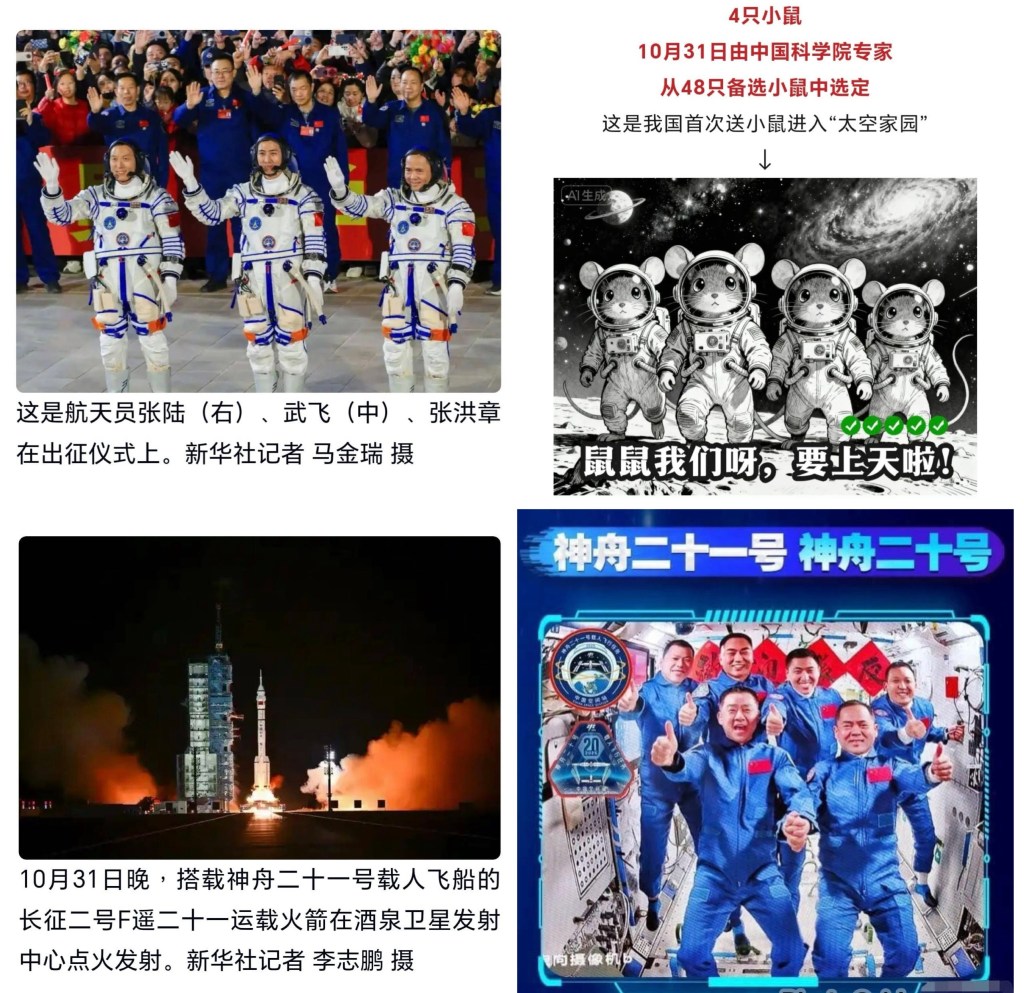
At 23:44 on October 31st, the command “Ignition!” pierced the night sky over the desert. The Long March 2F Yao-21 rocket, blazing with fire, thrust the Shenzhou-21 spacecraft straight into the clouds. Three astronauts were embarking on another journey, heading towards the ‘Heavenly Palace’ 400 kilometers away.
This wasn’t the first time, but it was faster than ever before: 3.5 hours from Earth to the space station – faster than taking the high-speed train from Beijing to Tianjin.
In the past, it took over six hours and orbiting Earth four times; now, it’s less than three orbits before they ‘arrive’. This isn’t just spaceflight; it’s practically ‘flash delivery’ to space.
Some joke that China’s space missions are now as routine as clocking in and out for work. The remark sounds playful, but it’s laced with both pride and the memory of a hard-won journey!
From Shenzhou-1 to Shenzhou-21, over fourteen years, we have turned the mythical feat of ‘ascending to the heavens’ into a routine operation that is plannable, repeatable, and increasingly efficient. This isn’t just a pile of technology; it’s precision carved out millimeter by millimeter, efficiency snatched second by second, paid for with countless heads of whitened hair, worn-out shoes, and balding scalps.
This mission also had some ‘furry’ passengers: four mice, two male and two female, hitched a ride to space. They aren’t pets; they are pioneers for science. How will their behavior, organs, and genes change in an environment of weightlessness, confinement, and radiation? The answers might just be the key to humanity’s long-term deep space presence in the future.
Centuries past spoke of ‘messenger pigeons’; today, we have ‘mice asking questions of the heavens’. From the tragic heroism of Wan Hu tying himself to a rocket-chair to today’s mice taking up residence in the space station, the Chinese obsession with the firmament has never been broken.
Even better, with the arrival of Shenzhou-21, the Heavenly Palace is getting lively. The ‘old residents’ of Shenzhou-20 haven’t left yet, the ‘express delivery’ of Tianzhou-10 just arrived, and Shenzhou-22 is already on its way. Three modules, three spacecraft, and six astronauts are about to have a true orbital ‘gathering’, capturing a real ‘space family portrait’.
This scene vividly echoes the line from The Wandering Earth 2: “The courage of humanity is the passport to the stars and the ocean.” Except, we don’t have to wait for the apocalypse; we are writing the future right now.
You might not know how much ‘meticulous embroidery-like work’ lies behind these 3.5 hours. The rocket’s control system uses a ‘dual ten-table optical inertial navigation system’, the tracking radars have been comprehensively upgraded, and even the optical equipment has optimized image processing – all to ensure the moment the spacecraft enters orbit, the phase difference from the space station is so small it’s practically ‘visible at a glance’.
Engineer Li Zhe put it lightly: “It has reduced the constraints on the launch window.” But how many sleepless nights bought the confidence behind that understated sentence?
From the first docking of Shenzhou-8 with Tiangong-1 in 2011 to Shenzhou-21’s current ‘space express delivery’, Chinese aerospace hasn’t taken detours; it has climbed a spiral staircase of progress. The docking mechanism itself has evolved from the initial ‘hard impact’ to an intelligent, ‘harmoniously balanced’ buffer system, much like the wisdom of Chinese conduct – round on the outside, square within, gentle yet firm.
Tonight, as we scroll through our phones under our blankets, someone is floating in the vacuum, feeding mice, calibrating equipment, and gazing at the blue arc of Earth. They aren’t superheroes; they’ve just moved their ‘home’ to the sky. And every star we look up at might just be reflecting in their portholes.
Shenzhou pierces the Nine Heavens once more, not to pluck stars, but to make a home.
People in the heavens, light on the ground.
This 3.5-hour journey is Chinese speed, but even more so, Chinese warmth
3.5小時到太空!神舟二十一號“閃送”航天員,還帶四隻小鼠上天安家…與某些國家的好萊塢製作不同, 這是真實的!
凌晨的酒泉,風颳得像刀子,可沒人覺得冷,因為天上,有家在等。
10月31日23點44分,一聲“點火”劃破大漠夜空。長征二號F遙二十一火箭噴出烈焰,托着神舟二十一號直插雲霄,三名航天員再次出征,奔赴400公裡外的“天宮”。
這不是第一次,卻比以往任何一次都更“快”:3.5小時,從地球到空間站,比你從北京坐高鐵到天津還快。
過去要繞地球四圈、等六個多小時,現在三圈不到,人就“到站”了。這哪是航天?簡直是太空“閃送”。
有人說,中國航天現在搞得跟上下班打卡似的。這話聽着調侃,實則心酸又驕傲!
從神舟一號到神舟二十一號,十四年,我們把“上天”這件神話般的事,干成了可計劃、可複製、可提速的日常操作。這不是技術堆砌,是無數人熬白的頭髮、磨破的鞋底、算禿的腦袋,一毫米一毫米摳出來的精度,一秒一秒搶出來的效率。
這次任務,還有個“毛茸茸”的乘客,四隻小鼠,兩公兩母,跟着上天。它們不是寵物,是科學的探路者。在失重、密閉、輻射的環境里,它們的行為、器官、基因會怎麼變?這些答案,或許就是未來人類長期駐留深空的鑰匙。
古人說“飛鴿傳書”,如今我們“飛鼠問天”。從萬戶綁火箭椅的悲壯,到今天小鼠住進空間站,中國人對蒼穹的執念,從未斷過。
更妙的是,神舟二十一號一到,天宮就熱鬧了。神舟二十號的“老住戶”還沒走,天舟十號的“快遞”剛到,神舟二十二號也已在路上,三艙三船,六名航天員即將在軌“會師”,拍一張真正的“太空全家福”。
這畫面,像極了《流浪地球2》里那句:“人類的勇氣,是星辰大海的通行證。”只不過,我們不用等到末日,此刻就在書寫未來。
你可能不知道,這3.5小時的背後,藏着多少“繡花功夫”。火箭控制系統用了“雙十表光學慣組”,測控雷達全面升級,連光學設備都優化了圖像處理,為的就是讓飛船入軌那一刻,離空間站的相位差小到幾乎“一眼就看見”。
李喆工程師說得輕巧:“減輕了對發射窗口的約束。”可這輕描淡寫的一句,是多少個不眠之夜換來的底氣?
從2011年神舟八號首次對接天宮一號,到如今神舟二十一號實現“太空速達”,中國航天走的不是彎路,是螺旋上升的階梯。對接機構也從當年的“硬碰硬”,進化成“剛柔並濟”的智能緩衝系統,像極了中國人處世的智慧,外圓內方,柔中帶剛。
今夜,當我們在被窩裡刷手機,有人正漂浮在真空之中,給小鼠餵食、調試設備、望向地球那顆藍色的弧線。他們不是超人,只是把“家”搬到了天上。而我們仰望的每一顆星,或許正映着他們的舷窗。
神舟再穿九霄雲,不為摘星,只為安家。天上有人,地上有光。這趟3.5小時的旅程,是中國速度,更是中國溫度!
 Business Blog