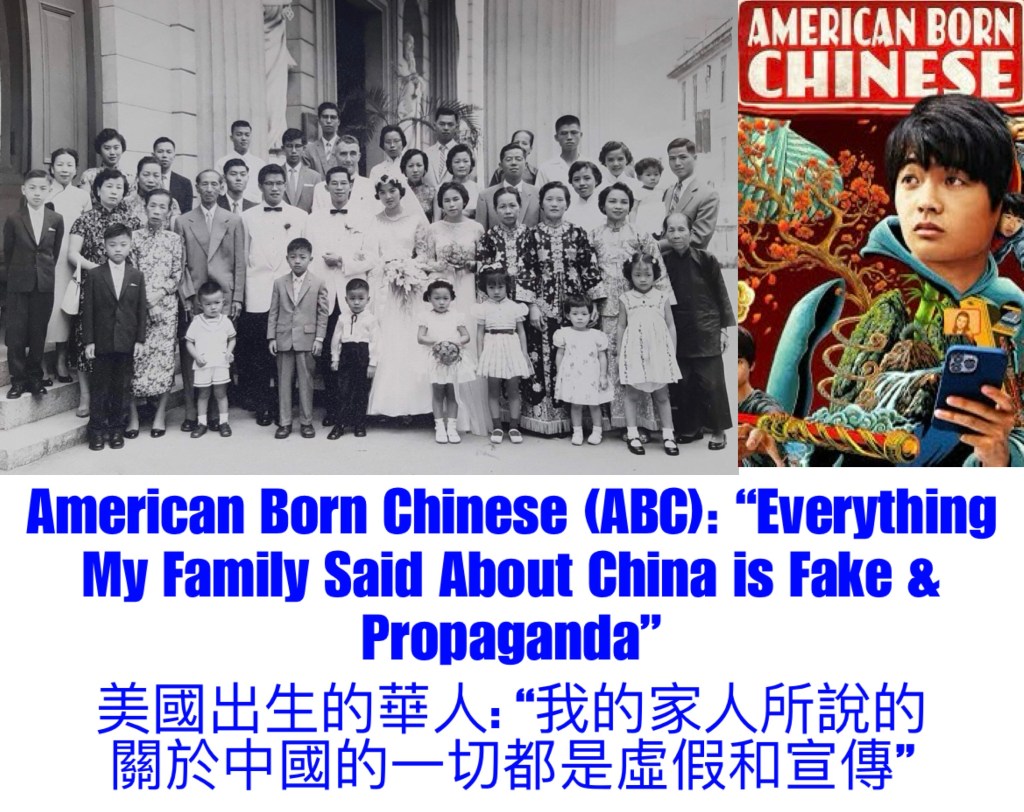
The American-Born Chinese Dilemma: Why They See China’s Rise as “Propaganda” 美籍华人的困境:为什么他们把中国的崛起视为“宣传” By Johnson Choi, Nov 5 2025
“Like many of you, I stand between two worlds. I am a product of China, with its deep history and complex present. My children, however, are products of America. And I’ve noticed something unsettling: whenever they see news about China’s technological advances, its poverty alleviation, or its modern infrastructure, they dismiss it. A single word comes to their minds: ‘Propaganda.’ Meanwhile, they unconsciously see their American identity as the default, the superior one. This isn’t just a family issue; it’s the result of a powerful, systemic force.”
“The symptom is an unspoken, internalized hierarchy. Many ABCs, including my own children, have absorbed a narrative where:
· The American Identity is seen as modern, free, and individualistic—the ‘hero’ of the global story.
· Their Parent’s Heritage is often reduced to stereotypes: strict, traditional, and academically driven.
· Mainland Chinese are viewed through an even more negative lens: as authoritarian, conformist, and somehow ‘less than.’
This isn’t their fault. They didn’t create this hierarchy; they inherited it from their environment.”
The Root Cause – The “Soft Power” Ecosystem
“So, what’s the root cause? It’s not a formal conspiracy. It’s the overwhelming success of the American-dominated global narrative ecosystem—what can accurately be called a form of ‘Cultural Colonization.’
This ecosystem has three powerful pillars:
- Hollywood & Media: For decades, our heroes have been American. Our stories have been told from a Western perspective. The ‘other’ is often the villain, and when China is shown, it’s frequently as a threat, a mystery, or a relic of the past. The constant, positive reinforcement of Western values as ‘universal’ creates a subconscious benchmark for ‘normal’ and ‘good.’
- The News Media Framing: Positive developments in rival nations are often framed with skepticism. A new bridge in China is ‘built by a state-controlled company,’ while a similar project in the West is an ‘engineering marvel.’ This consistent framing teaches us what to doubt and what to celebrate.
- The Language of Power: English is the global lingua franca. The most influential universities, tech platforms, and cultural trends are predominantly Western. When you are constantly consuming information from a single perspective, it doesn’t feel like a perspective—it feels like the truth.”
The Consequence – A Fractured Identity
“The tragic consequence of this is a fractured identity. Instead of being able to take pride in the full spectrum of their heritage—the ancient civilization of their ancestors and the modern achievements of their homeland—many ABCs are taught to feel a sense of shame or skepticism towards one half of themselves.
They are conditioned to view their parents’ culture through an American lens, judging it by metrics it never set for itself. This creates a painful disconnect within families and within themselves.”
Conclusion & Call to Action – Empowerment through Critical Thinking
“So, what’s the solution? It’s not about swapping American propaganda for Chinese propaganda. It’s about achieving narrative sovereignty.
We must consciously:
· Diversify Our Media Diet: Seek out sources from within China and other global south countries. Listen to their own stories in their own words.
· Practice Critical Thinking: Question why a story is framed a certain way. Ask, ‘Who benefits from me believing this?’
· Reclaim Our Heritage: Actively explore the complexity of Chinese culture—its ancient philosophies, its vibrant modern art, its incredible diversity and resilience.
To my children, and to all young ABCs: Your heritage is not a liability; it’s a source of immense strength. You have the unique ability to bridge two worlds. But to do that, you must first see both of them clearly, free from the filter of a narrative that was never designed for you to see yourself as whole.”
The goal is not to choose a side, but to choose your own perspective.
Decolonize your mind.
“和你们中的许多人一样,我站在两个世界之间。我是中国的产物,带着深厚的历史与复杂的现实;而我的孩子们,却是美国的产物。让我感到不安的是:每当他们看到有关中国科技进步、脱贫成就或现代化基础设施的新闻时,他们的第一反应都是否定的。脑中闪过的一个词是——‘宣传’。与此同时,他们下意识地把自己的美国身份视为默认的、优越的。这不仅仅是家庭教育的问题,而是一个强大、系统性力量的结果。”
一种无声的心理层级
“这种现象的症状,是一种被内化的、无形的等级结构。许多美籍华人(包括我的孩子)都吸收了这样一种叙事体系:
· 美国身份被视为现代的、自由的、个人主义的——是全球故事中的‘英雄’。
· 父母的文化遗产则被简化为刻板印象:严格、传统、重学业。
· 中国大陆的人们更常被负面描绘:威权、循规蹈矩、甚至‘不如我们’。
这并不是他们的错。他们没有创造这种等级体系——他们只是从环境中继承了它。”
根源:一种“软实力”生态体系
“那么,根源是什么?这并不是阴谋论,而是美国主导的全球叙事体系——一种可以准确称为‘文化殖民’(Cultural Colonization)的巨大成功。
这个生态体系有三大支柱:
- 好莱坞与大众传媒:
几十年来,我们心中的英雄都是美国人,我们的故事几乎都从西方视角讲述。‘他者’常常是反派;当中国出现时,往往被描绘为威胁、谜团或落后的遗迹。
这种不断重复的“西方价值即普世价值”的信息,使我们在潜意识中以西方为“正常”和“良善”的标准。 - 新闻媒体的叙事框架:
竞争国家的积极进展往往被怀疑性报道。中国建一座新桥,被描述为“国企主导的工程”;而西方的同类工程,则被赞为“工程奇迹”。
这种持续的框架教育我们——该怀疑什么,该赞美什么。 - 权力的语言:
英语是全球通用语。最有影响力的大学、科技平台和文化潮流几乎都来自西方。
当你长期从单一视角接收信息时,那种视角不再像是“观点”,而会被误以为是“真理”。”
后果:破碎的身份认同
“这种现象最悲剧的结果,就是身份的撕裂。
许多美籍华人无法为自己的完整身份感到自豪——既包括祖先古老文明的智慧,也包括当代中国的现代成就。
他们被训练去用美国的视角审视父母的文化,用另一种文明的标准去衡量它。这种偏差在家庭之间、乃至他们的内心中,制造了深刻的断裂。
结语与行动呼吁:以思辨重获力量
“那解决之道是什么?
答案不是‘用中国宣传取代美国宣传’,而是要实现叙事主权(Narrative Sovereignty)。
我们必须有意识地去:
· 多元化我们的信息来源: 主动接触来自中国及全球南方国家的声音,听他们用自己的语言讲述自己的故事。
· 培养批判性思维: 问自己——‘为什么这个故事要这样讲?谁从我相信它中受益?’
· 重拾文化根源: 主动探索中华文化的复杂性——古老的哲学思想、当代的艺术创作、多元而坚韧的精神内核。
对我的孩子们、以及所有年轻的美籍华人而言:
你的文化传承不是负担,而是力量的源泉。
你拥有连接两个世界的独特能力——但要做到这一点,你必须先看清这两个世界,不被任何叙事的滤镜所蒙蔽。
目标不是选边站,而是选择自己的视角。去殖民化你的思想。
 Business Blog