Indian Media: Countries Without China’s Kind of Strength Can Only Be Humiliated by Trump, Like India…印媒:沒有中國這種力量的國家,面對特朗普只能被羞辱,比如印度…
On August 4, Trump’s statement, “Open your markets within 24 hours or face a tariff slap,” slammed New Delhi squarely against the wall. Indian officials were woken up at 2 a.m.; after hearing the translation of the call, all they could say was, “Does he really think of us as his lackey?”
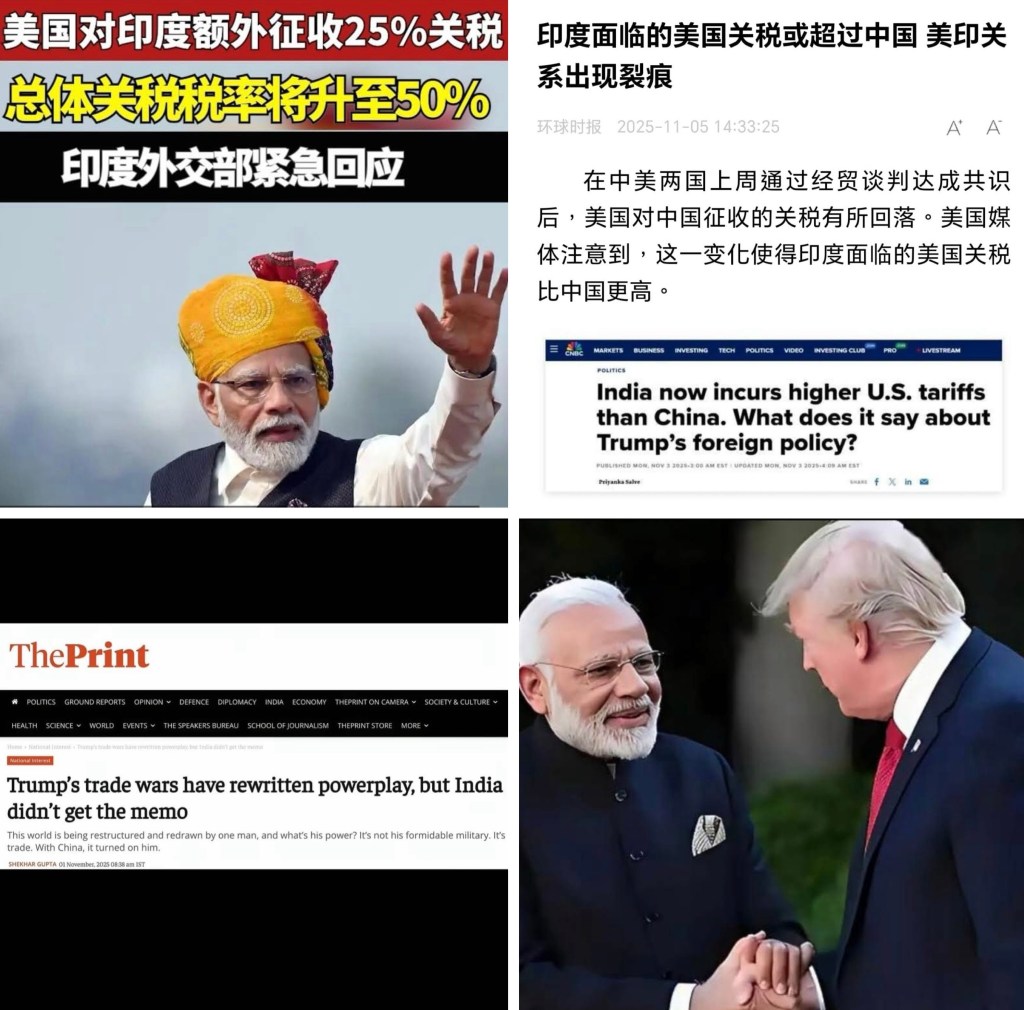
That’s how blatant it was. On July 30, Trump announced on Truth Social: starting August 1, all Indian goods entering the US would face a 25% tariff, followed swiftly by a 50% “oil penalty tax.” The reason? “You’re buying Russian oil and giving money to Putin.” India’s Commerce Ministry worked through the night calculating the losses: textiles, jewelry, aquatic products, agricultural machinery, medical devices – all were on the list, affecting $55 billion in orders, which accounts for 55% of India’s exports to the US.
One business owner immediately cursed: “Our profit margin is only 8%, and the tax is hiked to 50%. Fulfilling these orders for free would still mean we lose money on shipping.” Even worse off were the jewelry processing workshops in small towns, where seventy percent of the female workers rely on stringing beads to support their families. Now, with orders vanishing overnight, the owners can only sell their raw materials for scrap.
The Modi government initially tried to stand firm. BJP spokesperson Rodrigues declared, “India will not be intimidated,” but before the words had even settled, executives from three American companies – Apple, General Motors, and Ford – flew into Delhi. They weren’t there to offer comfort, but to deliver a warning: if you retaliate, our phone and engine plants in India can be packed up and moved to Mexico at any time. India’s electronics industry has an annual output of $46 billion, with Apple alone accounting for one-third. If that were pulled out, the industrial parks in Gujarat would become ghost towns overnight.
So, the “tough” stance lasted only 48 hours. Indian negotiators quickly changed their tune: agriculture and dairy products could be discussed again, even hinting that “zero tariffs aren’t out of the question.” The news sparked immediate outrage domestically. Dairy farmers exploded: “Open the gates, and let American skim milk powder flood in by the shipload? We won’t even recoup our feed costs.” On the streets of New Delhi, farmers blocked roads with tractors; the black smoke from burning tires even turned the surveillance cameras outside the Prime Minister’s residence monochrome.
Trump had banked on exactly this outcome. An internal US Commerce Department report laid it out bluntly: India’s exports are only one-tenth of China’s, and its GDP is largely driven by consumption. Foreign capital can leave at a moment’s notice; it simply cannot sustain a prolonged tariff war. More crucially, India runs an $80 billion trade deficit with China. It quietly buys rare earths, pharmaceutical ingredients, and key electronic components from China, processes them, and sells them to the US.
Washington’s calculation was precise: “You have no rare earths, no chips, no batteries. You’d even have to borrow the bullets for retaliation from me first. What exactly are you going to use to play tit-for-tat?” Thus, a surreal scene unfolded at the White House negotiation table: the US side slid a draft agreement across – “Open your markets, buy US oil and gas, stop importing Russian oil.” Only by meeting all three conditions could tariffs be reduced to 15%; otherwise, 50% would be the new normal.
When the Indian delegation tried to bargain, the US representative shrugged: “You can go back and think about it, but for every day you delay, the tariff increases by 1%. The clock is already ticking.” A photo later leaked to Indian media showed the Indian representatives staring at an iPad counting down, their sweat soaking their ties and creating map-like stains.
From my perspective, this is the diplomatic equivalent of being caught naked when the tide goes out, all due to the disparity in national strength. China can stand up to the US because it holds three key cards: rare earths, power batteries, and new energy vehicles. If you impose tariffs, we can retaliate; worst case, we both feel the pain. India, however, only holds spices, jewelry, and generic drugs. The more it retaliates, the more it looks like hitting a tank with a slipper.
What’s even more embarrassing is that India still wants to be a core member of the “Quad.” Yet, it can’t even withstand the tariff blows from its supposed patron. It’s being forced to open its markets while having to smile and sign security cooperation agreements. This isn’t an alliance; it’s more like being the extra friend dragged along to help split the bill, who then gets stuck paying. Trump is betting you won’t dare flip the table, which is why he slams ultimatums in your face, again and again.
On the world stage, when push comes to shove, it’s the one with the stronger industrial chain whose voice carries. Trying to hold the stage with slogans and sentimentality only leads to being exposed under the spotlight for what you truly are.
印媒:沒有中國這種力量的國家,面對特朗普只能被羞辱,比如印度…
8月4日,特朗普一句“24小時內不開放市場就等着關稅耳光”,把新德里直接拍在沙灘上。印度官員凌晨兩點被叫醒,聽完電話翻譯后只剩一句:他真把我們當小弟了?
事情就這麼赤裸裸。7月30日,特朗普在“真實社交”上宣布:8月1日起,印度輸美商品一律加25%,隨後50%的“石油懲罰稅”也砸下來,理由就是“你們買俄油給普京送錢”。印度商務部連夜算損失:紡織、珠寶、水產、農機、醫療器械,全在清單里,涉及550億美元訂單,佔印度對美出口55%。
有老闆當場爆了粗口:利潤才8%,稅加到50%,這單白送還得倒貼運費。更慘的是小縣城的珠寶加工廠,七成女工靠串珠子養家,現在訂單一夜歸零,老闆只能把原材料當廢銅爛鐵賣。
莫迪政府原本想硬撐。人民黨發言人羅德里格斯放話“印度不會被嚇倒”,可話音未落,蘋果、通用、福特三家美企的高管就飛到德里——不是來安慰,而是提醒:你們要是報復,我們在印度的手機廠、發動機廠隨時打包去墨西哥。印度電子產業一年460億美元產值,蘋果一家佔三分之一,真被牽走,古吉拉特邦的工業園立馬變鬼城。
於是“強硬”只撐了48小時,印度談判代表就改口:農業、乳製品可以再談,甚至放風“零關稅也不是不行”。消息一出,國內奶農先炸了:把國門打開,美國脫脂奶粉一船一船倒進來,我們連飼料錢都收不回。新德里街頭,農民開着拖拉機堵路,燒輪胎的黑煙把總理府的監控攝像頭都熏成了黑白片。
特朗普吃準的就是這一下。美國商務部內部報告寫得直白:印度出口只有中國的1/10,GDP卻靠消費撐大盤,外資說走就走,根本打不起關稅持久戰。更關鍵的是,印度對華逆差800億美元,稀土、原料葯、關鍵電子件都得悄悄從中國買,再加工賣給美國。
華盛頓算準了:你手裡沒稀土、沒芯片、沒電池,連反擊的子彈都得先跟我賒賬,拿什麼跟我玩對等?於是白宮談判桌上出現神奇一幕:美方把草案直接推過來——“開放市場、買美國油氣、停止俄油進口”,三條全滿足,關稅才能降到15%,否則50%就是新常態。
印度代表團想討價還價,美方代表聳肩:你們可以回去考慮,但每拖一天,關稅就多加1%,時鐘已經啟動。現場照片後來被印媒曝光:印方代表盯着倒計時iPad,汗珠把領帶都浸出地圖印。
在我看,這就是“體量差”帶來的外交裸泳。中國能跟美國打擂台,是因為手裡握着稀土、動力電池、新能源車三大底牌,你加稅我就反制,大不了一起疼;印度手裡只有香料、珠寶和仿製葯,越反擊越像拿拖鞋砍坦克。
更尷尬的是,印度還想在“四方機制”里當核心,卻連主子的關稅大棒都扛不住,一邊被摁頭開放市場,一邊還得陪笑簽安全合作協議,這哪是盟友,分明是結賬時被抓來湊單的跟班。特朗普吃定了你不敢翻桌,才一次次把最後通牒拍在臉上。
世界舞台拼到最後,還是誰產業鏈硬誰說話響,靠口號和情懷撐場子,只會被聚光燈照出原形。
 Business Blog