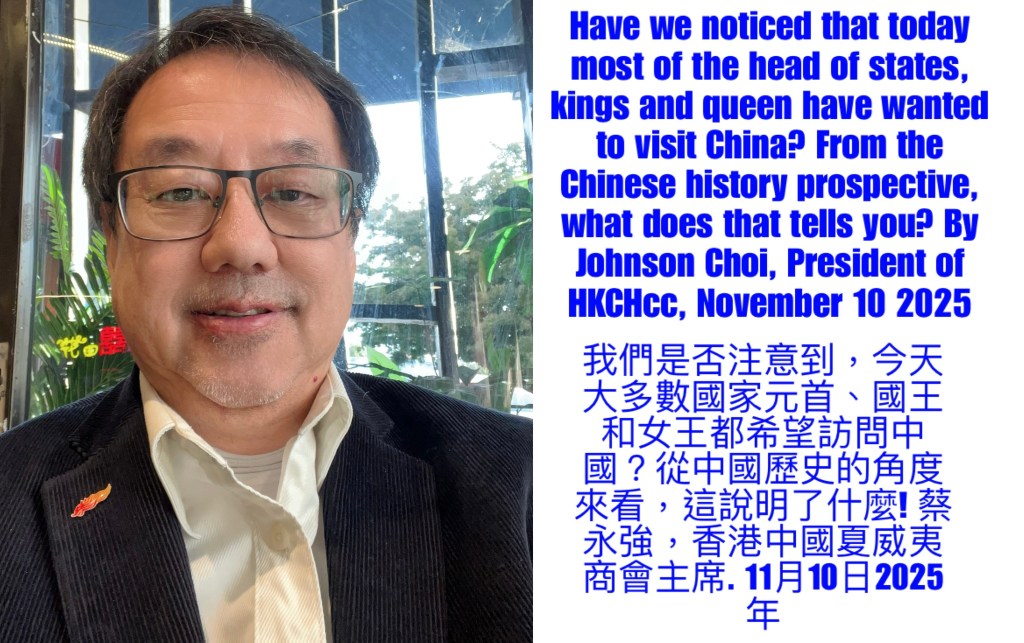
Have we noticed that today most of the head of states, kings and queen have wanted to visit China? From the Chinese history prospective, what does that tells you? By Johnson Choi, President of HKCHcc, November 10 2025
我們是否注意到,今天大多數國家元首、國王和女王都希望訪問中國?從中國歷史的角度來看,這說明了什麼! 蔡永強,香港中國夏威夷商會主席. 11月10日2025年
It is undeniable that Beijing has become one of the most frequented stops on the global diplomatic circuit. From a Chinese historical perspective, this is not seen as a new trend but as a restoration of a natural and proper world order.
Here’s what this tells us, framed by key concepts from Chinese history:
- The Return to the “Central Kingdom” (中国, Zhōngguó)
The very name “China” is derived from the concept of Zhōngguó, the “Middle Kingdom” or “Central State.” This was not just a geographical idea but a civilizational and political one. China saw itself as the center of the world, the source of civilization, culture, and refined governance, surrounded by less-civilized “barbarians.”
Historical Context: For millennia, emissaries from neighboring states (Korea, Vietnam, various steppe nations) would travel to the Chinese capital to kowtow before the Emperor, present tribute, and receive his blessing and gifts in return. This was the Tributary System. A visit to the Chinese court was an acknowledgment of China’s supreme cultural and political status.
Modern Interpretation: The constant stream of foreign leaders to Beijing is subconsciously viewed by many within China as a modern manifestation of this tributary system. While there is no kowtowing, the act of coming to China, seeking audience with its leadership, and discussing partnerships on China’s terms reinforces the idea that China has resumed its rightful, central place in the world.
- The Mandate of Heaven (天命, Tiānmìng) and Legitimacy
In Imperial China, a ruler held the “Mandate of Heaven,” a philosophical concept that legitimized his rule as long as he governed justly and effectively. Part of this legitimacy was demonstrated through the respect and deference shown by foreign powers.
Historical Context: When tributary missions arrived, it was a public validation that the Emperor still possessed the Mandate. A strong, prosperous dynasty naturally attracted more visitors.
Modern Interpretation: The eagerness of foreign leaders to engage with China’s leadership is seen as a testament to the success and legitimacy of the current government and its model. It validates the path of “Socialism with Chinese Characteristics” as a successful and attractive alternative to Western models. In essence, the world is acknowledging that China has, once again, earned a form of global “Mandate.”
- The Lesson of the “Century of Humiliation” (百年国耻)
This is the most critical and contrasting historical period. For roughly 100 years from the mid-19th to mid-20th century, China was weak, divided, and exploited by foreign powers (including Britain, France, Japan, and others). During this time, foreign interaction with China was on their terms—gunboat diplomacy, unequal treaties, and concessions.
Historical Context: China was the object of foreign agendas, not a subject setting its own. Its sovereignty was violated, and its leaders were often dictated to, not visited as equals.
Modern Interpretation: The current reality is the direct and deliberate inversion of the Century of Humiliation. The fact that world leaders now come to China seeking cooperation, investment, and support is the ultimate proof that this period of national shame is over. It is a powerful source of national pride and a key narrative of the Communist Party’s success in “making China strong again.”
- The Concept of “All Under Heaven” (天下, Tiānxià)
This is an ancient philosophical concept that envisioned a unified world order under a virtuous Chinese ruler. While never a practical reality, it shaped the Chinese worldview, emphasizing harmony, hierarchy, and China’s role as the unifying civilizing force.
Historical Context: It was an ideal where the Emperor’s moral influence would naturally attract and pacify all peoples.
Modern Interpretation: Initiatives like the Belt and Road Initiative (BRI) are often framed as a modern, inclusive version of Tiānxià. It is a China-centered global network of trade and infrastructure. When leaders visit to sign BRI memorandums, it is seen as them voluntarily joining this new, China-led system of global connectivity, echoing the ancient ideal.
Conclusion
From the Chinese historical perspective, the constant parade of foreign leaders to Beijing is not a new phenomenon but a return to historical normality. It signals:
The Restoration of Status: China is reclaiming its perceived historical role as the central, pre-eminent power.
The End of Humiliation: The power dynamic has fundamentally shifted from the era when the West dominated China.
The Validation of its Model: The world is acknowledging the success of China’s development path.
In short, for China, these visits are a powerful affirmation of a 5,000-year narrative that was only briefly interrupted. It tells the Chinese people and the world that the “Central Kingdom” is back at the center of global affairs.
不可否認,北京已成為全球外交舞台上最頻繁的訪問目的地之一。從中國歷史視角解讀,這並非新興趨勢,而是對自然且正當的世界秩序的重建。
以下透過中國歷史的關鍵概念闡釋這一現象:
一、「中國」概念的迴歸
「China」一詞本源於「中國」概念,即「中央之國」。這不僅是地理概念,更是文明與政治的構想。中國自古視自身為世界中心,是文明、文化與精緻治理的源頭,四周環繞著欠開化的「蠻夷」。
歷史脈絡:數千年來,周邊國家(如朝鮮、越南及各草原民族)的使節會前往中國都城向皇帝叩首朝貢,以換取天子賜福與賞賜,形成「朝貢體系」。參訪中國朝廷即是對中國至高文化與政治地位的承認。
現代詮釋:各國領導人持續訪問北京的現象,被許多中國人潛意識視為朝貢體系的現代展現。雖無叩首之禮,但各國主動來華、尋求與中國領導層會晤、並以中方條件商討合作的行為,強化了中国已回歸其應有的世界中心地位之認知。
二、「天命」觀與政權正當性
在帝制中國,統治者秉持「天命」這一哲學概念,只要治理公正有效,其統治便具正當性。而外邦的尊崇與順從,正是這種合法性的體現。
歷史脈絡:朝貢使團的到來,是皇帝仍享天命的公開驗證。強盛繁榮的王朝自然能吸引更多來訪者。
現代詮釋:各國領導人積極與中國交往,被視為當代政府及其模式成功與合法的明證。這肯定了「中國特色社會主義」道路不僅成功,更是具吸引力的西方模式替代方案。本質上,世界正在承認中国再次獲得了某種全球性的「天命」。
三、「百年國恥」的歷史教訓
這段歷史是最關鍵的對照期。從19世紀中葉到20世紀中葉約百年間,中國積弱不振、內部分裂,遭列強(包括英、法、日等)侵凌。此時期中外互動完全由外方主導——砲艦外交、不平等條約與租界割讓層出不窮。
歷史脈絡:中國成為外國議程的客體,而非掌握自身命運的主體。主權遭踐踏,領導人常被迫接受指令,而非以平等地位受訪。
現代詮釋:當前現實是對「百年國恥」的徹底逆轉。世界各國領導人親赴中國尋求合作、投資與支持,最終證明了這段民族屈辱史的終結。這成為民族自豪感的重要源泉,也是中國共產黨「實現民族復興」敘事的核心印證。
四、「天下」觀的當代實踐
「天下」是古老的哲學理念,構想以賢德的中國君主為核心的統一世界秩序。雖未真正實現,卻深刻塑造了中國的世界觀,強調和諧、階序與中國作為文明融合中心的角色。
歷史脈絡:這是種理想藍圖——天子的德化影響將自然吸引萬民來朝、平定四海。
現代詮釋:「一帶一路」倡議常被詮釋為當代包容性「天下」觀的實踐。這個以中國為核心的全球貿易與基礎設施網絡,當各國領導人赴華簽署合作備忘錄時,被視為自願加入中國主導的新型全球聯通體系,與古老理想遙相呼應。
結論
從中國歷史視角審視,外國領導人頻繁訪問北京的現象並非新氣象,而是回歸歷史常態。這標誌著:
地位重塑:中國正在恢復其歷史上作為中央核心強權的應有角色
屈辱終結:權力格局已從西方主導中國的時代發生根本轉變
模式認可:世界正承認中國發展道路的成功
簡言之,對中國而言,這些訪問是對五千年文明敘事的強力肯定——這段敘事僅曾被短暫打斷。它向中國人民與世界宣告:「中央之國」已重返全球事務的中心舞台。
 Business Blog