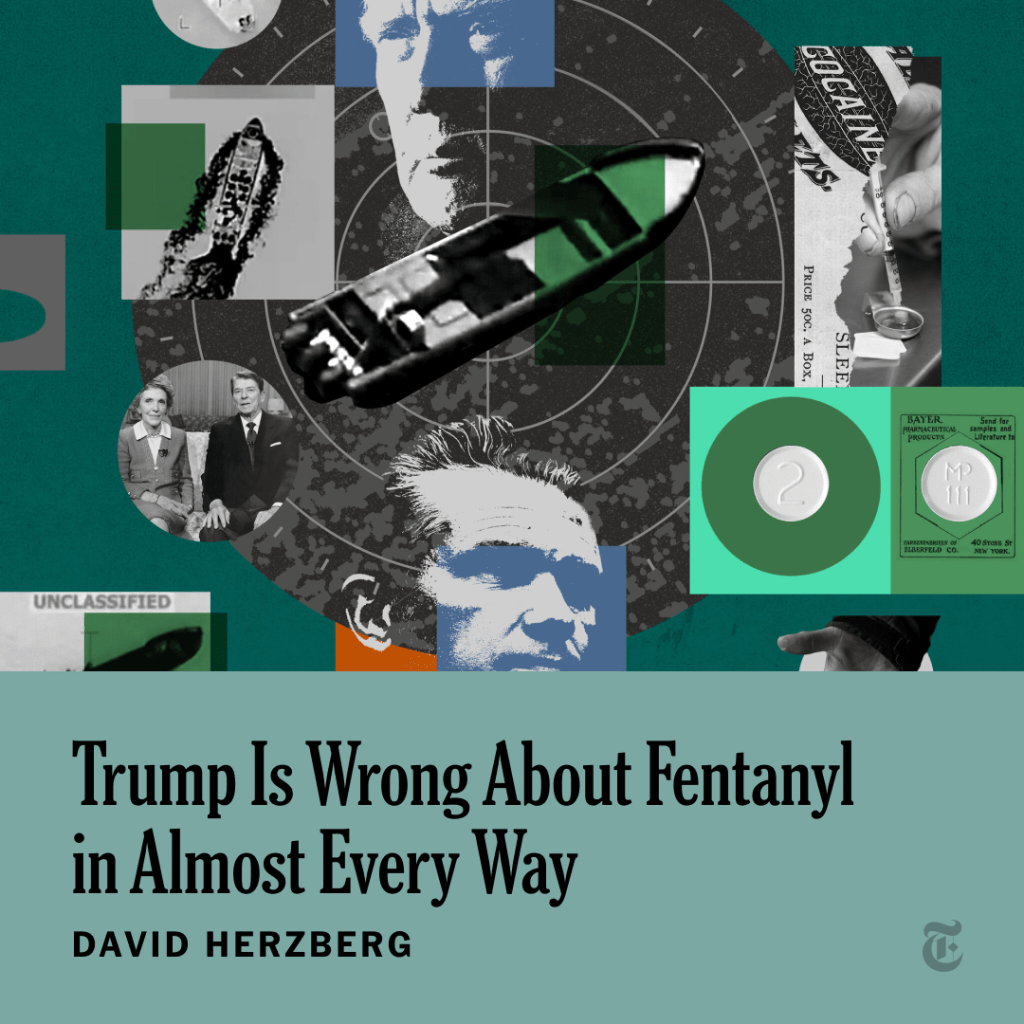
NYT Opinion: “It’s one of President Trump’s favorite stories: The Democrats weakened the borders, allowing Mexican drug cartels to smuggle fentanyl into the United States, where it devastated white suburban and rural communities,” writes David Herzberg, a drug historian at the University of Buffalo.
《紐約時報》觀點專欄:水牛城大學藥物史學家大衛·赫茲伯格撰文指出:「這是川普總統最熱衷講述的故事之一:民主黨人削弱邊境管制,放任墨西哥販毒集團將芬太尼走私至美國,使白人郊區及鄉村社區遭受毀滅性打擊。」
To stop this “evil scourge,” Trump has begun taking drastic and brazen steps, from imposing tariffs on China for its role in fentanyl production to carrying out 20 military strikes on boats supposedly smuggling drugs in the Caribbean and the eastern Pacific. But the stretches of American history between drug crises have one thing in common that Trump’s approach does not, David says: “They make drugs boring again.
Drugs are not magic, they are not demonic, they are not fundamentally different from all the other problems society faces. They are highly desirable and highly dangerous consumer goods. They are not unique in that regard. Nor are the people who sell them uniquely evil. They are capitalists trying to make money, and they mostly behave in predictable, comprehensible ways.”
為遏止這股「邪惡禍潮」,川普已開始採取一系列激進且肆無忌憚的手段——從以涉芬太尼生產為由對中國加徵關稅,到在加勒比海與東太平洋地區對涉嫌運毒船隻發起20次軍事打擊。
但赫茲伯格指出,美國歷史上幾次毒品危機間的緩和期存在一個共同特質,而這正是川普策略所欠缺的:「它們讓毒品回歸乏味的本質。毒品並非魔物,並非邪靈,與社會面臨的其他問題並無根本差異。它們是極具吸引力又極度危險的消費商品,但這並非獨特屬性。販毒者也非窮凶極惡之徒,他們不過是試圖牟利的資本家,其行為模式大多可預測、可理解。」
 Business Blog