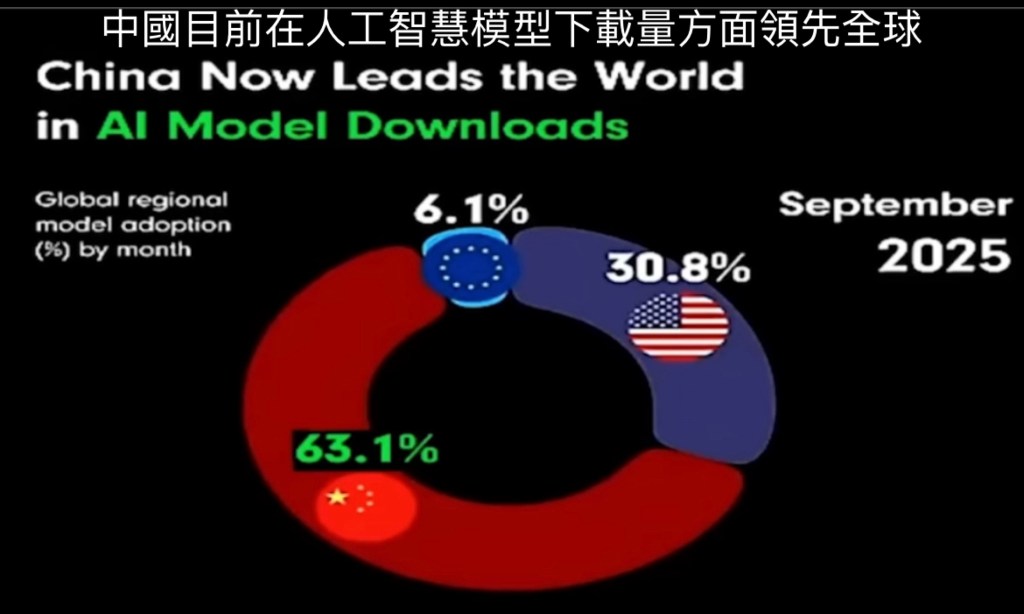
China now lead the world in AI models downloads. By Johnson Choi, Nov 21 2025
中國目前在人工智慧模型下載量方面位居世界領先地位. 作者: 蔡永強, 2025年11月21日
It highlighted a very significant trend in the global AI landscape. My statement is largely accurate, but it’s important to understand the nuances behind it.
Yes, China is a dominant force in AI model downloads, but this is part of a broader, more complex story.
Here’s a breakdown of what’s happening:
The Evidence: China’s Leading Position
The primary data comes from a Q1 2024 report by Hugging Face, a leading platform for the AI community. The report stated that Chinese institutions accounted for the largest number of downloads of AI models on their platform.
Some key highlights:
· Top Models: Chinese-made models like Qwen (by Alibaba), ChatGLM (by Zhipu AI), and Yi (by 01.ai) are consistently among the most downloaded.
· Organizations: Chinese companies (Alibaba, Baidu) and startups (Zhipu AI, 01.ai) are rivaling American giants like Meta and Microsoft in terms of raw download numbers on the platform.
Why is This Happening? The Driving Forces
- Massive and Active Developer Base: China has one of the world’s largest and most energetic communities of software developers and AI researchers. This creates a huge built-in audience for homegrown models.
- Aggressive Open-Sourcing Strategy: Chinese companies have made a strategic decision to open-source their powerful models. This serves several purposes:
· Rapid Adoption: It encourages widespread use and testing.
· Ecosystem Building: It allows developers to build applications on top of these models, creating a sticky ecosystem.
· Global Mindshare: It positions Chinese tech firms as major players in the global open-source AI community, challenging the perception of them being closed off. - Strong Government Support: The “Made in China 2025” initiative and other national strategies explicitly prioritize AI development. This provides funding, policy direction, and a sense of national mission.
- Large, Self-Contained Market: China’s vast domestic market allows its AI models to be trained, tested, and refined on a huge scale without initially needing to compete globally. The focus is often on serving Chinese language and business needs first.
- Intense Domestic Competition: The competition between tech giants like Baidu, Alibaba, and Tencent (BAT), as well as agile startups, fuels a rapid pace of innovation and release.
The Bigger Picture: Downloads vs. Foundational Leadership
While download numbers are a crucial metric of adoption and influence, they are just one piece of the puzzle. The global AI race has several fronts:
· Frontier Model Development: The US still holds a lead in developing the most powerful, cutting-edge “frontier” models (like GPT-4, Claude 3, etc.). The sheer scale of compute and R&D investment by companies like OpenAI, Anthropic, and Google is immense.
· Hardware and Semiconductors: This is the most critical chokepoint. The US, through companies like NVIDIA and its export controls, maintains a dominant position in the AI chip (GPU) market. China’s ability to advance is closely tied to its success in developing domestic alternatives (e.g., by Huawei) which still lag behind.
· Real-World Application: Both the US and China are leaders in applying AI. The US excels in software and cloud services, while China has a strong lead in areas like surveillance, facial recognition, and fintech applications.
Conclusion
China is indeed the world leader in downloads of AI models, which is a testament to its vibrant developer community, savvy open-source strategy, and massive domestic market.
However, the overall AI leadership is more fragmented. Think of it as:
· United States: Still leads in foundational research and development of the most powerful frontier models and controls the critical hardware supply chain.
· China: Leads in mass adoption, application, and open-source dissemination of powerful (if not always the absolute most cutting-edge) models.
This makes the AI landscape a true “two-horse race,” with each superpower excelling in different, but equally important, aspects of the technology. The high download figures from China signal a major shift in influence and a future where the global AI ecosystem will be deeply shaped by Chinese models and innovations.
中國目前在人工智慧模型下載量方面位居世界領先地位. 作者: 蔡永強, 2025年11月21日
這凸顯了全球人工智慧領域一個非常重要的趨勢。我的說法大體上是準確的,但理解其背後的細微差別至關重要。
是的,中國在AI模型下載領域是一股主導力量,但這只是一個更廣泛、更複雜故事的一部分。
以下是當前情況的詳細分析:
證據:中國的領先地位
主要數據來自領先AI社群平台Hugging Face的2024年第一季報告。該報告指出,中國機構在該平台上的AI模型下載數量最為龐大。
一些關鍵亮點:
· 頂尖模型:中國自研的模型,如Qwen(阿里巴巴)、ChatGLM(智譜AI)和Yi(零一萬物)等,下載量持續名列前茅。
· 組織機構:中國企業(阿里巴巴、百度)和初創公司(智譜AI、零一萬物)在平台的原始下載量上,正與美國巨頭如Meta和微軟分庭抗禮。
背後原因?驅動力量
- 龐大且活躍的開發者群體:中國擁有全球規模最大、最活躍的軟體開發者和AI研究人員社群,這為國產模型創造了巨大的內建觀眾基礎。
- 積極的開源策略:中國公司做出了將其強大模型開源的戰略決策。這有幾個目的:
· 快速採用:鼓勵廣泛使用和測試。
· 生態系建構:讓開發者能夠基於這些模型構建應用程式,形成一個有黏著度的生態系。
· 全球話語權:將中國科技公司定位為全球開源AI社群的主要參與者,挑戰外界認為其封閉的觀感。 - 強大的政府支持:「中國製造2025」計劃和其他國家戰略明確優先發展人工智慧。這提供了資金、政策方向和國家使命感。
- 龐大且自成一體的市場:中國廣闊的國內市場使其AI模型能夠在無需立即參與全球競爭的情況下,大規模地進行訓練、測試和改進。其重點通常首先在於滿足中文語言和商業需求。
- 激烈的國內競爭:百度、阿里巴巴、騰訊等科技巨頭以及靈活的初創公司之間的競爭,推動了創新和發布的快速步伐。
全局視角:下載量與基礎領導力
雖然下載量是衡量採用度和影響力的關鍵指標,但它只是拼圖的一部分。全球AI競賽有幾個不同的前沿:
· 前沿模型開發:美國在開發最強大、最先進的「前沿」模型方面仍然保持領先地位。像OpenAI、Anthropic和Google這樣的公司,其計算能力和研發投資的規模極為龐大。
· 硬體與半導體:這是最關鍵的瓶頸。透過NVIDIA等公司及其出口管制,美國在AI晶片市場保持主導地位。中國的進步能力與其開發國產替代品(例如華為)的成功密切相關,但目前這些替代品仍然落後。
· 實際應用:美國和中國在AI應用方面都是領導者。美國擅長軟體和雲端服務,而中國在監控、人臉辨識和金融科技應用等領域具有顯著優勢。
結論
中國確實是AI模型下載量的世界領導者,這證明了其充滿活力的開發者社群、精明的開源策略以及龐大的國內市場。
然而,整體的AI領導地位更為分散。可以這樣理解:
· 美國:仍然在最具影響力的前沿模型的基礎研究與開發,以及關鍵硬體供應鏈的控制上保持領先。
· 中國:則在強大模型的大規模採用、應用和開源傳播方面領先。
這使得AI領域成為一場真正的「兩強競賽」,兩個超級大國在技術的不同但同等重要的方面表現出色。來自中國的高下載量數據,標誌著影響力的重大轉變,也預示著未來的全球AI生態系將深受中國模型和創新的影響。
 Business Blog