Japan’s status as a defeated power in World War II was established by several key documents, not by any single country’s declaration. What would be the consequences if Japan were to militarily attack a victorious WWII power? By Johnson Choi, Nov 26 2025
日本的戰敗地位是由多份二戰關鍵文件確立的,而不是靠某一國單獨宣布. 如果日本武力攻擊二戰戰勝國有什麼後果? 作者: 蔡永強, 2025年11月26日
The following are the most critical legal and historical sources:
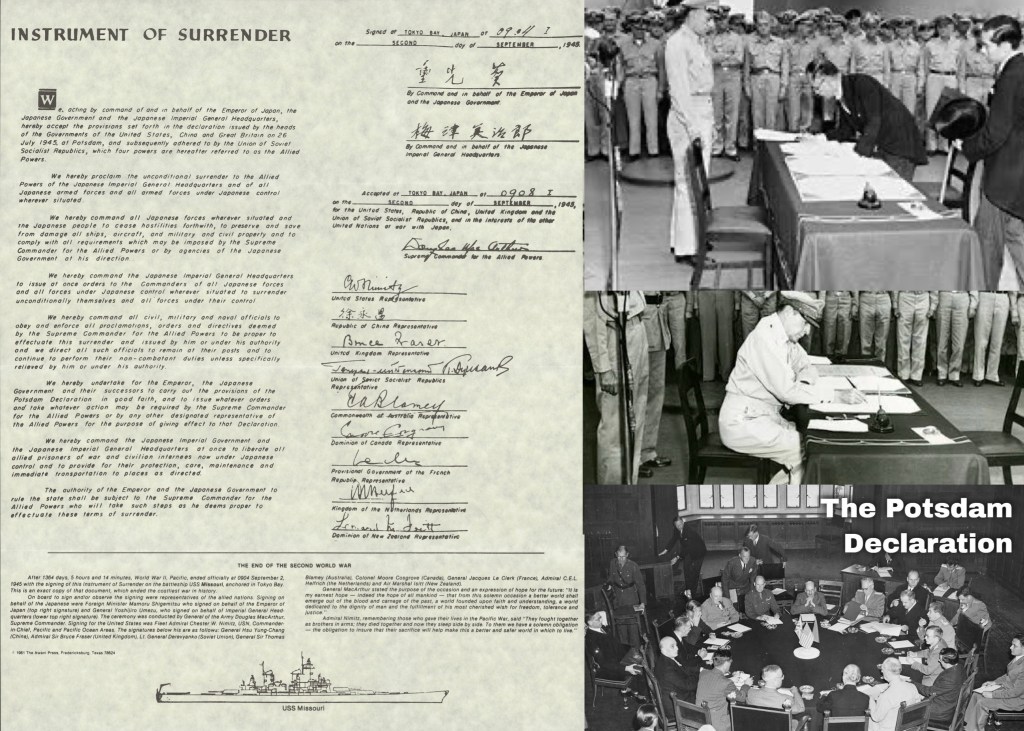
✅ 1️⃣ Potsdam Declaration (July 1945)
- Issued by the United States, United Kingdom, and China (later supported by the Soviet Union).
- Demanded Japan’s unconditional surrender.
- Explicitly defined the limits of Japanese sovereignty.
- Warned Japan of “prompt and utter destruction” if it did not comply.
📌 This is the core political document that set the terms for Japan’s defeat.
✅ 2️⃣ Japanese Instrument of Surrender (September 2, 1945)
- Formally signed by Japan aboard the USS Missouri.
- Declared unconditional surrender.
- Accepted all terms of the Potsdam Declaration.
- Marked Japan’s official status as a defeated power in World War II.
📌 This is the internationally legally binding document in which Japan acknowledged its defeat.
✅ 3️⃣ Treaty of San Francisco (Signed 1951, Effective 1952)
- Led by the United States and signed by 48 countries.
- Formally restored Japan’s sovereignty and international status.
- Marked the transition of Japan’s status as a defeated power into the “post-war settlement” phase.
What would be the consequences if Japan were to militarily attack a victorious WWII power?
This is a very serious hypothetical question. From the perspectives of international law, geopolitics, and realistic power dynamics, if Japan were to launch a military attack against a victorious WWII power (especially a permanent member of the UN Security Council such as China, the United States, Russia, the United Kingdom, or France), the consequences would be extremely severe and transformative.
The following are the potential multi-layered consequences:
- Legal and Political Consequences
· Complete Overthrow of the Post-War International Order: As a defeated power in WWII, Japan’s current Peace Constitution (especially Article 9) and national security architecture were established within the post-war international system. Initiating an attack would constitute a complete betrayal of this system, placing Japan in an untenable position both legally and morally under international law.
· Severe Response under the UN Charter: Such an act would be considered the most severe form of aggression. The United Nations Security Council (UNSC) would immediately initiate procedures under Chapter VII of the UN Charter to pass resolutions authorizing all necessary measures, including military action, to “maintain or restore international peace and security.” The attacked permanent member state holds veto power, ensuring the passage of the most severe resolutions.
· Complete Diplomatic Isolation: Japan would instantly become a pariah state in the international community. Almost all major countries, including its traditional allies, would strongly condemn it and sever diplomatic relations. It would lose all international support and trust.
- Military and Security Consequences
· Invalidation of the U.S.-Japan Security Treaty: The treaty is mutual; Article 5 stipulates that an armed attack against either party triggers collective defense. However, if Japan is the aggressor, the United States would have no legal or moral obligation to protect Japan. On the contrary, the U.S. would highly likely immediately suspend or invalidate the treaty, and could even join allies in taking military action against Japan.
· Overwhelming Military Retaliation:
· Conventional Warfare: Although the Japan Self-Defense Forces are well-equipped, they suffer significant disadvantages compared to any UNSC permanent member (especially China, the U.S., or Russia) in terms of strategic depth, nuclear arsenal, long-range strike capability, and troop numbers. Japan would face devastating, comprehensive conventional military strikes, with its military infrastructure, command centers, ports, and airfields likely paralyzed in the first wave.
· Nuclear Deterrence: If Japan attacks one of the three nuclear powers—China, the U.S., or Russia—the situation could escalate into nuclear war. To swiftly end the conflict and avoid greater losses, the attacked nuclear power might consider (or threaten to use) nuclear weapons against key targets in Japan. Japan itself possesses no nuclear weapons and would be utterly defenseless against nuclear deterrence.
· Multinational Coalition Intervention: Similar to the 1991 “Desert Storm” operation against Iraq, but on a much larger scale. The United States would likely lead or even participate in forming a broad international coalition to conduct military strikes against Japan to restore regional peace.
- Economic and Sanctions Consequences
· Devastating Comprehensive Sanctions: The UN and countries worldwide would immediately impose the most severe economic sanctions in history on Japan, including but not limited to:
· Complete Trade Embargo: Cutting off imports of all strategic materials, including energy (oil, natural gas), food, and minerals.
· Financial Blockade: Excluding Japan from international financial settlement systems like SWIFT and freezing all assets of the Japanese government, companies, and individuals overseas.
· Technology Blockade: Completely halting all exports of high-tech products and technology to Japan.
· Instant Collapse of the Japanese Economy: Japan is a country extremely scarce in resources and heavily reliant on imports and foreign trade. The aforementioned sanctions would lead to industrial shutdowns, energy shortages, social unrest, and the complete collapse of its economic system in a very short time.
- Ultimate Consequences for Japan Itself
· Military Defeat and Occupation: The outcome of the war is unquestionable; Japan would suffer a defeat even more devastating than at the end of WWII. Post-war, its national sovereignty would be subject to the strictest limitations.
· Regime Change and Demilitarization: The victorious powers and the international community would highly likely compel Japan to undergo “regime transformation,” completely abolishing its existing military forces and potentially implementing long-term international military occupation and supervision to ensure it never again becomes a threat.
· Complete Loss of National Status: Japan would fall from being a major global economy and a respected nation to a “rogue state” spurned by the international community and strictly monitored. Its international status and national dignity would suffer a devastating blow, and recovery could take centuries.
In summary, the probability of this hypothetical scenario occurring in reality is extremely low, as Japan’s political elites and citizens are fully aware of its catastrophic consequences. It would be tantamount to national suicide. No rational Japanese leader would or could make such a decision. The answer to this question clearly reveals that the power structure and red lines established based on the outcome of WWII in current international politics remain effective and possess strong deterrent power.
日本的戰敗地位是由多份二戰關鍵文件確立的,而不是靠某一國單獨宣布。
以下是最核心的法律與歷史來源:
✅ 1️⃣ 《波茨坦宣言》(1945年7月)
• 由美國、英國、中國共同發表(後蘇聯加入支持)。
• 要求日本無條件投降。
• 明確限定日本主權範圍。
• 日本若不接受將面臨「迅速而徹底的毀滅」。
📌 這是確立日本戰敗條件的核心政治文件。
✅ 2️⃣ 《日本投降書》(1945年9月2日)
• 日本在戰艦密蘇里號上正式簽署。
• 宣布無條件投降。
• 接受《波茨坦宣言》全部條件。
• 標誌著日本正式成為二戰的戰敗國。
📌 這是日本承認戰敗、具有國際法效力的文件。
✅ 3️⃣ 《舊金山和約》(1951年,1952年生效)
• 由美國主導,48國簽署。
• 日本正式恢復主權與國際地位。
• 戰敗國地位進入「戰後處理結束」階段。
如果日本武力攻擊二戰戰勝國有什麼後果?
这是一个非常严肃的假设性问题。从国际法、地缘政治和现实力量对比的角度来看,如果日本对一个二战战胜国(尤其是联合国安理会常任理事国,如中国、美国、俄罗斯、英国、法国)发动武力攻击,其后果将是极其严重且颠覆性的。
以下是可能发生的多层次后果:
- 法律与政治后果
· 彻底颠覆战后国际秩序:日本作为二战战败国,其现行的和平宪法(特别是第九条)和国家安全架构都是在战后国际体系下建立的。主动发动攻击将完全背叛这一体系,使其在国际法理和道义上陷入万劫不复的境地。
· 联合国宪章的严厉反应:此举将被视为最严重的侵略行为。联合国安理会(UNSC)会立即启动程序,根据《联合国宪章》第七章,通过决议授权采取包括军事行动在内的一切必要手段来“维持或恢复国际和平及安全”。作为常任理事国的被攻击国拥有一票否决权,可以确保最严厉的决议通过。
· 外交上的彻底孤立:日本将瞬间成为国际社会的“弃儿”。几乎所有主要国家,包括其传统盟友,都会对其进行最强烈的谴责并断绝外交关系。它将失去所有的国际支持与信任。
- 军事与安全后果
· 《美日安保条约》的失效:该条约是双向的,其第五条明确规定“对任一方”的武力攻击都会触发共同防御。但如果日本是主动的侵略方,美国将没有任何法律和道义义务去保护日本。相反,美国极有可能立即宣布条约中止或失效,甚至与盟国一起对日本采取军事行动。
· 压倒性的军事反击:
· 常规战层面:日本虽然自卫队装备精良,但在国土纵深、核武库、远程打击能力、兵员数量等方面,与任何一个安理会常任理事国(尤其是中、美、俄)相比都存在巨大劣势。它将面临毁灭性的、全方位的常规军事打击,其军事基础设施、指挥中心、港口和机场将在首轮打击中就被瘫痪。
· 核威慑层面:如果日本攻击的是中国、美国或俄罗斯这三个核大国,局势有升级为核战争的风险。为了迅速结束战争并避免己方遭受更大损失,被攻击的核大国可能会考虑(或在危机时威胁使用)核武器,对日本的关键目标进行打击。日本自身没有核武器,在核威慑面前将毫无还手之力。
· 多国联军干预:类似于1991年针对伊拉克的“沙漠风暴”行动,但规模会大得多。美国很可能领导甚至亲自参与组建一个广泛的国际联军,对日本进行军事打击,以恢复地区和平。
- 经济与制裁后果
· 毁灭性的全面制裁:联合国和世界各国会立即对日本实施史上最严厉的经济制裁,包括但不限于:
· 全面贸易禁运:包括能源(石油、天然气)、粮食、矿产等所有战略物资的进口被切断。
· 金融封锁:将日本排除在SWIFT等国际金融结算系统之外,冻结日本政府、企业和个人在海外的一切资产。
· 技术封锁:全面中止一切高科技产品和技术的对日出口。
· 日本经济的瞬间崩溃:日本是一个资源极度匮乏、严重依赖进口和对外贸易的国家。上述制裁将在极短时间内导致其工业停产、能源短缺、社会动荡和经济体系的彻底崩溃。
- 对日本自身的终极后果
· 军事失败与占领:战争的结局毫无悬念,日本将遭受比二战末期更惨重的失败。战后,其国家主权将受到最严格的限制。
· 政权更迭与非军事化:战胜国和国际社会很可能会强制要求日本进行“政权改造”,彻底废除其现有的军事力量,并可能实施长期的国际军事占领与监管,确保其永不再成为威胁。
· 国家地位的彻底沦丧:日本将从一个世界主要经济体和一个受人尊敬的国家,跌落为一个被国际社会唾弃、被严格监控的“流氓国家”,其国际地位和民族尊严将遭受毁灭性打击,复苏过程可能需要数个世纪。
总结来说,这个假设在现实中发生的概率极低,因为日本的政治精英和国民都非常清楚其灾难性后果。这无异于国家自杀行为。 任何理性的日本领导人都不会,也不可能做出这样的决策。这个问题的答案清晰地揭示了当前国际政治中基于二战结果所建立的权力结构和红线依然有效且具有强大的威慑力。
 Business Blog