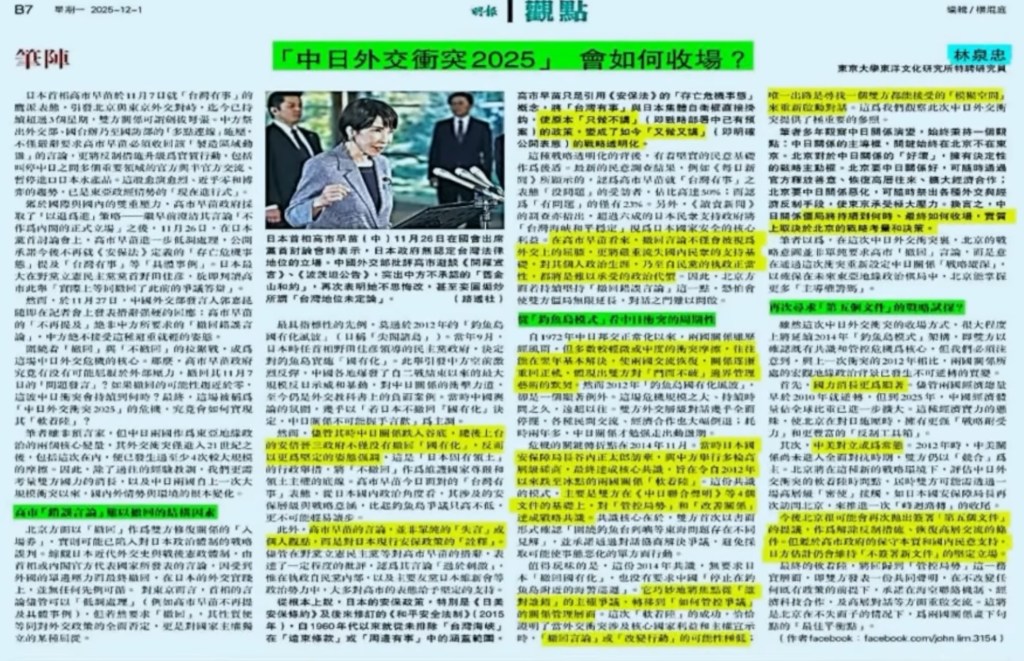
Possible Outcomes of What Ming Pao Calls the “2025 China–Japan Diplomatic Confrontation” — Based on Ming Pao and Other Public Reports/Commentaries
🔎 Origins of the Conflict and Current Situation (Quick Overview)
• The confrontation began when Japanese Prime Minister Sanae Takaichi stated in parliament on November 7, 2025, that if China used force against Taiwan, Japan might consider military involvement under the framework of collective self-defense — a remark Beijing viewed as a serious provocation.
• China immediately launched a series of countermeasures, including diplomatic protests, tightened media and social controls, travel and study-abroad warnings, bans or restrictions on Japanese seafood imports, and calls urging Chinese citizens to avoid traveling to Japan.
• Despite escalating rhetoric and diplomatic tension, there has been no immediate collapse on the economic and trade front; the long-standing pattern of “cold politics, hot economics” continues to hold.
Based on this, the two countries are in a state of high confrontation, but there has been no full diplomatic rupture or military clash — meaning there are multiple possible ways the situation could end.
📈 Five Possible End-Game Scenarios
Below are several outcomes or trends that appear plausible — each dependent on current political, economic, and geopolitical variables.
- Cooling Off / Partial De-escalation — Tension Remains but Full Confrontation Avoided
Economic interests and trade interdependence will push both sides to avoid a total breakdown. Japan may tone down certain sensitive remarks, while China may maintain sanctions but refrain from major escalation.
The result: diplomatic “cooling,” with limited but continued interaction — especially in the economic and commercial sphere. - Prolonged Stalemate, Continuing the “Political–Economic Separation” Model
Even if political confrontation continues, economic and people-to-people exchanges (business, tourism, culture) may partially resume or continue.
However, official and high-level political engagement will be restricted.
The bilateral relationship remains cool for the long term but does not completely collapse. - Limited Japanese Concessions (Verbal / Diplomatic Gestures) in Exchange for De-escalation
If the Japanese government (or the prime minister herself) believes the diplomatic and economic costs have become too high, Tokyo may make tactical “adjustments,” such as issuing diplomatic statements, softening its Taiwan-related rhetoric, or making partial compromises to ease tensions. - Continued Chinese Pressure — Expanded Countermeasures / Institutionalized “Punitive Mechanisms”
If Beijing believes Japan’s statements touch too deeply on China’s core interests (especially Taiwan and sovereignty), China may normalize or escalate sanctions and restrictions, or take tougher actions against Japanese companies, investments, and cultural exchanges.
The relationship would shift into a long-term adversarial / containment mode. - Influenced by Third Parties / Geopolitical Shifts — Possible Reconciliation or Reset
If the United States, France, or other major powers act as mediators or apply pressure — or if Asia’s broader security/economic landscape shifts (e.g., new regional security initiatives, reconfigured economic cooperation) — a new round of diplomacy could emerge.
This may reset the relationship, bringing it back to a pre-crisis but stable state.
🧮 Key Factors That Matter Most
• Political and Rhetorical “Red Lines”:
For Beijing, Taiwan is a core sovereignty issue. If Japan continues making public statements about “intervention” or “military involvement,” confrontation could flare up again. Japan toning down its rhetoric is a prerequisite for de-escalation.
• Economic and Trade Interdependence:
After years of mutual trade, investment, and supply-chain integration, both sides benefit from economic ties. This interdependence is a major force preventing extreme confrontation.
• Role of Major Powers and Regional Security Dynamics:
External actors (such as the U.S. and European countries) and their positions on Taiwan and Asian security can significantly shape China–Japan interactions — either as mediators or as pressure sources.
• Domestic Political Pressures and Public Opinion:
Both governments must weigh domestic sentiment and nationalism. Strong domestic support for hardline stances can make compromise more difficult.
🎯 Most Likely Outcome: Cold Politics, Hot Economics + Long-Term Stalemate
Overall, the most probable trajectory is a cooled but entrenched stalemate — neither a full breakdown nor quick reconciliation.
More specifically:
• The two sides will not easily return to the normal, close engagement seen in 2023–2024.
• Economic/trade/business interactions may partially recover or continue, but official political and security cooperation will sharply decrease.
• China–Japan relations will enter a new “normal”: avoiding sensitive issues, maintaining low-profile exchanges, yet still vulnerable to sudden diplomatic or economic flare-ups.
✅ Key Turning Points / Indicators to Watch
To determine whether the conflict is ending or escalating, pay special attention to:
• Whether Japan or its leadership clearly tones down or re-clarifies its stance on “a Taiwan contingency / collective self-defense.”
• Whether China lifts its restrictions on Japanese seafood, tourism, and cultural exchanges — or expands such measures.
• Whether the U.S., Europe, or regional actors intervene through mediation, security proposals, or actions affecting the Taiwan Strait.
• Whether economic data, trade flows, or investment patterns show sharp declines — reduced interdependence could accelerate a diplomatic reset or, conversely, deepen confrontation.
明報 所稱「中日外交衝突2025」可能如何收場的幾種情境/分析 — 基於明報及其他公開報道/評論。 
🔎 衝突起因與現況(速覽)
• 衝突起點是日本首相 高市早苗 於 2025年11月7日在國會中發言,指出若中國對台灣動武,日本可能考慮出兵,觸及「集體自衛權」—被北京視為嚴重挑釁。 
• 中國立即做出多種反制,包括外交抗議、社會/媒體管控、旅遊與留學警示、禁止或限制日本水產品進口、呼籲中國公民避免赴日等。 
• 雖然言論與外交關係緊張,但經貿層面並未立刻見到崩潰;過去多年「政治冷、經濟熱」的格局曾持續。 
基於此,目前雙邊是高度對峙狀態,但尚未全面「斷交」或發生軍事衝突 — 這意味著未來的「收場」有多種可能。
📈 五種可能的「收場」情境
以下是幾種比較可能的結果/趨勢 — 每一種都基於目前政治、經濟、國際格局的變數。
情境描述
- 冷卻/局部降溫 — 維持緊張但避免全面對立
經濟利益/貿易依存將促使雙方避免全面破裂。日本可能對部分敏感言論收斂,中國可能維持制裁但不進一步擴大。結果是:外交關係「降溫」,但仍有限度互動 — 特別是經濟與商業層面持續。 - 維持僵持、循「政治-經濟分層」模式
即使政治上對峙,經濟、民間交流(商業、旅遊、文化)可能部分恢復/持續,但官方與高層互動將受限。雙方關係長期冷淡,但不會完全崩壞。 - 日方有限讓步(口頭/外交姿態)以換取緩和
如果日本政府(或首相本人)認為外交與經濟成本過高,可能做出策略性「收斂」,透過外交聲明、降低對台言論強度、局部妥協等手段,為雙邊關係降溫。 - 中方持續施壓 — 擴大反制/制度化「懲罰機制」
若北京認為日本言論觸及其核心利益(尤其台灣/主權議題)過深,可能將制裁、限制常態化,甚至對日方企業、投資、文化交流採取更嚴重行動,使雙方關係進入「長期敵對/制衡」模式。 - 受第三方/國際局勢影響 — 出現和解或重置
若 United States、France、或其他國際大國扮演調停或施壓角色,又或亞洲整體安全/經濟格局變化(例如區域安全協議、經濟合作重組),可能出現新一輪外交斡旋,使中日關係重置或回到「預衝突但穩定」狀態。
🧮 哪些因素最關鍵?
• 政治與言論的「底線」:對北京而言,台灣議題觸及核心主權;只要日本再有類似公開「干預」、「武力介入」言論,衝突就可能再起。若日本收斂言論,是降溫的前提。 
• 經濟/貿易互賴:經歷多年貿易、投資與供應鏈合作,中日雙方都從對方經濟中獲益。這種互賴是緩和衝突、避免極端對立的重要動力。 
• 國際大國角色與區域安全格局:外部勢力(如美國、歐洲國家)對亞洲安全與台海議題的立場與動作,可能嚴重影響中日互動,也可能成為斡旋/壓力來源。 
• 國內政治壓力與輿論:無論是日本還是中國,政府都要考慮國內輿論與民族情緒。如果國內支持反制或強硬立場,也可能使妥協更困難。 
🎯 我傾向的「最可能收場」:政治冷、經濟熱 + 長期僵持
綜合上述,我認為最可能的結果是一種「冷卻但僵持」——既不會真正破裂,也不會迅速和解。具體來說:
• 雙方都不會輕易回到像 2023-2024 年那樣正常且密切的互動關係。
• 經濟/貿易/商業層面可能部分恢復或維持,但官方交流、政治/安全合作將大幅減少。
• 中日關係進入一種「新常態」:敏感議題迴避、低調互動,但不排除出現突發外交或經濟摩擦。
✅ 還有哪些「轉捩點」/關鍵觀察指標值得留意
如果你我往後要判斷衝突是否終結/升級,可以特別關注這些信號:
• 日本或高層是否針對「台灣有事/集體自衛權」的言論明確收斂或重申克制。
• 中國是否解除對日本水產品、旅遊、文化交流的限制;是否恢復或擴大與日本的交流。
• 美、歐或區域其他國家是否介入斡旋、發布安全倡議,或影響台海局勢。
• 雙方經濟數據、投資/貿易流量是否顯著受衝突影響 — 若依賴程度削弱,可能促使更快和解。
 Business Blog