SCMP: Beijing has condemned Japanese Prime Minister Sanae Takaichi’s remarks on Taiwan, not only as a violation of the one-China principle but also as a challenge to the post-war international order. 香港南華早報: 北京譴責日本首相高市早苗有關台灣的言論,不僅違反一個中國原則,也是對戰後國際秩序的挑戰。
Takaichi suggested on November 7 that Tokyo could respond militarily to a potential attack on the island, making her the first sitting Japanese leader since World War II to publicly link a Taiwan contingency with the possible deployment of Japan’s Self-Defence Forces.
Why does it matter?
Taiwan was a colony of Japan from 1895 to 1945, along with the Penghu Islands, after China’s Qing government was forced to cede them under the Treaty of Shimonoseki, or the Treaty of Maguan, signed after China lost the first Sino-Japanese war.
In the 1943 Cairo Declaration, the US, Britain and China stated explicitly that “all the territories Japan [had] stolen from the Chinese” were to be restored, including Taiwan and the Penghu Islands.
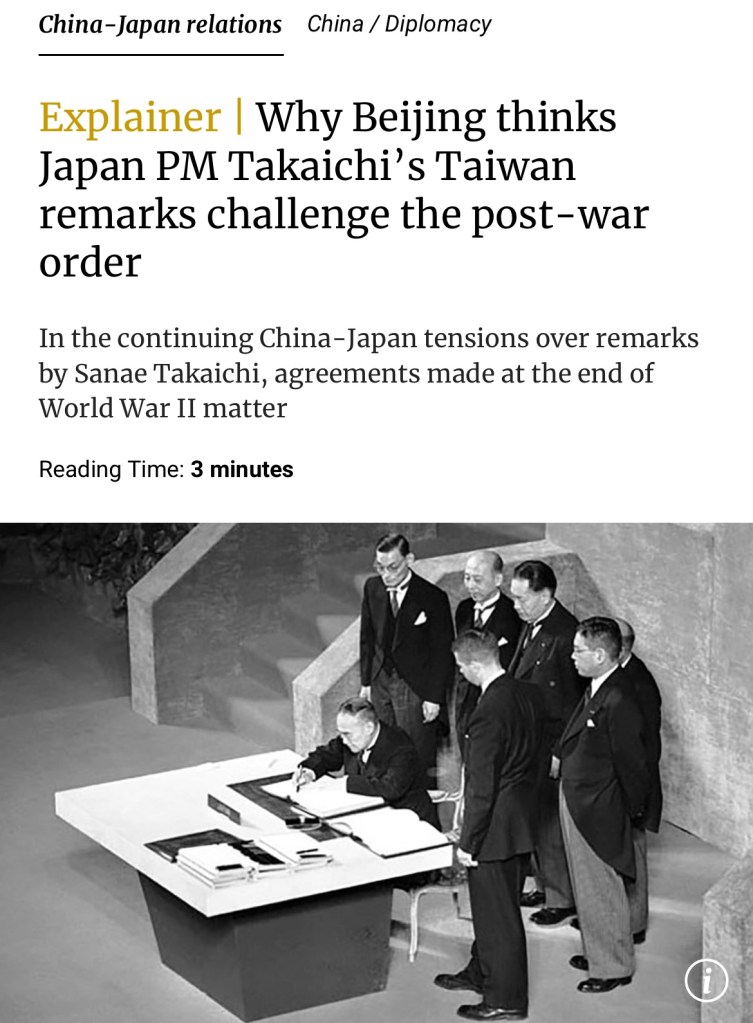
The Potsdam Declaration of 1945 reaffirmed this position and set the conditions for Japan’s surrender. Later that year, Japan formally accepted these terms in its surrender instrument.
“Japan has an obligation under international law to observe those documents, which was the prerequisite for Japan to be readmitted to the international community after the war,” ministry spokesman Lin Jian said.
Beijing says the question of Taiwan’s status was effectively settled in 1945, following China’s victory in what it calls the “war of resistance against Japanese aggression” and Japan’s surrender.
How does Ryukyu fit in?
Ryukyu is the ancient Chinese name for a chain of islands that includes Okinawa – under Japan’s administration today but once part of an independent kingdom and tributary state of the Chinese dynasties.
The San Francisco treaty – which Beijing claims is invalid – put the Ryukyu Islands under the temporary administration of the United States, which handed the authority to Japan in 1972.
According to state media and some scholars in China, the 1972 action violated the UN Trusteeship Council’s fundamental principles on national self-determination, leaving the sovereign status of the Ryukyu Islands unresolved under international law.
“China stressed the undetermined status of the Ryukyu Islands on top of reaffirming that Taiwan is an inalienable part of China,” Yu wrote in an article published by the state-owned Beijing Daily on Tuesday.
“This is a concrete manifestation of proactively transforming academic discourse into strategic initiative, which helps to foster a correct understanding of historical issues worldwide and enhances collective vigilance against Japan’s right-wing forces.”
11月7日,高市早苗暗示日本可能對潛在的台海衝突作出軍事回應,這使她成為二戰後首位公開將台灣事態與日本自衛隊可能部署聯繫起來的日本現任領導人。
為什麼這件事很重要?
1895年至1945年,台灣和澎湖群島曾是日本的殖民地,當時中國清政府在中日甲午戰爭戰敗後,被迫通過《馬關條約》將其割讓。
在1943年的《開羅宣言》中,美國、英國和中國明確表示,”日本所竊取於中國之領土”必須歸還,包括台灣和澎湖群島。
1945年的《波茨坦公告》重申了這一立場,並為日本投降設定了條件。同年晚些時候,日本在投降書中正式接受了這些條件。
外交部發言人林劍表示:”根據國際法,日本有義務遵守這些文件,這是日本戰後重新被國際社會接納的前提。”
北京方面表示,台灣的地位問題在1945年已得到有效解決,此前中國在抗日戰爭中取得勝利,日本投降。
琉球與此有何關係?
琉球是一串島嶼的古中國名稱,其中包括沖繩——如今由日本管轄,但曾是獨立王國和中國朝代的藩屬國。
《舊金山和約》將琉球群島置於美國的臨時管轄之下,美國於1972年將管轄權移交給日本。北京聲稱該條約無效。
根據中國官方媒體和一些學者的說法,1972年的行動違反了聯合國託管理事會關於民族自決的基本原則,使得琉球群島的主權地位在國際法上仍未解決。
官方媒體《北京日報》11月12日發表的一篇文章中寫道:”中國在重申台灣是中國不可分割的一部分的同時,強調了琉球群島地位未定的事實。這正是積極將學術話語轉化為戰略主動的具體表現,有助於在世界範圍內正確認識歷史問題,並增強對日本右翼勢力的集體警惕。”
 Business Blog