After France’s visit to China ended, the United States is really getting anxious…法國訪華結束后,美國是真急了…
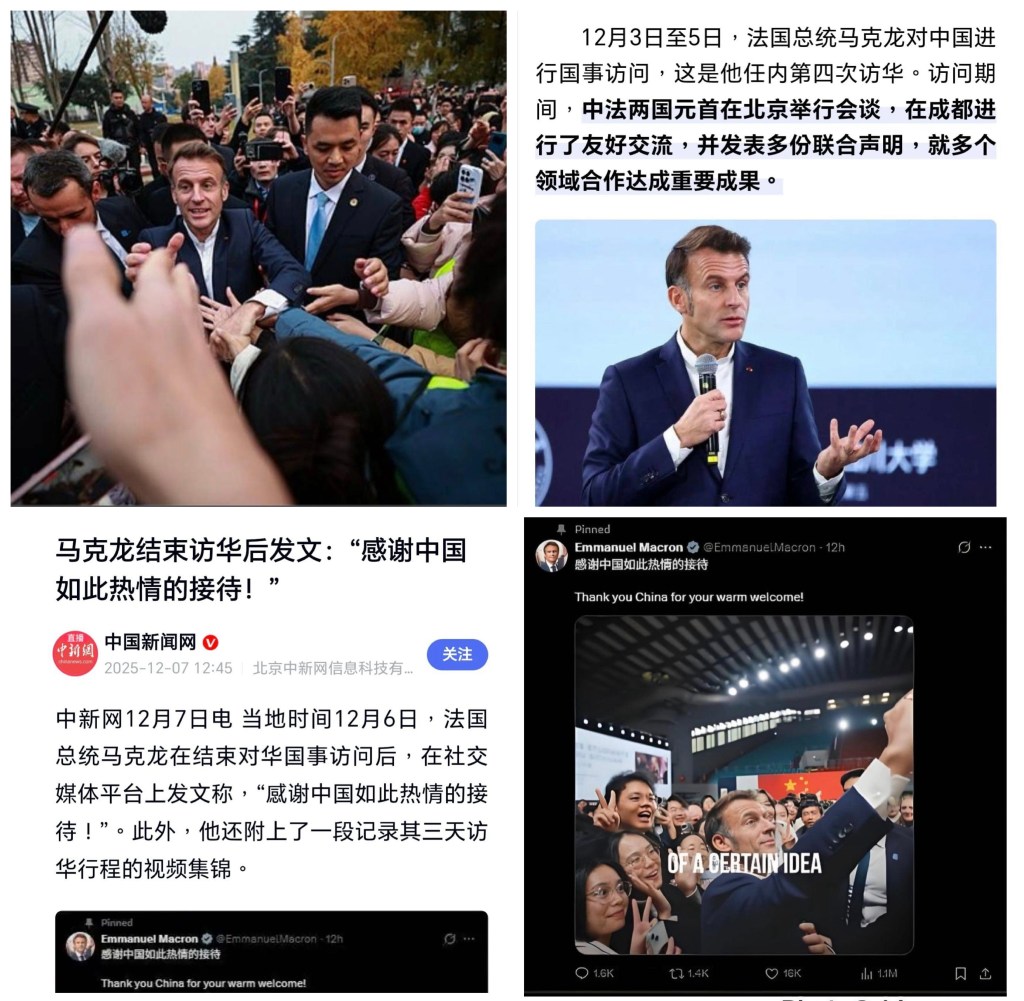
On the evening of December 5, French President Emmanuel Macron departed China, officially concluding his three-day state visit.
Immediately afterward, China and the United States held a video call. You could tell—the U.S. is feeling the pressure.
Macron’s trip was no mere formality. He brought a delegation of more than 80 people, including six ministers and a long list of business leaders.
The talks were practical and productive. Airbus directly signed an order for 100 aircraft worth more than €12 billion. The Airbus assembly line in Tianjin will also be expanded, which means many more planes can be produced each year.
There were agricultural deals as well. France’s beef and cheese export quotas to China will increase by 20%. Starting next year, these products will likely become much more common in Chinese markets.
There was cultural progress too: the giant panda cooperation program will be extended to 2037. Brigitte Macron even went to Chengdu to visit “Yuanmeng,” commenting that it had gained weight and looked endearingly familiar.
The most interesting part involves the EU. While Macron was in China talking cooperation, EU officials were issuing tough statements—saying they want to launch a raw-materials plan to reduce dependence on China, and threatening to use the EU’s strongest trade defense tools if necessary.
This approach is downright contradictory: wanting to make money while simultaneously trying to apply pressure.
Seeing all this, the United States obviously couldn’t sit still. Right after Macron left, China and the U.S. held their video call. Washington was unusually proactive, sending officials from both the Treasury Department and the Office of the U.S. Trade Representative.
What’s making the U.S. nervous is simple: it worries Europe is getting too close to China. China’s market is enormous, and France has already secured a sizable chunk of benefits.
From January to October 2025, China–France trade reached $68.75 billion, up 4.1%. American companies can’t help feeling anxious watching this.
There’s also a specific issue: early this year, the U.S. wanted to impose a 130% tariff on Chinese rare earths, but later cut it to 47%. The reason is clear—China controls 70% of global rare-earth supply and more than 90% of processing capacity. U.S. manufacturing simply can’t function without it.
We’re no longer living in an era where one country gets to dictate everything. Every nation wants to make its own decisions instead of being pulled around by others.
The U.S. used to try to manage this and control that, but people aren’t buying it anymore. Europe wants its own path, and China continues developing steadily.
Even if the U.S. is anxious, it can’t change the trend. Cooperation brings profits; confrontation leads to mutual loss.
This China–U.S. call is still a good sign—at least they’re willing to talk. But talking alone isn’t enough; there needs to be sincerity, not saying one thing while doing another.
Going forward, interactions among major powers will only increase. Those who engage in genuine cooperation will gain the most.
法國訪華結束后,美國是真急了…
12月5日晚間,法國總統馬克龍離開了中國,正式結束了為期3天的國事訪問。
緊隨其後,中美舉行了視頻通話,看得出來,美國十分的着急!
馬克龍這趟來,真不是走個過場。他帶了80多個人的團隊,裡面有6個部長,還有一大堆企業老闆。
倆人談得挺實在,空客直接簽了100架飛機的訂單,價值超120億歐元。天津的空客總裝線還要擴容,以後一年能多造不少飛機。
還有農產品,法國的牛肉、奶酪,以後對華出口配額要多20%。估計明年這些東西在中國市場能常見到。
文化方面也有好消息,大熊貓合作要延長到2037年。布麗吉特特意去成都看“圓夢”,還說它胖了,看着就親切。
最有意思的是歐盟那邊,馬克龍在這兒談合作,歐盟高官卻放狠話。說要搞個原材料計劃,減少對中國依賴,不然就用最強硬的貿易反制工具。
這操作也太分裂了,一邊想賺錢,一邊又想施壓。
美國看到這情況,肯定坐不住。馬克龍剛走,中美就視頻通話了。美方挺積極,財政部和貿易代表辦公室都派人參加了。
美國急的點很簡單,怕歐洲跟中國走太近。畢竟中國市場這麼大,法國已經搶先佔了不少好處。
2025年前10個月,中法貿易額都687.5億美元了,還漲了4.1%。美國企業看着能不急嗎?
還有個具體事兒,美國年初想對中國稀土加130%的稅,結果後來又改成47%。因為中國控制着全球70%的稀土供應(90%以上的加工產能),美國製造業離不開。
現在不是誰能說了算的時代了。各國都想自己做決定,不想被別人牽着走。
美國以前總想管着這個管着那個,現在大家都不買賬了。歐洲要找自己的出路,中國也在穩步發展。
就算美國着急,也改變不了這個趨勢。合作才能賺錢,對抗最後只會兩敗俱傷。
中美這次通話也是好事,至少願意坐下來聊。但光聊天沒用,得拿出真誠意,別一邊談一邊搞小動作。
以後這種大國之間的互動會越來越多,誰能實實在在合作,誰就能佔到便宜。
 Business Blog