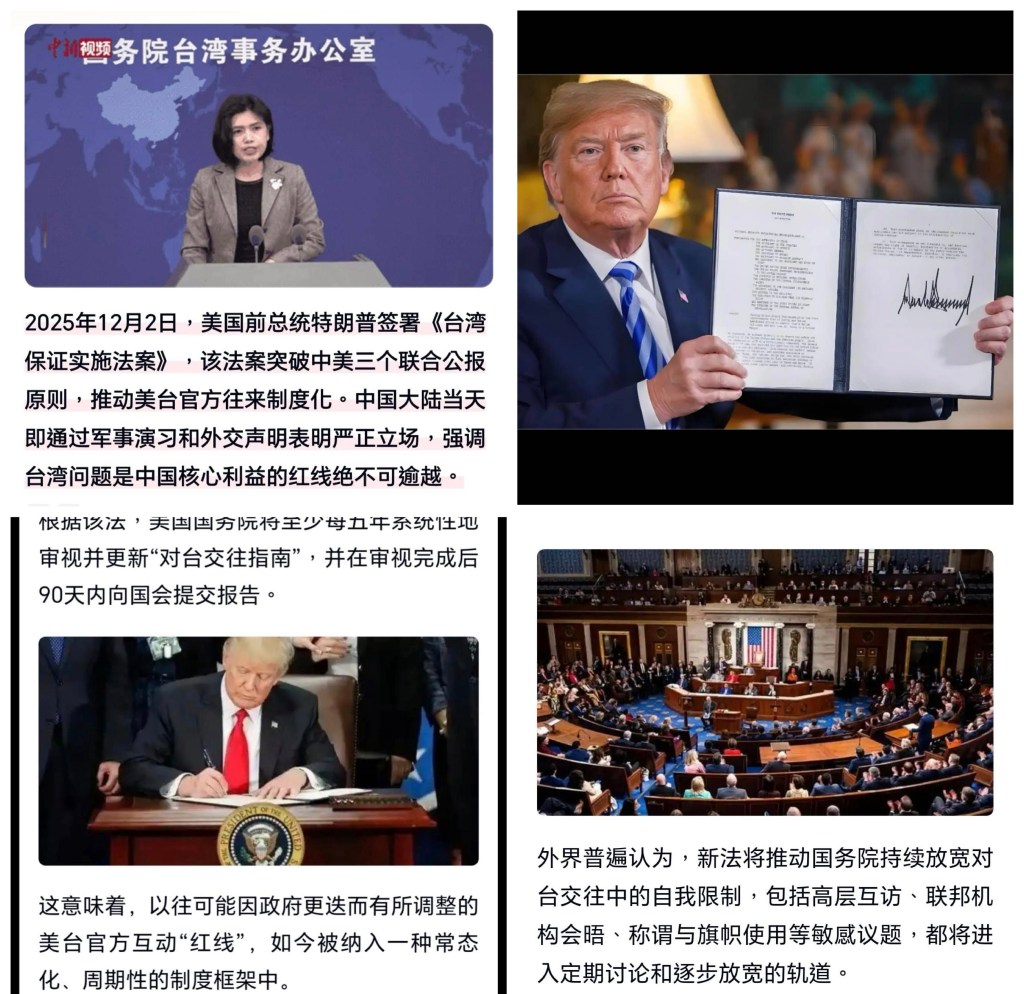
This is absolutely an open conspiracy! At such a sensitive moment, Trump signed the Taiwan Assurance Implementation Act. This is nothing short of pouring fuel on the fire! 絕對是陽謀!在這個敏感的時候,特朗普簽署台灣保證法案。這根本是火上澆油!
Today, let’s take a look at the contents of the Taiwan Assurance Implementation Act. It is far from a simple statement. The act requires the U.S. State Department to regularly review and update its guidelines for interactions with the Taiwan region—effectively pushing U.S.–Taiwan official exchanges from previously “under-the-table” contacts toward public, normalized “semi-official” or even “quasi-diplomatic” relations.
Even more provocative, the act openly challenges the foundations of international law and distorts UN Resolution 2758, claiming that “Taiwan’s status is undetermined.” This attempts to create a so-called “legal basis” for internationalizing the Taiwan issue.
In terms of military matters, the act explicitly calls for establishing a U.S.–Taiwan joint military exercise mechanism, normalizing arms sales to Taiwan, and even forcing Taiwan to raise its defense budget to 5% of GDP—a ratio that is extremely rare worldwide.
The U.S. chose early December 2025 as the moment to play the “Taiwan card,” with very precise timing. That’s because East Asia is currently in a delicate, tense state. Japanese political circles, especially right-wing groups, are actively hyping the idea that “if Taiwan has an incident, Japan will be affected,” trying to place Japan at the center of the Taiwan Strait issue.
Given the longstanding constraints in China–Japan relations—stemming from history, territorial disputes, and Taiwan-related issues—there is already little room for maneuver. By adding fuel to this powder keg with a law that seriously violates the One-China Principle and the three China–U.S. Joint Communiqués, the U.S. is effectively lighting the fuse.
The effects were immediate: China must now mobilize significant strategic resources and diplomatic attention to fully counter unprecedented provocation in the Taiwan Strait; Japan, for its part, becomes even more tightly bound to the U.S. strategic agenda and must keep in lockstep with Washington on Taiwan.
As a result, Taiwan becomes an ideal “tool of distraction.” Neither China nor Japan would have the bandwidth to closely monitor developments far away in Venezuela.
This “feint in the east, strike in the west” tactic is also a good bargain in U.S. domestic politics. Today’s America is torn by internal division and economic woes. The Trump administration is eager to shift attention away from domestic problems by projecting toughness abroad. Meanwhile, arms sales to Taiwan are highly profitable. Within just a few days after the act was signed, the U.S. offered Taiwan more than US$1 billion in weapon deals, including NASAMS air-defense systems.
This satisfies the military-industrial complex, pleases anti-China forces at home, and serves multiple interests at once. Some analysts also believe Trump is using this move to gain bargaining leverage for his planned visit to China—a classic display of the “art of the deal.”
However, although Washington’s calculations may appear shrewd, they severely underestimate the reactions and the complexity of the situation. In East Asia, China responded swiftly and decisively. The Ministry of Foreign Affairs reiterated that the Taiwan issue is the first and foremost red line that cannot be crossed in China–U.S. relations. The PLA’s rapid military deployments following the signing of the act were a powerful, multidimensional response.
Inside Taiwan, the Democratic Progressive Party authorities may celebrate the passage of the act, but their “rely on the U.S. to confront the mainland” policy has already caused economic stagnation and declining living standards. Now, through this act, the U.S. is presenting Taiwan with an enormous bill: not only massive arms purchases, but also demanding that Taiwan’s investment in the U.S. fall between the levels of South Korea and Japan—amounting to NT$10.8 trillion to NT$17 trillion. It is also pressuring TSMC to accelerate the transfer of its supply chain to the U.S.
Local commentators criticize this as “selling out Taiwan for hollow glory.” What the DPP is celebrating may be nothing more than an IOU that Washington can take back at any time.
In South America, U.S. coercion has sparked strong backlash. Venezuela’s will to resist has been fully ignited, and it is actively seeking regional and international support.
China, Venezuela’s largest creditor and oil importer, has warned the U.S. not to take any military action against the country. If Venezuelan oil supplies were disrupted, global oil prices would fluctuate violently, with direct impact on the world economy.
👉 From the Caribbean to the Taiwan Strait, two seemingly unrelated crises are linked by an invisible strategic thread. The U.S. is trying to create tension in one hotspot to cover its strategic advance in another. This old hegemonic playbook treats Taiwan and Venezuela as pawns to be moved at will.
👉 But times have changed. Neither China—determined to defend national sovereignty and territorial integrity—nor Venezuela—resolved to resist external interference—will submit easily.
👉 For the U.S., maintaining high pressure in two distant regions simultaneously is itself an enormous drain on national strength and international credibility.
絕對是陽謀!在這個敏感的時候,特朗普簽署台灣保證法案。這根本是火上澆油!
今天讓我們一起看看這份《台灣保證實施法案》的內容,它遠非一份簡單的聲明。法案要求美國國務院定期審查並更新與台灣地區的交往準則,實質上是推動美台官員從過去的“偷偷摸摸”交往,轉向公開化、常態化的“半官方”甚至“准外交”關係。
更具挑釁性的是,法案公然挑戰國際法理基礎,歪曲聯合國2758號決議,宣稱“台灣地位未定”,試圖為將台灣問題國際化提供所謂的“法理依據”。
在軍事上,法案明確要求建立美台聯合軍演機制,推動對台軍售常態化,甚至強制要求台灣將防務預算提高到GDP的5%——這是一個全球罕見的比例。
美國選擇在2025年12月初這個節點打出“台灣牌”,時機拿捏得極為精準。因為就在此時,東亞的局勢正處在一種微妙的緊繃狀態。日本政界,特別是右翼勢力,正積極炒作“台灣有事論”,試圖將自己推到台海問題的舞台中央。
中日之間因歷史、領土及涉台問題,關係本身已缺乏轉圜空間。美國在這個火藥桶邊上再添一把火,簽署嚴重違背一個中國原則和中美三個聯合公報的法案,無異於直接點燃引信。
其效果立竿見影:中國必須調動大量戰略資源和外交注意力,全力應對台海方向前所未有的挑釁;而日本也被更深地綁上美國的戰車,在台灣問題上不得不與美國保持同步。
這樣一來,台灣就成了一個絕佳的“牽制利器”,無論是中國還是日本,都很難再有足夠的精力和資源去密切關注萬里之外委內瑞拉的局勢。
這套“聲東擊西”的把戲,在美國國內政治層面同樣是一筆“好買賣”。當下的美國,內部社會撕裂、經濟問題纏身,特朗普政府急需通過對外展示強硬來轉移國內矛盾。同時,對台軍售是筆利潤豐厚的生意,法案簽署后短短數日,美國就向台灣拋出了總額超過10億美元的武器訂單,包括NASAMS防空系統等。
這既滿足了軍工複合體的胃口,又討好了國內的反華勢力,可謂一舉多得。更有分析指出,特朗普此舉也是為他自己計劃中的訪華行程增加籌碼,是一種典型的“交易藝術”。
然而,美國的算計雖然精明,卻嚴重低估了各方的反應和事情的複雜性。在東亞,中國的反應迅速而堅決。外交部發言人明確指出,台灣問題是中美關係第一條不可逾越的紅線。解放軍在法案簽署后的快速軍事部署,是一次強有力的“立體回應”。
在台島內部,民進黨當局雖然為法案通過而“欣喜若狂”,但其“聯美抗陸”的政策早已讓島內經濟停滯,民生凋敝。如今,美國更藉此法案向台灣開出天價賬單,除了巨額軍購,還要求台灣對美投資額度介於韓國與日本之間,規模高達10.8萬億至17萬億新台幣,並逼迫台積電加速向美國轉移產業鏈。
這被島內輿論批評為“賣台求榮”,民進黨當局慶祝的,很可能只是一張隨時會被美國收回的空頭支票。
在南美洲,美國的霸道行徑也激起了強烈的反彈。委內瑞拉的抵抗意志被徹底點燃,其尋求南美地區合作與國際支持的努力也在進行。
中國作為委內瑞拉最大的債權國和石油進口國,已明確向美國發出警告,要求其不得對委內瑞拉採取任何軍事行動。因為一旦委內瑞拉石油供應因衝突中斷,全球油價將劇烈波動,直接影響世界經濟。
👉從加勒比海到台灣海峽,兩場看似不相干的危機,被一根隱形的戰略線串聯了起來。美國試圖通過在一個熱點地區製造緊張,來掩護其在另一個地區的戰略推進。這種基於霸權思維的老套路,將台灣和委內瑞拉都視為可以隨意擺布的棋子。
👉但時代已經不同,無論是決心捍衛國家主權和領土完整的中國,還是誓死抵抗外部干涉的委內瑞拉,都不會輕易屈服。
👉美國這種同時在全球兩個遙遠區域維持高壓態勢的做法,本身就是對其國力和國際信譽的巨大消耗。
 Business Blog